
Banni Grasslands
Environment
Context
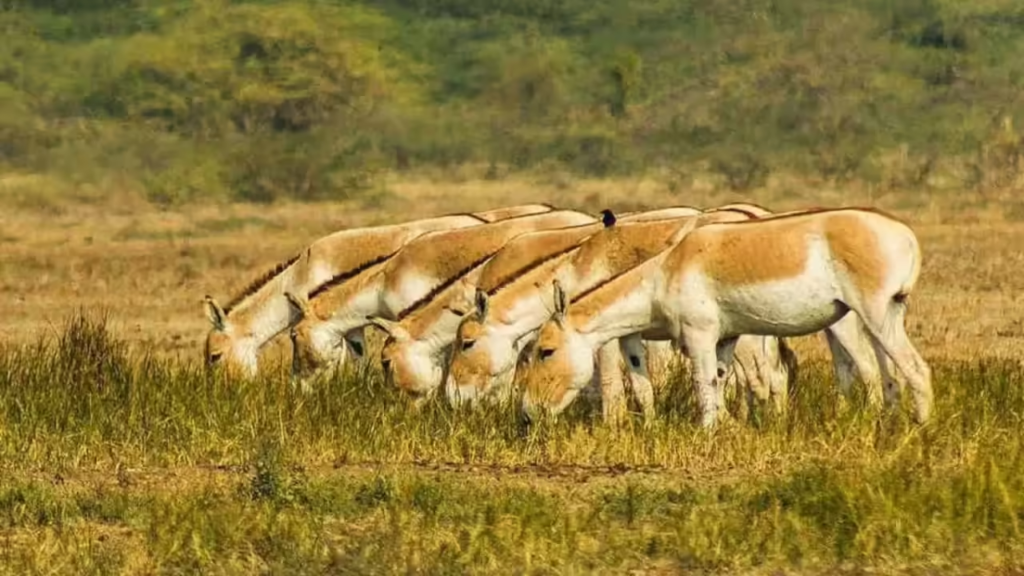
- The proposed solar project by NTPC Renewable Energy Limited in Gujarat’s Banni grasslands has raised concerns over its impact on local communities, biodiversity, and wetlands.
Banni Grassland
- Location – The Banni grasslands in Kachchh
- Uniqueness – Asia’s largest natural grasslands
- Pastoral communities – Fakirani Jat.
- The region contains over 70 species of nutritious grasses and supports grazing of camels, buffaloes, sheep, and goats.
- Nearby – Chhari Dhand Wetland Conservation Reserve is a Ramsar site important for migratory birds and local biodiversity.
Concerns
- Local communities fear loss of grazing land, cultural spaces, graveyards, and traditional livelihoods.
- Conservationists warn that solar infrastructure, light pollution, and human activity may disturb bird habitats and migratory routes.
Majuli Island
Geography
Context
- A recent study by scientists from the Birbal Sahni Institute of Palaeosciences has reconstructed nearly 4,000 years of climate, vegetation, and river dynamics of Majuli Island.
Majuli Island
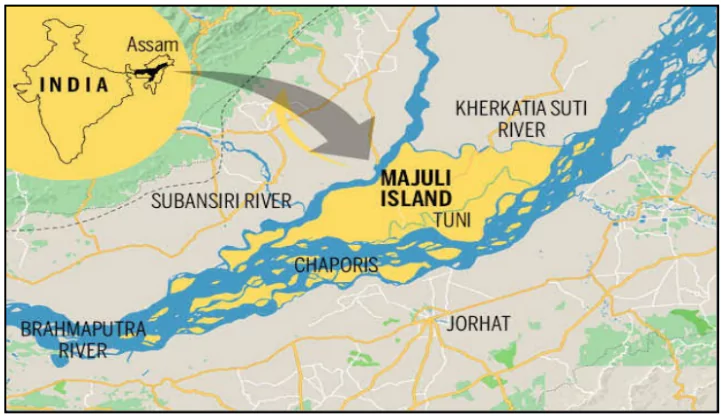
- Majuli is located in the Brahmaputra River system in Assam.
- Uniqueness – world’s largest inhabited river island.
- Majuli is a unique fluvial island formed by the Brahmaputra River and its tributaries, covering about 875 sq. km.
- It is bounded by the Subansiri River in the north, Kherkatia Suti in the northeast, and the Brahmaputra River in the south.
- Geographical features – Its landscape consists of alluvial plains, braided channels, wetlands (Beels), and riverine sandbars known as Chaporis.
- The island is an important centre of Neo-Vaishnavite culture established by Srimanta Sankardeva.
- It hosts around 30 Sattras (Vaishnavite monasteries), which serve as centres of religion, culture, education, and community governance.
- It is home to several indigenous tribal communities, including the Mising, Deori, and Sonowal Kachari tribes.
- Threats- The island faces recurrent floods, riverbank erosion, deforestation, and land loss.
Additional Information- Brahmaputra River
- The Brahmaputra is a major transboundary river in Asia.
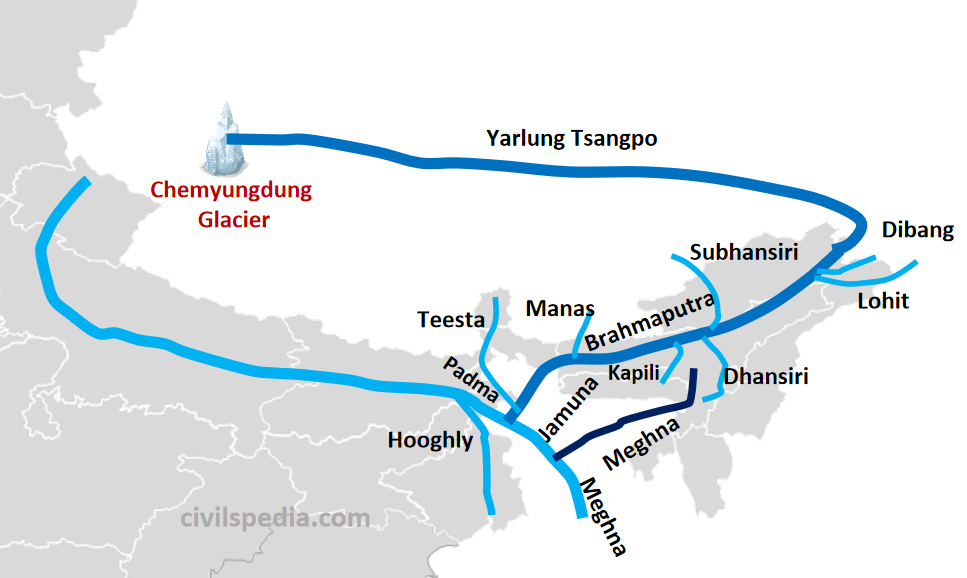
- It originates from the Chemayungdung Glacier near Lake Manasarovar (Mapam Yumco) in Tibet.
- It is known variably as Yarlung Tsangpo in Tibet (its longest upper stretch), Siang or Dihang in Arunachal Pradesh, Brahmaputra in Assam & Jamuna in Bangladesh.
- It flows east through Tibet’s plateau, enters India via Arunachal Pradesh, widens in Assam’s plains, and merges with the Ganges in Bangladesh before reaching the Bay of Bengal.
AUKUS Alliance
International Relations

Context
- The AUKUS alliance between Australia, the United Kingdom, and the United States has completed five years and recently expanded cooperation in maritime defence and advanced technologies.
AUKUS
- It was launched in September 2021
- It is a trilateral strategic security partnership.
- Objective – to strengthen defence capabilities, technological cooperation, and strategic stability in the Indo-Pacific region.
Two Pillars of AUKUS
Pillar I:
- Focuses on helping Australia acquire conventionally armed nuclear-powered submarines (SSNs).
- It will make Australia the seventh country to operate nuclear-powered submarines.
Pillar II:
Focuses on cooperation in advanced technologies such as artificial intelligence, quantum computing, cyber capabilities, undersea technologies, and advanced weapon systems.
Forest Rights Act and PESA
Polity and Governance
Context
- The constitution of a task force in Chhattisgarh to fast-track the implementation of laws such as the Forest Rights Act, 2006 and the Panchayats (Extension to the Scheduled Areas) Act, 1996, has led to controversy.
Forest Rights Act
- It is also called The Scheduled Tribes and Other Traditional Forest Dwellers (Recognition of Forest Rights) Act, 2006
- Mandate – to recognize the rights of forest-dwelling communities, including Scheduled Tribes, over forest resources
- Nodal Ministry: Ministry of Tribal Affairs (MoTA).
Four Main Rights
- Title Rights: Ownership of cultivated forest land up to 4 hectares.
- Use Rights: Right to collect, use, and sell Minor Forest Produce (MFP) like bamboo and honey.
- Development Rights: Right to use land for local schools, clinics, and roads.
- Forest Management: Power to protect and manage their traditional forests.
PESA Act, 1996
- PESA Act, 1996 stands for the Provisions of the Panchayats (Extension to Scheduled Areas) Act, 1996.
The PESA Act (1996) grants self-governance to tribal areas across 10 Indian states.
- Gram Sabha Power: Village assemblies protect tribal culture and approve all local development plans.
- Land Protection: Must give permission before land is taken or mined for sand and stone.
- Resource Ownership: Full rights over minor forest items (fruits, honey) and small water bodies.
- Economic Control: Regulates local markets, stops bad money lenders, and can ban alcohol.
- Tribal Leadership: Scheduled Tribes must hold at least 50% of seats and all chairperson roles.
Base Year Revision of Wholesale Price Index (WPI)
GS3/ Economy
Context
- The Government of India has approved the revision of the base year of the Wholesale Price Index (WPI) from 2011–12 to 2022–23.
Wholesale Price Index (WPI)
- Objective – It tracks the price of goods sold in bulk by wholesale businesses.
- Published by – The Office of the Economic Adviser, Ministry of Commerce and Industry.
- It covers goods only. It does not track services.
- Base Year: 2022–23 (Updated in 2026 from 2011–12).
- Note – WPI will be phased out by 2031. India is moving to a new Producer Price Index (PPI).
Additional Information – Core Differences Between WPI and CPI
|
Feature |
Wholesale Price Index (WPI) |
Consumer Price Index (CPI) |
|
Stage of Transaction |
Tracks prices when goods are traded in bulk between businesses. |
Tracks prices at the final retail stage when bought by households. |
|
Commodity Coverage |
Only Goods. It completely excludes the service sector. |
Both Goods and Services (e.g., education, medical care, housing). |
|
Published By |
Office of Economic Adviser, Ministry of Commerce and Industry. |
National Statistical Office (NSO), Ministry of Statistics and Programme Implementation (MoSPI). |
|
Base Year |
2011-12 (An official panel transition to 2022-23 / PPI is underway). |
2024 (Updated from 2012 by MoSPI to reflect modern spending). |
|
Policy Target |
Used mostly to monitor macroeconomic producer-level price trends. |
Used by the RBI as the headline metric for inflation targeting |














Leave a Reply