
Vaishya Tekri Stupa in Ujjain
History & Culture
Context
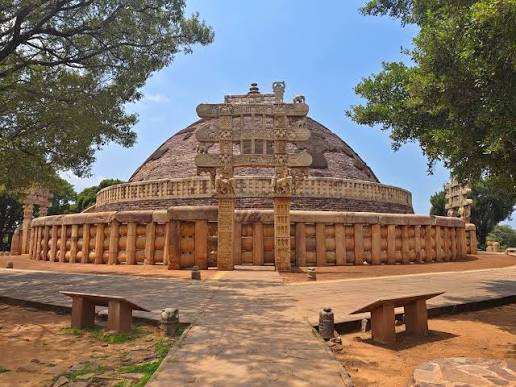
- The Madhya Pradesh government is considering fresh excavation at Vaishya Tekri in Ujjain, where a massive Buddhist stupa probably larger than Sanchi Stupa, was partially excavated in 1938–39.
Vaishya Tekri
- Vaishya Tekri is a large archaeological mound located near Ujjain in Madhya Pradesh.
- It is believed to contain the remains of a large Buddhist stupa, popularly associated with the ancient Kanipura/Kanakgiri Buddhist establishment.
- The site has been tentatively dated to the Mauryan period, around the 3rd century BCE. The monument has traditionally been associated with Emperor Ashoka and his period of governance at Ujjain.
- The stupa is estimated to have an approximate diameter of 350 ft and a height of 100 ft or more.
Additional Information – The Great Stupa of Sanchi
-
- A stupa is a Buddhist commemorative monument usually containing sacred relics of the Buddha or other saints.
- Established: The stupa was commissioned in the third century BCE by Emperor Ashoka of the Maurya dynasty.
- The stupa was subsequently enlarged and embellished during the Shunga and Satavahana periods.
- Structure: The Great Stupa is a hemispherical dome made of stone and brick, with a central structure that is a large, raised platform containing the relics of the Buddha.
- It is topped by a ‘harmika’ that holds the triple umbrella, or ‘chhatraveli’, which represents the three jewels of Buddhism – the Buddha, the Dharma, and the Sangha.
- Above the dome, there is a pillar-like structure called the chatra, which is a symbol of the Buddha’s presence and enlightenment.
- The Stupa is a UNESCO World Heritage site and a pilgrimage destination for Buddhists from around the world.
India’s Campaign For a UN Security Council (UNSC) Seat in 2028-29
International Relation
Context
- India has launched its campaign for a non-permanent United Nations Security Council (UNSC) seat for 2028–29, with the election scheduled for June 2027.
United Nations Security Council (UNSC)
-
- It is one of the six principal organs of the United Nations
- Objective – to maintain international peace and security.
-
- It is the only UN body empowered to issue legally binding resolutions that all UN member states are obligated to comply with under international law.
- Structure and Composition: The Council has 15 members divided into two categories:
- Permanent Members (P5) with Veto Power: China, France, Russia, the United Kingdom, and the United States.
-
- A single veto from any P5 member is sufficient to block any substantive resolution, regardless of how many other members support it.
- Non-Permanent Members (10 seats): Elected by the UN General Assembly for two-year terms, distributed geographically.
- Headquarters: New York, USA
Sri Aurobindo
History & Culture
Context
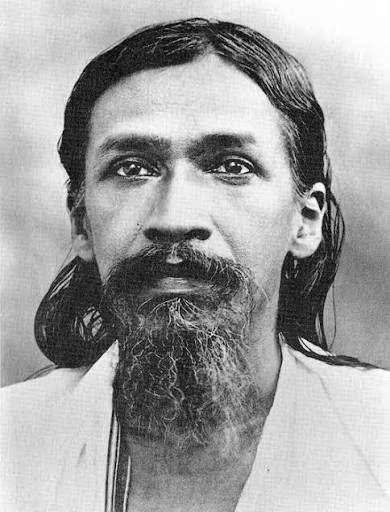
- PM Modi paid tribute to Sri Aurobindo (15 August 1872–5 December 1950) on his birth anniversary.
About –
- He received his primary education in England at St. Paul’s School, London, and King’s College, Cambridge.
- He returned to India in 1893 and worked for the next thirteen years in the Princely State of Baroda and as a professor in Baroda College.
Role in freedom struggle
- He helped establish a series of youth clubs, including the Anushilan Samiti of Calcutta in 1902.
- In 1906, Aurobindo was appointed the first principal of the National College in Calcutta (Bengal National College), and started to impart national education to Indian youth.
- He was the first political leader in India to openly put forward the idea of complete independence for the country in his newspaper Bande Mataram.
- In 1907 at the Surat session of Congress, he led along with extremists.
- He was arrested in 1908 in connection with the Alipore Bomb Case.
Yogic Life
-
- Sri Aurobindo had begun the practice of Yoga in 1905 in Baroda.
- In 1910 he withdrew from politics and went to Pondicherry in order to devote himself entirely to his inner spiritual life and work.
- During his forty years in Pondicherry he evolved a new method of spiritual practice, which he called the Integral Yoga.
- In 1926, he founded the Sri Aurobindo Ashram.
Literary works
-
- The Life Divine, which deals with the philosophical aspect of Integral Yoga.
- Synthesis of Yoga, which deals with the principles and methods of Integral Yoga.
- Savitri: A Legend and a Symbol, an epic poem.
- He also started two weeklies: the Karmayogin in English and the Dharma in Bengali.
Rajasthan Trees (Protection) Bill-2026
Polity
Context
- The Rajasthan Cabinet has approved the Rajasthan Trees (Protection) Bill-2026.
About
- The Bill will regulate the felling of 29 specified tree species on non-forest land.
- The list includes the state tree Khejri, Rohida, Banyan, Peepal, Lasoda, Tendu, Mahua, Kair and Chironji.
- Felling or causing the felling of a specified tree on land owned or occupied by a person will require prior permission from the authorised authority.
- Offences under the proposed law will be cognisable and bailable. A person convicted of illegal felling may face imprisonment of up to one year, a fine of up to ₹1 lakh, or both.
- Where a tree is removed with permission, the person will be required to plant a prescribed number of trees in the same area for each tree removed.






Leave a Reply