
Dark-Web
Science & Technology

Context
- The State Bank of India (SBI) has disclosed that it is investigating a cybersecurity incident involving the suspected exposure of customer data on the Dark Web.
Dark Web
- Definition: A part of the internet that requires specialised software, such as The Onion Router (Tor), to access certain hidden services anonymously.
- Origin: The foundational technology behind onion routing was developed by researchers at the U.S. Naval Research Laboratory (NRL).
- Purpose: Designed to support anonymous communication and protect sensitive communications from monitoring.
- Concerns: Can facilitate cybercrime, illegal trade, data leaks and identity theft, although it also has legitimate privacy and security uses.
Constitutional Provisions
- Article 21: Protects the right to life and personal liberty.
- K.S. Puttaswamy v. Union of India (2017): Supreme Court recognised the right to privacy as a fundamental right.
Legal Framework for Data Protection
- Digital Personal Data Protection (DPDP) Act, 2023:
- Section 8(6): Requires a Data Fiduciary to inform the Data Protection Board of India and affected individuals of a personal data breach, subject to the Act’s provisions.
Government Initiatives
- Samanvaya Platform: Ministry of Home Affairs initiative supporting cybercrime data sharing, analytics and coordination among law-enforcement agencies.
- Indian Cyber Crime Coordination Centre (I4C): Strengthens coordination among agencies to combat cybercrime.
- Cyber Swachhta Kendra: Helps detect and remove malicious software and promotes cybersecurity awareness.
Namami Gange
Government Schemes
Context
- The programme adopts a multi-technology approach to wastewater treatment, combining infrastructure development, decentralised solutions, rehabilitation and long-term operation.
About Namami Gange
- Launch: 2014.
- Nature: Integrated Conservation Mission.
- Nodal Ministry: Ministry of Jal Shakti.
- Implementing Agency: National Mission for Clean Ganga (NMCG).
- Objectives: Pollution abatement, conservation and rejuvenation of the River Ganga.
Major Pillars
- Sewerage Treatment Infrastructure: Construction and rehabilitation of sewage treatment plants (STPs).
- Riverfront Development: Development of ghats and crematoria.
- River-Surface Cleaning: Removal of floating waste.
- Biodiversity Conservation: Protection of aquatic ecosystems and species.
- Afforestation: Plantation along the Ganga basin.
- Public Awareness: Community participation and behavioural change.
- Industrial Effluent Monitoring: Monitoring and control of industrial pollution.
- Ganga Gram: Promoting sanitation and cleanliness in villages along the Ganga.
Significance
- Improves river-water quality and sanitation.
- Reduces the discharge of untreated sewage and industrial effluents.
- Supports aquatic biodiversity and ecological restoration.
- Promotes sustainable river management through technology and community participation.
Additional Information – GANGA RIVER
Origin and Course
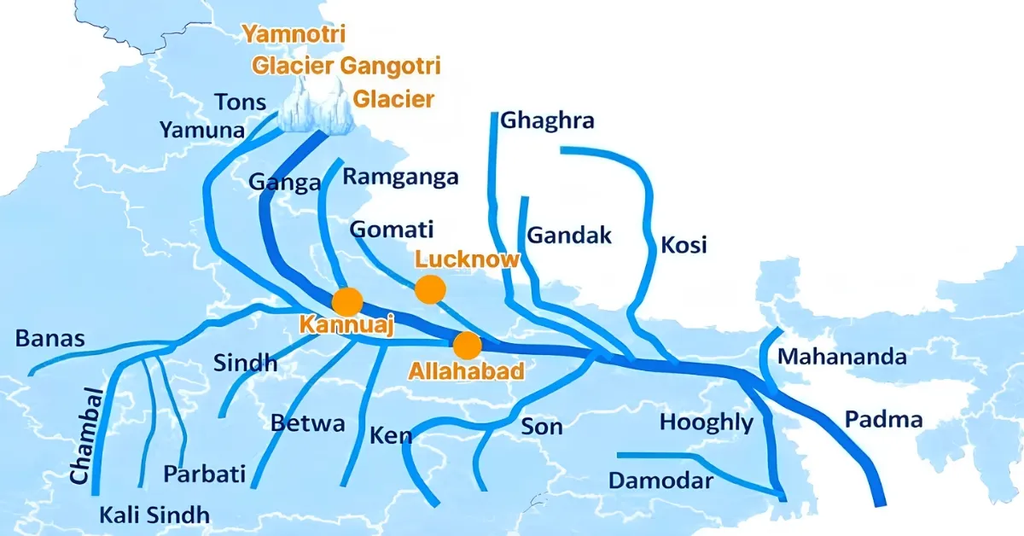
- Origin: Gangotri Glacier (Gaumukh), Uttarakhand; the headstream is called the Bhagirathi.
- Confluence: Bhagirathi meets the Alaknanda at Devprayag, forming the Ganga.
- Length: Approximately 2,525 km.
- Drainage Basin: India and Bangladesh.
- Outfall: Enters the Bay of Bengal through the Ganga–Brahmaputra–Meghna delta.
Major Tributaries
- Left-bank tributaries: Ramganga, Gomti, Ghaghara, Gandak, Kosi and Mahananda.
- Right-bank tributaries: Yamuna, Son, Punpun and Damodar.
States Through Which It Flows
- Uttarakhand, Uttar Pradesh, Bihar, Jharkhand and West Bengal.
- In Bangladesh, its main distributary is known as the Padma.
Important Features
- Largest river basin in India by drainage area.
- The Yamuna is a major tributary, joining the Ganga at Prayagraj, Uttar Pradesh.
- The Sundarbans Delta, formed by the Ganga–Brahmaputra river system, is among the world’s largest deltas.
- Supports agriculture, drinking water, transport, fisheries and biodiversity.
Ecological Significance
- Habitat of the Gangetic river dolphin — India’s National Aquatic Animal.
- Other important species include the gharial and several freshwater turtle species.
- The Ganga basin supports a large share of India’s population and agricultural activity.
Major Government Initiatives
- Namami Gange Programme (2014): Pollution abatement, conservation and rejuvenation of the Ganga.
- National Mission for Clean Ganga (NMCG): Implements the Namami Gange Programme.
- Ganga Action Plan: Launched in 1985 to reduce river pollution.
UNESCO WORLD HERITAGE TENTATIVE LIST – 3 NEW INDIAN SITES
History & Culture
Context
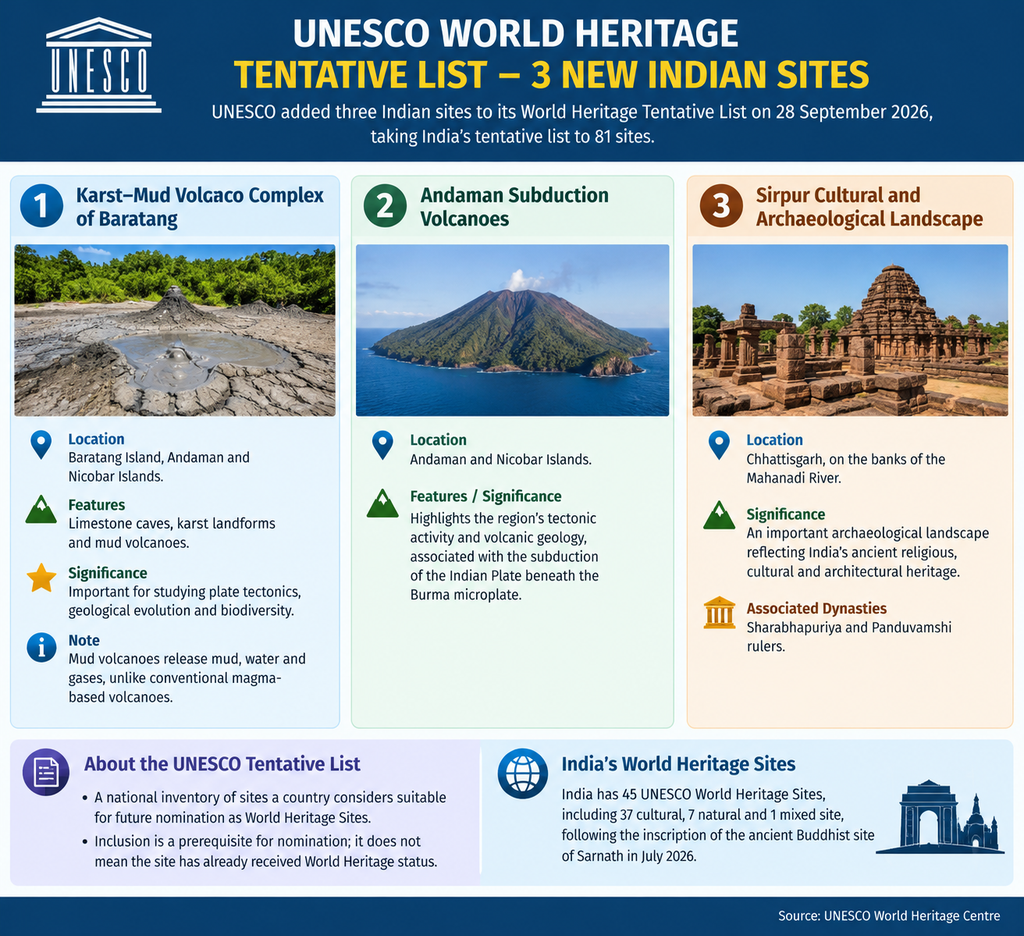
- Three Indian sites were added to UNESCO’s Tentative List of World Heritage Sites, taking India’s tentative list to 81 sites, as stated in the source.
About the Tentative List
- A Tentative List is an inventory of properties a country considers suitable for future nomination to the UNESCO World Heritage List.
- Inclusion on the Tentative List is a prerequisite for nomination to the World Heritage List.
Three Newly Added Sites
- Baratang Karst–Mud Volcano Complex
- Location: Baratang Island, Andaman and Nicobar Islands.
- Features: Limestone caves and active mud volcanoes.
- Mud Volcanoes: Release mud, water and gases rather than molten rock.
- Andaman Subduction Volcanoes
- Location: Barren Island and Narcondam Island, Andaman and Nicobar Islands.
- Barren Island: Home to India’s only confirmed active volcano.
- Narcondam Island: Forest-covered volcanic island known for biodiversity and the Narcondam hornbill, endemic to the island.
- Significance: Illustrates volcanic processes and ecological succession.
- Sirpur Cultural and Archaeological Landscape
- Location: Mahasamund district, Chhattisgarh, on the eastern bank of the Mahanadi River, around 78 km from Raipur.
- Historical Name: Shripur.
- Historical Significance: Developed under the Sharabhapuriya and Panduvamshi dynasties and associated with the ancient Kosala region.
- Importance: Archaeological remains reflect historic architecture, trade links and the coexistence of multiple religious traditions.
Badr Memorandum of Understanding (MoU)
International
Context
- Pakistan, Turkey, Qatar, and Indonesia have signed the Badr Memorandum of Understanding (MoU).
BADR MEMORANDUM OF UNDERSTANDING (MoU)
Context
- Pakistan, Türkiye, Qatar and Indonesia reportedly signed the Badr MoU to strengthen military cooperation and defence capabilities.
Key Objectives
- Promote defence manufacturing, joint production and domestic defence industries.
- Enhance military training, research and technology development.
Badr MoU vs Mecca Pact
- Badr MoU: Focuses on defence-industrial cooperation.
- Mecca Pact: Focuses on collective defence, as described in the source.
Significance for India
- May support Pakistan’s military modernisation and defence manufacturing.
- Could affect regional security dynamics and technology-sharing arrangements.
WHALE STRANDINGS ON INDIA’S WESTERN COAST
Environment
Context
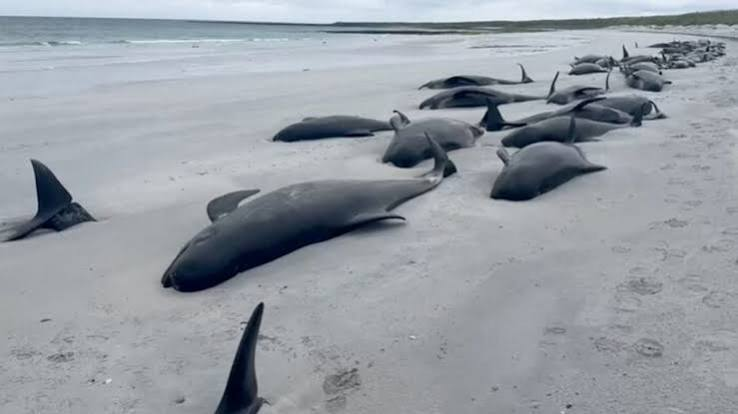
- A global database of blue whale strandings identified India’s western coast, particularly Gujarat, as an important region for recorded strandings.
Blue Whale (Balaenoptera musculus)
- Classification: Marine mammal; order Cetacea.
- Features: Largest animal known to have lived on Earth; adults reach approximately 24–28 metres.
- Distribution: All oceans except the Arctic Ocean.
- Subspecies: Five recognised subspecies, including the Antarctic, Northern, Pygmy, Northern Indian Ocean and Chilean blue whales.
- Conservation Status: Endangered (IUCN Red List); Appendix I of the Convention on Migratory Species (CMS).
About Cetaceans
- Include whales, dolphins and porpoises.
- Characteristics: Warm-blooded, breathe through lungs, give birth to live young and must surface to breathe.
- Around 30–35 cetacean species are reported from the waters of the Indian subcontinent.
Additional Information – International Whaling Commission (IWC)
- Established: 1946 under the International Convention for the Regulation of Whaling.
- Headquarters: Impington, United Kingdom.
- Commercial Whaling Moratorium: Adopted in 1982; effective from 1986.
- Functions: Regulates whaling and promotes whale conservation.
- Types of Whaling: Commercial, Aboriginal subsistence and special-permit (scientific) whaling.
- India’s Membership: Since 1981.











Leave a Reply