
Kambala
History & Culture
News-
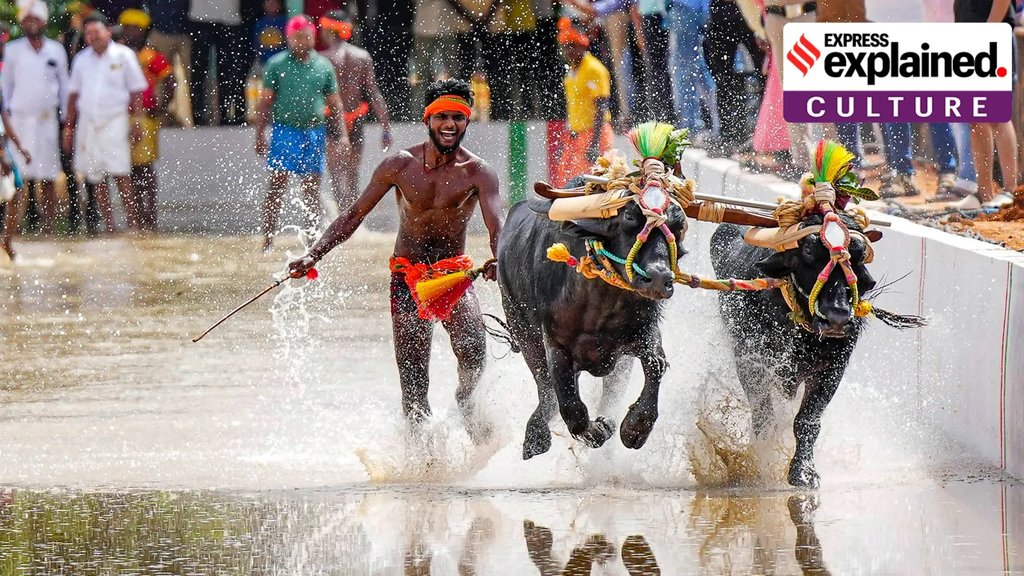
- Kambala recently made its historic debut at the Mysuru Dasara festivities.
Kambala
- ITION: Traditional buffalo race associated with coastal Karnataka.
- REGION: Tulu Nadu, particularly Dakshina Kannada and Udupi districts.
- EVENT: Pairs of buffaloes race through slushy, water-filled paddy fields, guided by a jockey.
- CULTURAL SIGNIFICANCE: Reflects the agrarian traditions and cultural identity of the Tulu-speaking region.
- SEASON: Generally held during post-monsoon and winter months.
- ORGANISATION: Conducted by local communities and Kambala committees.
- ANIMAL WELFARE: Subject to applicable animal welfare laws and judicial directions.
- IMPORTANCE: Promotes Karnataka’s cultural heritage, rural tourism and local traditions.
PM CARES for Children Scheme
Government Schemes
- The Ministry of Social Justice and Empowerment has notified Aadhaar authentication or proof of possession of an Aadhaar number as a requirement for availing benefits under the Special Scholarship Scheme of PM CARES for Children.
About –
- Launch: 2021, to support children who lost both parents, a surviving parent, legal guardian or adoptive parents due to COVID-19.
- Nodal Ministry: Ministry of Women and Child Development.
- Objective: Ensure comprehensive care, protection and well-being of affected children.
Key Features
- Education: Support for school education, scholarships and continuation of higher education.
- Financial Assistance: Provision of ₹10 lakh upon attaining 23 years of age.
- Health Coverage: Health insurance under Ayushman Bharat–PM-JAY, as per scheme provisions.
State of Biodiversity Action Report
Environment
Context:
- Released by the UN Convention on Biological Diversity (CBD), providing the first global stocktake of progress towards 2030 targets and the 2050 vision.
Key Gaps
- Implementation: National targets do not fully align with global targets.
- Progress: Slow action on biodiversity-loss drivers; gaps in marine, coastal and inland water ecosystems.
- Finance: Limited private funding and reduction of harmful subsidies.
- Data: Gaps in data, indicators and technical capacity.
- Governance: Poor policy coordination and stakeholder participation.
Additional Information – Convention on Biological Diversity (CBD)
-
- Origin: The Convention was opened for signature in 1992 at the United Nations Conference on Environment and Development (Rio Earth Summit).
- The Convention on Biological Diversity (CBD) entered into force on 29 December 1993.
- The first session of the COP was scheduled in 1994 in the Bahamas.
- Secretariat: Montreal, Canada.
-
- Ratification: The CBD has been ratified by 196 nations, making it one of the most widely adopted international treaties.
- Note – The United States is the only UN member state that has not ratified the convention.
It has 3 main objectives;
- The conservation of biological diversity
- The sustainable use of the components of biological diversity
- The fair and equitable sharing of the benefits arising out of the utilization of genetic resources.
- The governing body is the Conference of the Parties (COP), which meets every two years.
- The Cartagena Protocol on Biosafety and the Nagoya Protocol on Access and Benefit-Sharing are supplementary agreements to the CBD.
Kunming-Montreal Global Biodiversity Framework
- The Kunming-Montreal Global Biodiversity Framework was concluded at COP15 of the Convention on Biological Diversity (CBD), held in Montreal, Canada, in 2022.
- It features 23 targets to be met by 2030 and four global goals for 2050 to preserve biodiversity for current and future generations.
- The agreement is not binding on members.
Green Diwali Campaign
Environment

Context –
- WWF-India & Environmental Information, Awareness, Capacity Building and Livelihood Programme (EIACP) has launched a nationwide Green Diwali Campaign.
- It encourages environmentally responsible Diwali celebrations by promoting cracker-free festivities.
Environmental Information, Awareness, Capacity Building and Livelihood Programme (EIACP)
- EIACP is an initiative of the Ministry of Environment, Forest and Climate Change (MoEFCC).
- Objective – It focuses on environmental information dissemination, public awareness, capacity building and the promotion of environmentally sustainable livelihoods.
- WWF-India is a conservation organisation working on biodiversity protection and environmental sustainability. It was established in 1969.
India’s First Red List of Ecosystems (RLE)
Environment
News-
- Kerala launched India’s first state-level RLE project across all 14 districts to assess ecosystem collapse risk.
India’s First Red List of Ecosystems (RLE)
- Launched by: Kerala State Biodiversity Board (KSBB).
- Coverage: All 14 districts of Kerala.
- Objective: Assess the risk of ecosystem collapse.
- Key Concern: Southern Western Ghats riparian evergreen forests have lost 83% of their extent and qualify as Critically Endangered.
Additional Information – International Union of Conservation of Nature
- Establishment – 1948.
- Set up in – Gland, Switzerland.
- Objective – To promote international cooperation and to provide scientific knowledge and tools to aid conservation action.
- IUCN Red List – It established the IUCN Red List of Threatened Species in 1964.
IUCN Red List
-
-
It is a list compiled by the IUCN, which contains the world’s most comprehensive information on the conservation status of plants, animals, and fungus species.
-
Species in the IUCN Red List – There are 143000 species on the Red List.
-
-
India’s membership in IUCN – India became a member in 1969
-
The IUCN classification – The IUCN classification of species is based on their extinction/conservation status.
They are as follows
- Extinct (EX)
- Extinct in the Wild (EW)
- Critically Endangered (CR)
- Endangered (EN), Vulnerable (VU)
- Near Threatened (NT)
- Least Concern (LC)
- Data Deficient (DD)
- Not Evaluated (NE)
Martian Moons eXploration (MMX) Mission
Science & Technology
Context (IT):
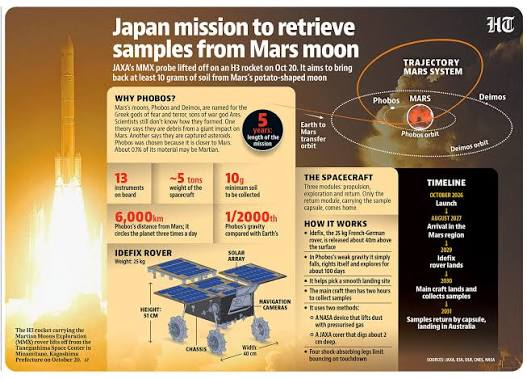
- Japan Aerospace Exploration Agency (JAXA) is preparing to launch its Martian Moons eXploration (MMX).
Martian Moons eXploration (MMX) Mission
- Agency: Japan Aerospace Exploration Agency (JAXA), with international contributions.
- Objective: Collect at least 10 grams of material from Phobos and return it to Earth in 2031.
- Timeline: Arrival at Mars system in 2027; sample return planned for 2031.
- Significance: If successful, it will be the first mission to return samples from a Martian moon.
- Rover: Developed jointly by Germany’s DLR and France’s CNES.
Phobos and Deimos
- Location: Two natural satellites of Mars.
- Discovery: August 1877 by American astronomer Asaph Hall.
- Shape: Small and irregular.
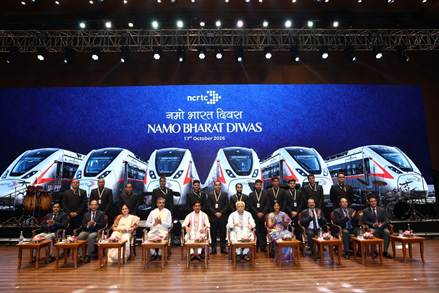
Namo Bharat Diwas 2026
Polity
Context (PIB):
- National Capital Region Transport Corporation (NCRTC) celebrated Namo Bharat Diwas 2026 on October 17, to mark the anniversary of the launch of Namo Bharat services for the public.
About:
- India’s Regional Rapid Transit System (RRTS) service for fast, comfortable intercity travel.
- First Corridor: Delhi–Ghaziabad–Meerut, approximately 82 km.
- Inauguration: First priority section (Sahibabad–Duhai Depot) inaugurated on 20 October 2023.
- Objectives: Reduce travel time, road congestion and vehicular emissions; promote regional development.
- Implementing Agency: National Capital Region Transport Corporation (NCRTC), incorporated in 2013 as a joint venture of the Centre and Delhi, Haryana, Rajasthan and Uttar Pradesh governments.
World Health Summit (WHS) 2026
International
Context (TH):
- Recently, the World Health Summit took place from October 11–13, 2026, in Berlin, Germany.
- Theme (2026): From Crisis to Resilience: Innovating for Health.
- Purpose: Summit convened leaders from politics, science, civil society, and private sector to catalyse collaborative and innovative solutions for key global health priorities.
World Health Summit (WHS)
- Founded: 2009 by Charité – Universitätsmedizin Berlin.
- Annual Summit: Held every October; international presidency rotates annually among WHS Academic Alliance institutions.
- WHS Academic Alliance: Scientific network (formerly M8 Alliance) promoting international collaboration and evidence-based health policy.
- Regional Meeting: Hosted by the institution holding the presidency; Rio de Janeiro will host the 2028 Regional Meeting.









Leave a Reply