
Refugee Convention
International
News-
- The 1951 Refugee Convention recently marked its 75th anniversary.
1951 Refugee Convention
- Adopted: 1951, Geneva; key international treaty for refugee protection.
- Refugee: Person outside their country facing a well-founded fear of persecution due to race, religion, nationality, social group or political opinion.
- Key principle: Non-refoulement – refugees should not be returned to a place where their life/freedom is threatened.
- Rights: Employment, education, housing, courts, religion and movement.
- 1967 Protocol: Removed the Convention’s temporal and geographical limitations.
- India: Not a party to the 1951 Convention or 1967 Protocol; has no dedicated refugee law.
World Ozone Day
Environment
News
- World Ozone Day 2026 was observed on September 16, commemorating the Montreal Protocol and highlighting 10 years of adoption of the Kigali Amendment.
OZONE LAYER DEPLETION
Basics – Ozone Layer (O3)
- It is a highly reactive molecule containing three oxygen atoms.
- Found in – It is present between 10 and 50 km above the earth’s surface, called the stratosphere.
- Function – This ozone layer serves as a natural filter for blocking deadly incoming UV radiation from the sun.
- Significance – This ozone shield is necessary for the survival of human life on the earth.
OZONE LAYER DEPLETION
- Definition – The decrease in ozone concentration in the middle layers of the atmosphere – mainly in the stratosphere is referred to as the depletion of the ozone layer.
- Caused by – It is caused by emissions of anthropogenic halogenated hydrocarbons such as CFCs, HCFCs, Halons, Carbon tetrachloride and Methyl bromide.
Why is ozone depletion more in Antarctica than the equator?
-
- The severe depletion of the Antarctic ozone layer known as the “ozone hole” occurs because of the special weather conditions that exist there and nowhere else on the globe.
- The very low temperatures of the Antarctic stratosphere create ice clouds called polar stratospheric clouds (PSCs).
Measures to Prevent Ozone Layer Depletion
Vienna Convention
- Objective – To protect human health and the environment from any harmful effects of the depletion of the ozone layer.
- Held in – Vienna , Austria
- Adopted in – 1985.
- Came into force – 1988.
Montreal Protocol
- Enforcement – It was agreed upon in 1987 in Montreal, Canada and entered into force in 1989.
- Objective – To protect the Ozone layer by reducing the production of substances that are supposed to be responsible for Ozone layer depletion.
- Kigali Agreement – The protocol was further strengthened with the ratification of the legally binding Kigali Agreement in 2016 in Kigali, Rwanda.
- Significance – It seeks to phase out the production of hydrofluorocarbons (HFCs) that are potent greenhouse gases by the late 2040s.
State of the World’s Birds 2026
Environment
News –
- BirdLife International published its quadrennial State of the World’s Birds report at the Global Flyways Summit in Nairobi.
About –
- Released by: BirdLife International; published every 4 years.
Key findings:
- 45% of migratory bird species are declining.
- 1 in 9 migratory species faces extinction.
- Slender-billed Curlew declared extinct in 2025; last recorded in Morocco in 1995.
- Major drivers: Invasive species, agricultural expansion/intensification, climate change, unsustainable hunting & trapping.
- Flyway: Geographical route connecting breeding and wintering grounds, with stopover sites.
- Global flyways: BirdLife recognises 14 major flyways — 8 terrestrial + 6 marine.
- Examples: Central Asian, East Asian–Australasian, African–Eurasian Flyways.
- Nairobi Flyways Declaration: Emphasises coordinated conservation across entire flyways, involving multiple countries and stakeholders.
Additional Information – BirdLife International
- Nature: Global partnership for bird and biodiversity conservation.
- Founded: 1922 as International Council for Bird Preservation (ICBP).
- Headquarters: Cambridge, UK.
- Key role: Identifies Important Bird & Biodiversity Areas (IBAs) and supports conservation research and policy.
- Reports: Publishes the State of the World’s Birds report.
- Network: Works through partner organisations across 120+ countries.
Ring-tailed Lemur (Lemur catta)
Environment

News –
- Bangladeshi investigators reportedly traced two ring-tailed lemurs stolen from Gazipur Safari Park to Vantara in Jamnagar, Gujarat.
About
- Scientific name: Lemur catta
- Distribution: Southern & south-western Madagascar; arid spiny scrub and rocky habitats.
- Features: Omnivorous, social strepsirrhine (wet-nosed) primate; distinctive 12–14 black-and-white tail rings.
- Behaviour: Female-led groups; highly terrestrial among lemurs; males perform scent-based “stink fights.”
- Threats: Habitat loss, charcoal production, hunting & illegal pet trade.
- IUCN: Endangered (EN)
- CITES: Appendix I
Tso Kar Glacier Lake
Environment

News
- Ladakh has launched a project aimed at reviving and conserving Tso Kar Glacier Lake.
About
- Location: Rupshu Plateau, Ladakh.
- Part of Tso Kar Wetland Complex, comprising Tso Kar + Startsapuk Tso.
- Tso Kar: Means “white lake”, referring to salt deposits/efflorescence along its margins due to evaporation of saline water.
- Ramsar Site: Designated in 2020.
- Concern: Lake has reportedly shrunk ~70% in a decade, linked to receding glacial inputs and changing climate patterns.
- Conservation: Ladakh has launched a project for its revival and conservation.
National Institute of Mental Health and Neuro Sciences (NIMHANS)
Polity
News –
- New Delhi Declaration adopted during 18th BRICS Summit agrees to support establishment of training hubs and Centres of Excellence for mental health, with NIMHANS being the coordinating centre.
About –
- Full name: National Institute of Mental Health and Neuro Sciences.
- Location: Bengaluru, Karnataka.
- Focus: Mental health, neurosciences and neurosurgical care; patient care, research & training.
- Deemed University: 1994.
- Institute of National Importance: 2012, through an Act of Parliament.
- Tele-MANAS: Designated nodal centre.
- Bellary Model: NIMHANS’ pilot model contributed to the District Mental Health Programme (DMHP).
Additional information – Mental Health Initiatives in India
|
Initiative |
Key point |
|
National Mental Health Programme (NMHP), 1982 |
Accessible mental healthcare; district-level services |
|
District Mental Health Programme (DMHP), 1996 |
Integrates mental health services at district level |
|
Tele-MANAS, 2022 |
24×7 tele-mental health support; toll-free 14416 |
|
Mental Healthcare Act, 2017 |
Right to access mental healthcare; decriminalises attempted suicide |
|
KIRAN Helpline, 2020 |
Mental-health counselling/support helpline |
|
Manodarpan, 2020 |
Psychological support for students |
|
National Suicide Prevention Strategy, 2022 |
India’s first national framework to reduce suicide mortality |
Ramanathaswamy Temple
History & Culture
News –
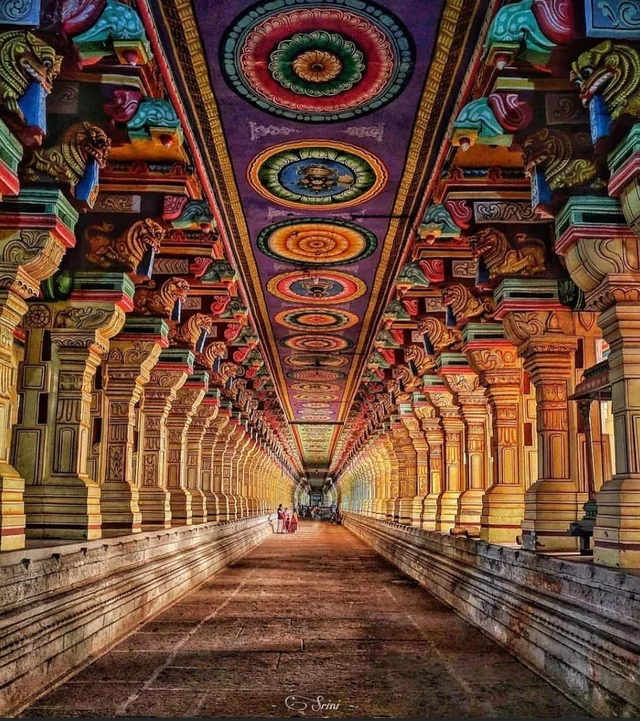
- During the 18th BRICS Summit in New Delhi, PM Narendra Modi welcomed visiting leaders at Bharat Mandapam against a backdrop featuring the iconic Ramanathaswamy Temple of Rameswaram.
About
- Location: Rameswaram, Pamban Island, Tamil Nadu.
- Deity: Lord Shiva; one of the 12 Jyotirlingas and one of the Char Dham.
- Architecture: Dravidian style, famous for elaborate gopurams, carved pillars and long corridors.
- Corridor: Known for the longest temple corridor in India/world.
- History: Expanded substantially under the Nayaks and Sethupathi rulers (15th–18th centuries), with earlier Pandya patronage.
Additional Information- 12 Jyotirlingas
|
No. |
Jyotirlinga |
State |
|
1 |
Somnath |
Gujarat |
|
2 |
Mallikarjuna |
Andhra Pradesh |
|
3 |
Mahakaleshwar |
Madhya Pradesh |
|
4 |
Omkareshwar |
Madhya Pradesh |
|
5 |
Kedarnath |
Uttarakhand |
|
6 |
Bhimashankar |
Maharashtra |
|
7 |
Kashi Vishwanath |
Uttar Pradesh |
|
8 |
Trimbakeshwar |
Maharashtra |
|
9 |
Vaidyanath |
Jharkhand |
|
10 |
Nageshwar |
Gujarat |
|
11 |
Rameshwaram (Ramanathaswamy) |
Tamil Nadu |
|
12 |
Grishneshwar |
Maharashtra |
Thirukkural
History & Culture
News –
- PM Modi gifted a Russian translation of the Thirukkural to President Putin ahead of the 18th BRICS Summit in New Delhi.
About
- Author: Thiruvalluvar; foundational Tamil ethical text.
- Period: Post-Sangam era; date debated (c. 300 BCE–500 CE).
- Structure: 1,330 couplets → 133 chapters → 10 couplets/chapter.
Three divisions:
- Aram – Virtue/ethics
- Porul – Polity/statecraft
- Inbam – Love
- Nature: Secular and universal; covers ethics, governance, justice and social values.
- Also known as Kural, Tamil Marai (Tamil Veda) and Divine Book.

















Leave a Reply