
Tulu Language
Culture
Context
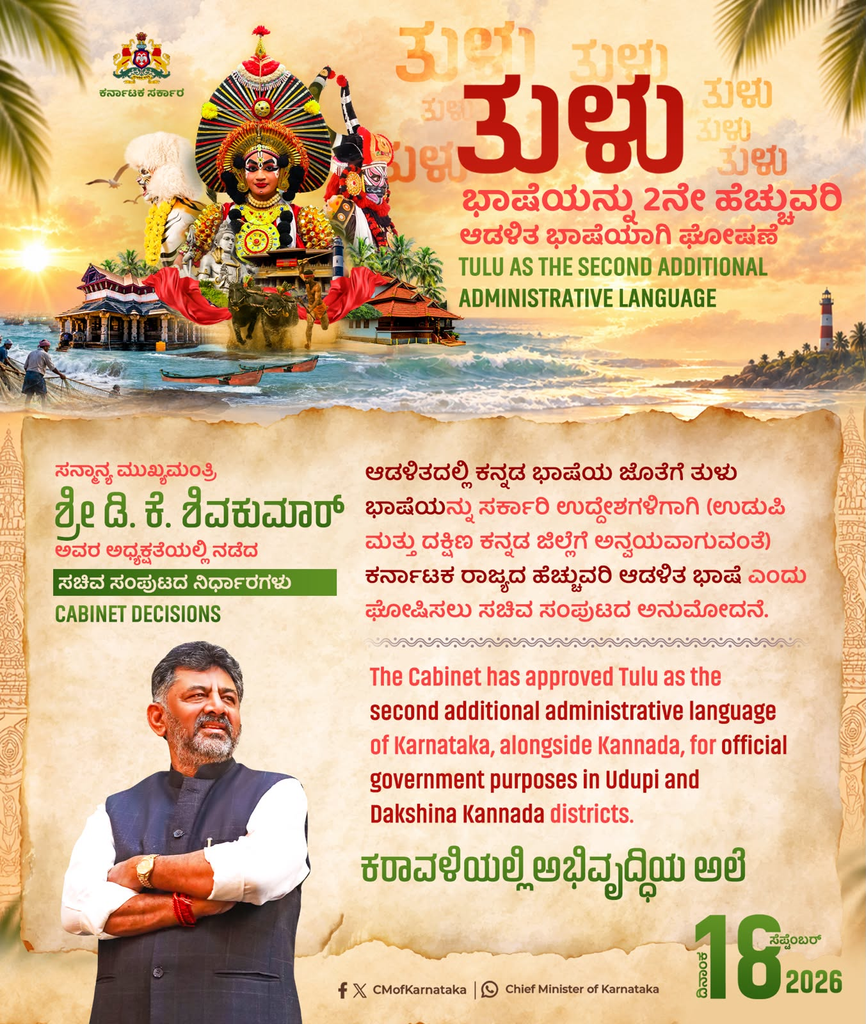
- The Karnataka Cabinet has decided to accord additional official language status to Tulu for administrative purposes in the Dakshina Kannada and Udupi districts.
Tulu
- Tulu: Independent Dravidian language with a history of 2,000+ years.
- Region: Mainly Dakshina Kannada & Udupi (Karnataka) and Kasaragod (Kerala).
- Status: Not included in the Eighth Schedule of the Constitution.
- Recognition: Census authorities recognise Tulu as an independent language and provide separate speaker data.
- Script: Historically had its own Tulu script; Kannada script is predominantly used today.
- Historical references: Mentioned in Tamil Sangam literature; Charition Papyrus (~2nd century BCE) is cited as an early reference.
- Karnataka: Cabinet decided to grant Tulu additional official language status for administrative purposes in Dakshina Kannada and Udupi.
Key Developments in the Recognition Process
- Committee Recommendation: A six-member panel led by K.M. Gayatri, former Director of the Kannada and Culture Department, submitted its report to the Secretary of the Kannada and Culture Department on March 4, 2026.
- Adoption of the Andhra Pradesh Model: The committee specifically studied the administrative and legal framework used by Andhra Pradesh to grant Urdu second official language status to ensure a smooth implementation for Tulu.
- Constitutional Basis: The state aims to accord this status under Article 345 of the Constitution of India, which allows state legislatures to adopt one or more languages for official purposes.
Swachh Bharat Mission (SBM)
Government Schemes
Context
- The Swachh Bharat Mission (SBM) has moved beyond toilet construction to focus on sustained sanitation practices and behavioural change in India.
Swachh Bharat Mission (SBM)
-
Launched: 2 October 2014 to achieve universal sanitation & ODF India by 2 October 2019.
-
Two components:
-
SBM-Gramin [SBM(G)] → Ministry of Jal Shakti
-
SBM-Urban [SBM(U)] → Ministry of Housing & Urban Affairs
-
-
Focus: Toilet construction → behavioural change + sustainable sanitation + waste management.
Phases
|
Component |
Key Focus |
|
SBM(G) Phase I |
ODF status; sanitation infrastructure |
|
SBM(G) Phase II (2020–21) |
ODF sustainability + Solid & Liquid Waste Management |
|
SBM(U) 2.0 (2021–26) |
ODF sustainability + scientific solid/liquid waste treatment |
News
- The Prime Minister has paid homage to Saratchandra Chattopadhyay on his 150th birth anniversary.
Sarat Chandra Chattopadhyay (1876–1938) – UPSC
- Born: Devanandapur, Bengal (1876); later lived in Rangoon (Myanmar).
- Associated with the Indian freedom movement; President of Howrah Congress unit (1921–36).
- Major Bengali novelist known for portraying women, social oppression and orthodox social norms.
- Major works: Devdas, Srikanta, Pather Dabi, Parinita, Biraj Bau, Palli Samaj, Charitraheen and Swami.
- Pather Dabi: Depicts revolutionary nationalism and anti-colonial resistance.
- Srikanta: Narrates the life and experiences of a wandering protagonist.
- His works gained pan-Indian and international popularity.
Foreign Contribution Regulation Act (FCRA)
Polity and Governance
Context
- At the first meeting of Parliament’s Joint Committee on the Foreign Contribution (Regulation) Amendment Bill, 2026, members raised questions on the proposed changes.
Foreign Contribution (Regulation) Act
- Enacted in – It is an act of Parliament enacted in 1976 and amended in 2010.
- Objective – To regulate foreign donations and to ensure that such contributions do not adversely affect the internal security of the country.
- Applicability – The Act is applicable to all associations, groups and non-governmental organizations (NGOs) who intend to receive foreign donations.
- Restrictions – The members of legislatures, political parties, government officials, judges and media persons are prohibited from receiving any foreign contributions.
Key Provisions of the 2026 Amendment Bill
- Asset Seizure: The government can take over and sell physical assets (like hospitals or schools) built with foreign funds if an NGO’s license is cancelled or expires.
- Automatic Expiry: If an NGO does not renew its registration in time, it lapses automatically. The state can step in to control its property right away.
- Personal Liability: Key heads, directors, and trustees are held personally liable for any rules broken by the NGO.
- Central Approval: Local police or agencies cannot investigate an NGO under this law without prior approval from the Central Government.
- Lower Jail Time: The maximum jail term for breaking the law drops from 5 years to 1 year, shifting the focus to financial penalties.
E.V. Ramasamy
History & Culture
Context
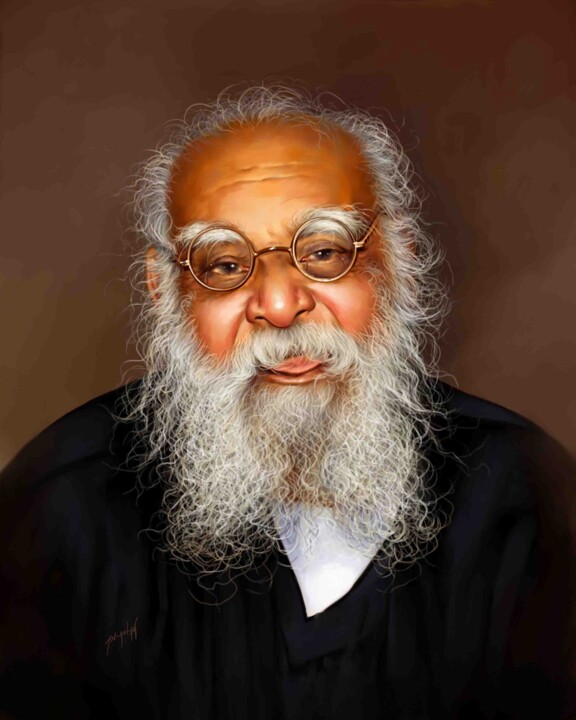
- Tamil Nadu Chief Minister Vijay paid floral tributes on the 147th birth anniversary of social reformer E.V. Ramasamy in Chennai.
E.V. Ramasamy (Periyar)
- Born: 17 September 1879, Erode, Tamil Nadu.
- Popularly known as Periyar (“The Great One”).
- Self-Respect Movement (1925): Challenged caste hierarchy and promoted social equality, rationalism and self-respect.
- Congress: Left in 1925 over separate dining arrangements for Brahmin and non-Brahmin students at Gurukkulam.
- Vaikom Satyagraha (1924–25): Participated in the movement for lower-caste access to public roads around Vaikom Temple.
- Dravida Nadu: Advocated a separate Dravidian homeland; founded Dravidar Kazhagam (DK).
- Journal: Kudi Arasu.
- Social Justice Day: Tamil Nadu observes 17 September as Periyar’s birth anniversary.
India Deep Tech Alliance
Science and Technology
News
- The India Deep Tech Alliance (IDTA) members invested ₹2,170 crore in 56 Indian deep-tech firms over the past year, signalling growing private investment in strategic technologies.
India Deep Tech Alliance (IDTA)
|
Aspect |
Details |
|
Launched |
September 2025 |
|
Nature |
Industry-led consortium |
|
Members |
Investors, corporates, technology partners & ecosystem stakeholders from India and abroad |
|
Focus |
India’s deep-tech startups |
|
Key sectors |
AI, semiconductors, advanced computing, robotics, biotech, etc. |
|
Support |
Long-term capital, technical mentorship, market linkages & policy engagement |
|
Objective |
Build globally competitive deep-tech companies from India |
India Rejects Pakistan-China Boundary Joint Commission
IR
Context
- India has rejected the so-called Pakistan-China Boundary Joint Commission, saying Pakistan has no locus standi to enter into arrangements concerning Indian territory under its illegal and forcible occupation.
Pakistan–China Boundary Agreement
|
Aspect |
Key Facts |
|
India’s position |
India rejects Pakistan–China arrangements concerning Indian territory under Pakistan’s occupation, arguing Pakistan has no locus standi to alter its status. |
|
1963 Agreement |
Pakistan–China Boundary Agreement signed in 1963 to demarcate the boundary between Xinjiang and Pakistan-occupied territory. India considers it illegal and invalid. |
|
Shaksgam Valley |
Also called Trans-Karakoram Tract; Pakistan ceded it to China under the 1963 agreement. |
|
Location |
In the Hunza–Gilgit region, north of the Siachen Glacier; area is 5,000+ sq km. |
|
Historical context |
The princely state of Jammu & Kashmir was established after the Treaty of Amritsar (1846) and historically encompassed Jammu, Kashmir, Ladakh, Gilgit-Baltistan, PoK and the Trans-Karakoram Tract. |
|
Boundary Joint Commission |
Originated in the 2013 Agreement on the Boundary Management System, signed during Chinese Premier Li Keqiang’s visit to Pakistan. |
|
Purpose of Commission |
Oversee implementation of Pakistan–China border-management arrangements. |
|
India’s objection |
India maintains that Pakistan’s transfer of the Shaksgam Valley to China constitutes an illegal transfer of Indian territory. |
Central Board of Film Certification (CBFC)
Polity
News –
- The Government of India has reconstituted the Central Board of Film Certification (CBFC).
Central Board of Film Certification (CBFC)
- Nature: Statutory body under the Ministry of Information & Broadcasting.
- Established: Under the Cinematograph Act, 1952.
- Headquarters: Mumbai.
- Regional offices: 9 across India.
- Composition: Chairman and non-official members, appointed by the Central Government.
- Function: Examines films intended for public exhibition and grants certificates as per applicable laws.
- Key provision: Films can be publicly exhibited in India only after CBFC certification.
















Leave a Reply