
South Korea Tests Indigenous Hypersonic Glide Vehicle
Defence

Context
- South Korea has successfully test-fired its first domestically developed Hypersonic Glide Vehicle (HGV), marking a step towards acquiring a new high-speed strike capability amid rising tensions on the Korean Peninsula.
HYPERSONIC WEAPONS
- Definition: Weapons that travel at Mach 5 or higher (five times the speed of sound).
Types:
- Hypersonic Glide Vehicles (HGVs): Rocket boosters propel them to high altitudes; they then glide towards targets while manoeuvring at hypersonic speeds.
- Hypersonic Cruise Missiles: Use high-speed, air-breathing engines such as scramjets to sustain hypersonic flight within the atmosphere.
INDIA’S HYPERSONIC PROGRAMMES
- HSTDV: Hypersonic Technology Demonstrator Vehicle; demonstrated flight at approximately Mach 6.
- BrahMos-II: Proposed hypersonic cruise missile designed to achieve speeds of around Mach 7.
Southern Indian Ocean Fisheries Agreement (SIOFA)
Environment and Ecology
Context
- The Union Government approved India’s accession to the Southern Indian Ocean Fisheries Agreement (SIOFA), elevating its status from a Cooperating Non-Contracting Party to a full Contracting Party.
About
- Full Form: Southern Indian Ocean Fisheries Agreement.
- Objective: Conservation and management of fishery resources in the high seas of the Southern Indian Ocean.
- Coverage: Fish, molluscs, crustaceans and sedentary species, subject to specified exclusions under UNCLOS.
- Significance for India: Accession could expand fishing opportunities for Indian vessels beyond their traditional operating range of 60–80 nautical miles from the coast.
Additional Information – United Nations Convention on the Law of the Sea (UNCLOS)
- It is a comprehensive international treaty that establishes the legal framework for governance of oceans and seas.
- Adopted in 1982 at Montego Bay, Jamaica and entered into force in 1994.
It defines:
- Maritime boundaries of coastal states
- Rights and duties of states in maritime zones
- Rules for navigation, resource exploitation, and environmental protection
- Because of its extensive scope, it is commonly referred to as the “Constitution of the Oceans.”
-
- Membership: 168 parties, including the European Union.
- Countries such as India, Japan, and China are parties.
- Note – The United States has signed but not ratified the convention.
Maritime Zones under UNCLOS
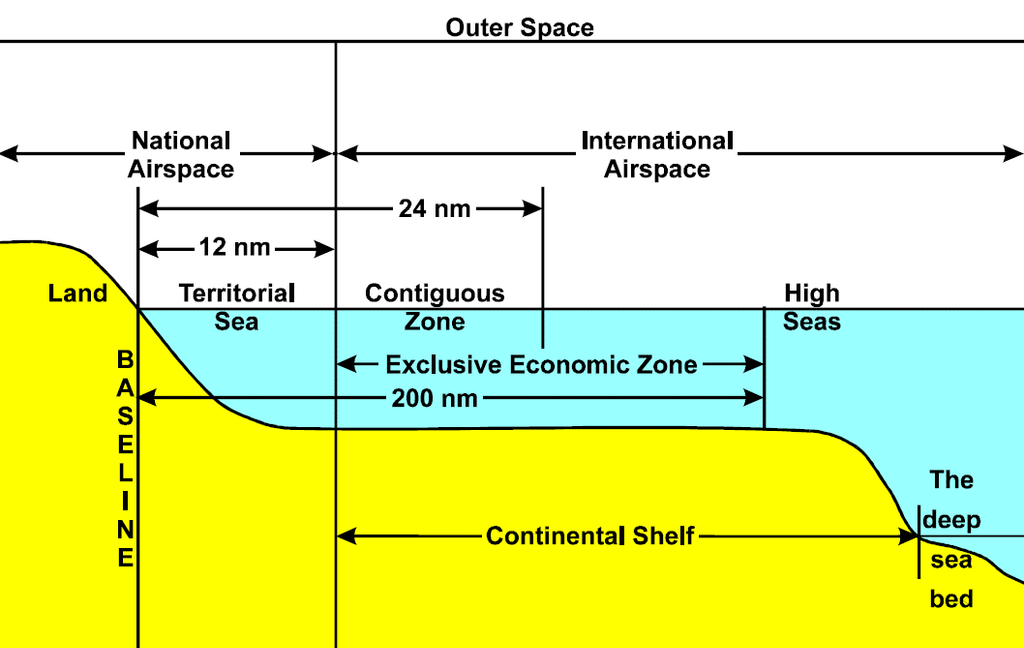
- UNCLOS divides the oceans into several legal zones, each with different rights and responsibilities.
- Territorial Sea: Extends up to 12 nautical miles from a coastal state’s baseline. The coastal state has full sovereignty over these waters. Foreign ships enjoy the right of innocent passage.
- Contiguous Zone: Extends 12–24 nautical miles from the baseline. Coastal states can enforce laws relating to Customs, immigration, sanitation & security.
- Exclusive Economic Zone (EEZ): Extends up to 200 nautical miles. The coastal state has exclusive rights over natural resources. However, other states retain freedom of navigation and overflight.
- High Seas (International Waters): Areas beyond the EEZ of any state. No country has sovereignty over them. Governed by international law and UNCLOS principles.
Oman Replaces US as top LNG supplier to India
Economy
News
- Oman became India’s largest supplier of liquefied natural gas (LNG), replacing the United States.
LIQUEFIED NATURAL GAS (LNG)
- Definition: Natural gas cooled to approximately −162°C to convert it into liquid form.
- Volume Reduction: Liquefaction reduces its volume to about 1/600th of its gaseous volume.
- Transport: Carried in insulated LNG ships and converted back into gas through regasification at import terminals.
USES OF LNG
- Power Generation and fertilizer production.
- City Gas Distribution: Domestic cooking and transport.
- Industrial and Commercial Applications.
REASONS FOR SUPPLIER RANKING CHANGES
- Geopolitical Disruptions: West Asian tensions affected energy supply routes.
- Global Competition: European demand for US LNG reduced cargo availability for India.
- Qatar Disruption: Reported damage at Ras Laffan Industrial City following an Iranian strike in March 2026 affected Qatari shipments.
SIGNIFICANCE FOR INDIA
- Energy Security: Diversifying suppliers reduces dependence on a few countries.
- Price Stability: Multiple sources improve supply flexibility.
- Import Vulnerability: India remains exposed to geopolitical tensions, global competition and international price fluctuations.
India’s Coir Sector
Economy

Context
- India’s coir sector is gaining importance as a sustainable, export-oriented industry that promotes rural livelihoods, women’s empowerment and value addition to agricultural waste.
COIR INDUSTRY
- Definition: Coir is a natural fibre extracted from the outer husk of coconuts, used to make mats, ropes, brushes and mattresses.
- Global Position: India is the world’s largest producer and exporter of coir and coir products, accounting for around two-thirds of global production.
- Employment: Provides direct and indirect employment to over 7 lakh people, around 80% of whom are women.
- Exports: Reached ₹6,614.40 crore in FY 2025–26, compared with ₹1,630.33 crore in FY 2014–15.
- Udyam Registration: Over 21,000 coir units, employing around 2.3 lakh people.
COIR VIKAS YOJANA (CVY)
- Ministry: Ministry of Micro, Small and Medium Enterprises (MSME).
- Objective: Sustainable development and modernisation of the coir industry.
- Key Interventions:
- Skill Development: Training for artisans, especially rural women.
- Research and Technology: Improved machinery and production techniques.
- Market Promotion: Domestic sales, exports and trade fair participation.
- Financial Assistance: Support for production infrastructure.
Pradhan Mantri Samajik Sahayata Yojana (PMSSY)
Government Scheme
News
- The Union Cabinet has renamed the National Social Assistance Programme (NSAP) as the Pradhan Mantri Samajik Sahayata Yojana (PMSSY)
NATIONAL SOCIAL ASSISTANCE PROGRAMME (NSAP)
- Launch: 15 August 1995.
- Ministry: Ministry of Rural Development.
- Nature: Centrally Sponsored, non-contributory social assistance programme.
- Objective: Financial assistance to vulnerable BPL households, including elderly persons, widows, persons with disabilities and families losing their primary breadwinner.
- Constitutional Basis: Article 41 of the Directive Principles of State Policy (DPSP).
KEY COMPONENTS
- Old-Age Pension: Indira Gandhi National Old Age Pension Scheme (IGNOAPS).
- Widow Pension: Indira Gandhi National Widow Pension Scheme (IGNWPS).
- Disability Pension: Indira Gandhi National Disability Pension Scheme (IGNDPS).
- Family Benefit: National Family Benefit Scheme (NFBS) provides a one-time grant following the death of the primary breadwinner in an eligible BPL household.
DISABILITY PENSION — KEY PROVISIONS
- Eligibility: Benchmark disability of 40% or more, as stated in the supplied announcement.
- Age Requirement: The announcement states that the minimum age limit has been removed.
- Monthly Assistance: ₹375 for beneficiaries aged 0–79 years and ₹625 for those aged 80 years and above, as stated in the supplied announcement.
- Coverage: Approximately 3.20 crore beneficiaries, according to the announcement.
Mining Project Threatens Future of Rare Jeypore Ground Gecko
Environment

Context
- The bauxite mining project in the Odisha’s Balda hills threatens the future of rare Jeypore ground gecko.
- It was presumed extinct for 130 years until it was rediscovered in 2010 by an Indian scientist.
Jeypore Ground Gecko
- Scientific Name: Cyrtodactylus jeyporensis.
- Distribution: Endemic to the Eastern Ghats; recorded in Odisha and Andhra Pradesh.
- Features: Nocturnal gecko, originally described in 1878 by Richard Henry Beddome.
- Habitat: Moist semi-evergreen forests at elevations of around 1,200–1,300 metres.
- Threats: Habitat loss due to coffee plantations, hydropower projects and mining.
- IUCN Status: Endangered (EN), as per the cited assessment.
- CITES: Appendix II — regulates international trade to prevent unsustainable exploitation.





Leave a Reply