
World Food Day 2026
Economy
Context
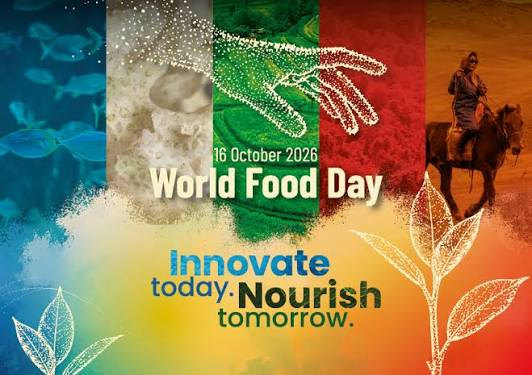
- The Ministry of Agriculture (MoA), in collaboration with the Food and Agriculture Organization of the United Nations (FAO), International Fund for Agricultural Development (IFAD) celebrated World Food Day 2026.
WORLD FOOD DAY 2026
- Observed: 16 October; marks the founding of FAO in 1945.
- Theme 2026: “Innovate today. Nourish tomorrow.”
- Objective: Raise awareness about hunger and promote global food security.
Food Security Concerns — SOFI 2026
- Global hunger: 7.8% of the global population faced hunger in 2025.
- India’s undernourishment: 142.5 million (9.8%) in 2023–25, down from 243.9 million in 2004–06.
- Healthy diet cost: PPP $4.11 per person per day in India in 2025.
- Affordability crisis: 520.1 million Indians (35.5%) could not afford a healthy diet.
- Child malnutrition: Stunting — 32.9%; Wasting — 18.7%.
- Emerging concerns: Rising childhood overweight, adult obesity and women’s anaemia.
Additional Information – India’s Food Security Framework
- National Food Security Act (NFSA), 2013: Subsidised foodgrains for up to 75% of the rural and 50% of the urban population, covering around 81 crore people.
- Pradhan Mantri Garib Kalyan Anna Yojana (PMGKAY): Free foodgrains for eligible beneficiaries; extended until 2028, as stated in the supplied source.
- Targeted Public Distribution System (TPDS): Foodgrain distribution to eligible households.
- One Nation One Ration Card (ONORC): Nationwide ration portability, especially for migrant workers.
- Digitisation: Aadhaar seeding and digitised ration cards help reduce leakages.
- PM POSHAN: School meal programme to improve children’s nutrition, attendance and retention.
- Food fortification: Fortification of rice, wheat flour and edible oils.
- Poshan Tracker: Monitors children’s growth and nutritional status.
- Saksham Anganwadi and POSHAN 2.0: Integrates Anganwadi Services, POSHAN Abhiyaan and support for adolescent girls to combat malnutrition.
Dal Lake
Environment
Context
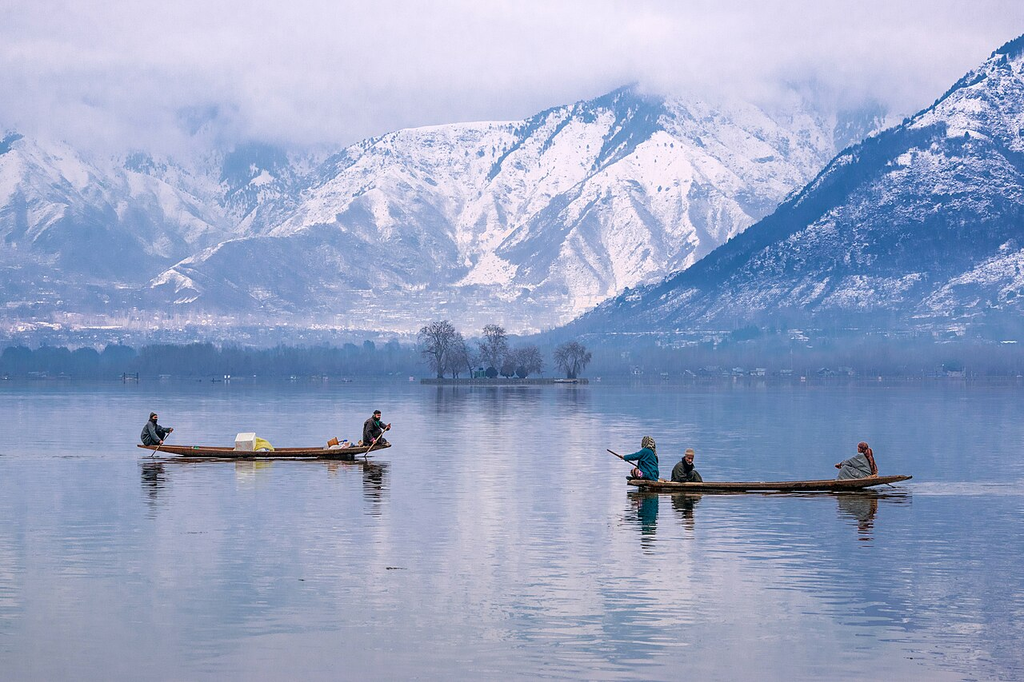
- The Jammu and Kashmir High Court has banned the use of motorboats and jet skis in Dal Lake.
Dal Lake
- Location: Srinagar, Jammu and Kashmir, in the Kashmir Valley.
- Significance: Famous urban lake known for houseboats, shikaras and scenic beauty.
- Area: Lake covers approximately 18 sq. km; the larger wetland area is about 21.1 sq. km.
- Basins: Includes Gagribal, Lokut Dal, Bod Dal and Nigeen.
- Major Attractions: Floating gardens, shikara rides, houseboats and floating vegetable market.
- Economic Importance: Supports tourism, fishing, horticulture and local livelihoods.
- Ecological Importance: Supports aquatic biodiversity and helps regulate the local hydrological environment.
- Environmental Threats: Untreated sewage, solid waste, aquatic weed growth, siltation and encroachment.
Additional Information – Important Lakes in India
|
Lake |
State/UT |
Key fact |
|
Wular Lake |
Jammu & Kashmir |
One of India’s largest freshwater lakes; associated with the Jhelum River. |
|
Dal Lake |
Jammu & Kashmir |
Famous for houseboats, shikaras and floating gardens. |
|
Pangong Tso |
Ladakh |
High-altitude, saline lake extending into Tibet (China). |
|
Tso Moriri |
Ladakh |
High-altitude lake in the Changthang region; important for migratory birds. |
|
Chilika Lake |
Odisha |
Brackish-water lagoon; Ramsar site and habitat of Irrawaddy dolphins. |
|
Pulicat Lake |
Andhra Pradesh–Tamil Nadu |
Brackish lagoon; separated from the Bay of Bengal by Sriharikota barrier island. |
|
Vembanad Lake |
Kerala |
Longest lake in India; part of the Vembanad–Kol wetland system. |
|
Ashtamudi Lake |
Kerala |
Ramsar wetland known for its palm-shaped backwater system. |
|
Sasthamkotta Lake |
Kerala |
Largest freshwater lake in Kerala. |
|
Kolleru Lake |
Andhra Pradesh |
Freshwater lake between the Krishna and Godavari deltas; Ramsar site. |
|
Loktak Lake |
Manipur |
Famous for floating masses of vegetation called phumdis; site of Keibul Lamjao National Park. |
|
Deepor Beel |
Assam |
Ramsar wetland near Guwahati; important for waterbirds. |
|
Sambhar Lake |
Rajasthan |
India’s largest inland saline lake; important for salt production. |
|
Lonar Lake |
Maharashtra |
Saline and alkaline lake formed by a meteorite impact in basaltic rock. |
|
Nalsarovar |
Gujarat |
Shallow wetland and important habitat for migratory birds; Ramsar site. |
|
Bhojtal (Upper Lake) |
Madhya Pradesh |
Major artificial freshwater lake in Bhopal. |
|
Pushkar Lake |
Rajasthan |
Sacred lake associated with Hindu pilgrimage. |
Overseas Citizens of India
Polity and Governance
Context
- Actor Imran Khan, a US citizen and Overseas Citizen of India (OCI) cardholder, has been asked by the Foreigners Regional Registration Office (FRRO) to leave India, days after he joined a protest in Mumbai.
OCI (Overseas Citizen of India)
- Status: Foreign citizens of Indian origin. It is not dual citizenship.
- Eligible: Anyone who was an Indian citizen on/after Jan 26, 1950, or their descendants. Foreign spouses qualify after 2 years of marriage.
- Barred: Anyone with ties to Pakistan or Bangladesh. Foreign military personnel are also excluded.
Privileges (What They CAN Do)
- Lifelong Visa: Multiple-entry, multi-purpose visa.
- No Foreigners Regional Registration Office: No police reporting required, regardless of stay duration.
- NRI Parity: Same rights as NRIs in economic, financial, and educational fields.
- Work: Can practice as doctors, dentists, lawyers, and chartered accountants in India.
Restrictions (What They CANNOT Do)
- No Voting: Cannot vote in any Indian elections.
- No Public Office: Barred from government jobs and constitutional posts (e.g., President, Judge).
- No Farm Land: Cannot buy agricultural or plantation property.Permissions Needed: Requires prior approval for journalism, research, missionary work, or visiting restricted areas.
Diabetes
Health
Context
- The ICMR-INDIAB study estimates India now has 101 million people living with diabetes and 136 million with prediabetes.
Definition
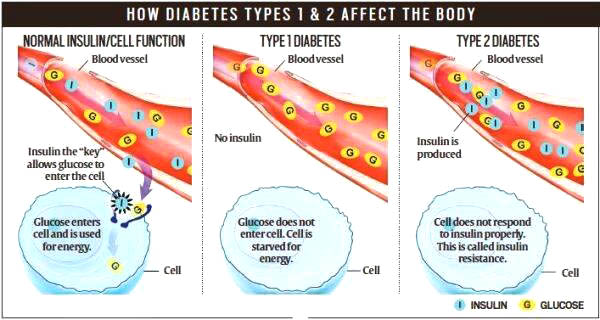
- Diabetes mellitus: A chronic metabolic disorder characterised by high blood glucose levels due to insufficient insulin production or ineffective insulin use.
- Insulin: A hormone produced by the pancreas that enables glucose to enter cells for energy.
Types of Diabetes
- Type 1: An autoimmune disease that destroys insulin-producing cells; requires lifelong insulin therapy.
- Type 2: Caused by insulin resistance or inadequate insulin production; associated with obesity, physical inactivity, unhealthy diet and family history.
- Gestational Diabetes: Develops during pregnancy; increases the future risk of Type 2 diabetes.
World Diabetes Day
- Observed: 14 November annually.
- Objective: Raise awareness about diabetes prevention, management and care.
India Adds Two New Ramsar Sites
Environment
Context
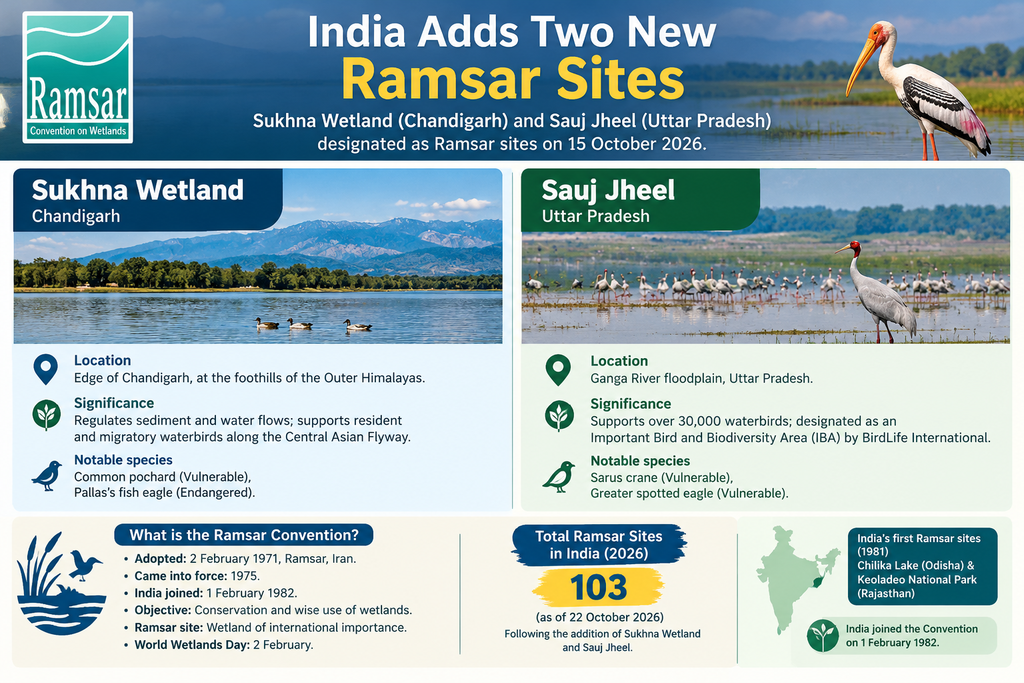
- India’s Ramsar Site tally has reached 103, with Sukhna Lake in Chandigarh and Sauj Jheel in Uttar Pradesh becoming the latest additions.
Sukhna Wetland
- Location: Chandigarh, at the foothills of the Outer Himalayas.
- Significance: Reservoir that regulates sediment and water flows; supports resident and migratory waterbirds along the Central Asian Flyway.
- Important Species: Common pochard (Vulnerable) and Pallas’s fish eagle (Endangered).
Sauj Jheel
- Location: Uttar Pradesh, in the Ganga River floodplain.
- Significance: Shallow lake supporting over 30,000 waterbirds; designated an Important Bird and Biodiversity Area (IBA) by BirdLife International.
- Important Species: Sarus crane (Vulnerable) and Greater spotted eagle (Vulnerable).
Connect with the basics – Ramsar Convention
-
- A Ramsar site is a wetland designated as one of international importance under the Ramsar Convention.
- Ramsar Convention – It is one of the inter-governmental accords to preserve the wetlands of international importance.
- It was signed on February 2, 1971 in Ramsar, Iran and came into force in 1975.
- India became a signatory to the Ramsar Convention in 1982.
Montreux Record (Threatened Sites)
- What it is: A register of Ramsar sites facing ecological danger from pollution or human interference.Active Indian Sites:
- Only two sites—Keoladeo National Park (Rajasthan) and Loktak Lake (Manipur).
- Removed- Chilika Lake was removed after successful recovery.
RAMSAR FACTS 2026
Important Facts
- Total Ramsar Sites in India: 103 (as of 22 October 2026).
- First Ramsar Sites: Chilika Lake (Odisha) and Keoladeo National Park (Rajasthan), designated in 1981.
- India joined: 1 February 1982.
- Most Ramsar Sites: Tamil Nadu (20), followed by Uttar Pradesh (14).
- 100th Ramsar Site: Surha Tal (Jai Prakash Narayan Bird Sanctuary), Uttar Pradesh.
- Latest Additions: Sukhna Wetland (Chandigarh) and Sauj Jheel (Uttar Pradesh).
Important Ramsar Sites — Location and Significance
- Chilika Lake — Odisha: Brackish-water lagoon; Irrawaddy dolphins.
- Keoladeo National Park — Rajasthan: Important bird habitat.
- Wular Lake — Jammu & Kashmir: Freshwater lake associated with the Jhelum River.
- Loktak Lake — Manipur: Floating phumdis; Keibul Lamjao National Park.
- Sambhar Lake — Rajasthan: India’s largest inland saline lake.
- Vembanad–Kol Wetland — Kerala: Extensive backwater ecosystem.
- Kolleru Lake — Andhra Pradesh: Freshwater lake between the Krishna and Godavari deltas.
- Sukhna Wetland — Chandigarh: Habitat for resident and migratory waterbirds.
- Sauj Jheel — Uttar Pradesh: Ganga floodplain wetland supporting large waterbird populations.









Leave a Reply