
Census (Amendment) Rules, 2026
Polity and Governance
Context
- The Ministry of Home Affairs (MHA) notified the Census (Amendment) Rules, 2026, expanding the categories of persons eligible for appointment as Census enumerators.
Eligible Categories
- Teachers: From government, local authority, aided/private educational institutions, societies and trusts.
- Clerks and Officials: From Central/State governments, local authorities, PSUs, statutory bodies, banks, companies, institutions, societies and trusts.
- Other Persons: Individuals considered suitable by the respective State Government or UT administration.
Role of Census Enumerators
- Visit households and collect demographic, social and economic data.
- Ensure accurate and comprehensive population enumeration.
- Provide reliable data for government planning and policymaking.
Census of India
- Legal Basis: Census Act, 1948.
- Frequency: Generally conducted every 10 years.
- Last completed Census: 2011.
- 2021 Census: Postponed due to the COVID-19 pandemic.
Significance of the Amendment
- Expands the pool of eligible enumerators.
- Supports effective staffing and implementation of Census operations.
Special Summary Revision (SSR)
Polity and Governance
Context
- The Election Commission of India (ECI) announced the schedule for the Special Summary Revision (SSR) of electoral rolls in 17 States and Union Territories, including five states scheduled to hold Assembly elections in early 2027.
SPECIAL SUMMARY REVISION (SSR)
Legal Basis
- Article 324: Empowers the Election Commission of India (ECI) to supervise, direct and control electoral rolls and elections.
- Laws: Representation of the People Act, 1950, and Registration of Electors Rules, 1960.
- Section 21, RPA 1950: Provides for the preparation and revision of electoral rolls.
What is SSR?
- A periodic exercise to update existing electoral rolls by:
- Adding newly eligible voters.
- Correcting errors in existing entries.
- Removing deceased, duplicate or permanently shifted electors, following due procedure.
SSR vs SIR
- Special Summary Revision (SSR):
- Existing electors are generally retained in the draft roll.
- Focuses on new voter registration and correction of existing entries.
- Deletions follow prescribed statutory procedures, including notices and hearings where required.
- Special Intensive Revision (SIR):
- Uses enumeration forms to verify electors for inclusion in the draft roll.
- Certain electors may be required to submit documents to establish eligibility, including citizenship.
- May involve additional verification of existing electors.
- Key Difference: SSR focuses on updating existing electoral rolls, whereas SIR involves more intensive enumeration and verification.
PUFFINS Telescope Mission
Science & technology

News
- Dr. Ramya Anche, Bengaluru-born astronomer, selected as Principal Investigator of NASA’s $20-million PUFFINS mission.
About PUFFINS
- Full Form: Polarimetry in the Ultraviolet to Find Features in Interstellar Dust.
- Type: Small Satellite (SmallSat) in Low Earth Orbit (LEO).
- Funding: NASA’s Astrophysics Pioneers programme.
- Lead Institution: University of Arizona’s Steward Observatory, with support from McDonald Observatory, University of Texas.
- Objective: Study the composition, structure and magnetic alignment of interstellar dust grains and their role in star and planet formation.
- Technique: Ultraviolet spectropolarimetry — measures the polarisation of ultraviolet starlight across wavelengths.
- Focus: Interstellar dust particles smaller than approximately 50 nanometres.
Significance
- Improves understanding of interstellar dust and galactic magnetic fields.
- Helps explain the processes involved in star and planetary system formation.
INS Samarthak
Defence
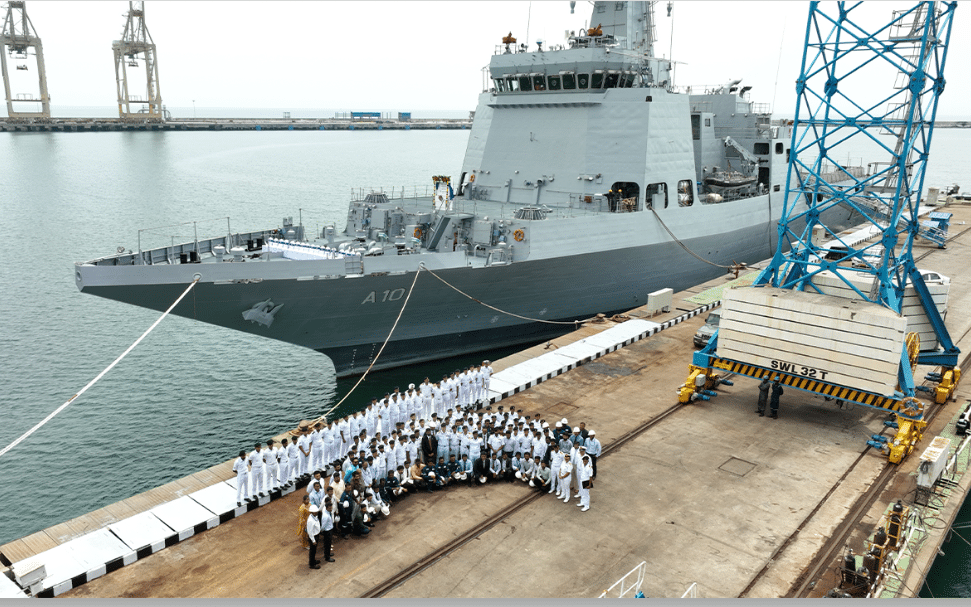
In News
- The Indian Navy commissioned INS Samarthak, the lead ship of the indigenously designed Multi-Purpose Vessels (MPVs), strengthening India’s naval capabilities and indigenous shipbuilding.
INS Samarthak
- Type: Multi-Purpose Vessel (MPV); a 107-metre auxiliary naval platform.
- Builder: Larsen & Toubro (L&T) Shipyard, Kattupalli, Tamil Nadu.
- Roles:
- Supports fleet operations and testing of indigenous weapons and sensors.
- Acts as a mothership for autonomous systems.
- Supports the launch, control and recovery of UAVs, AUVs and USVs.
- Performs auxiliary tasks, reducing the workload and machinery wear of frontline warships.


Leave a Reply