
SIPRI Yearbook 2026
Science and Technology
Context
- According to the Stockholm International Peace Research Institute (SIPRI) Yearbook 2026, India is estimated to have modestly expanded its nuclear arsenal in 2025.
Key Highlights for India
- Nuclear Growth: India’s nuclear arsenal grew to 190 warheads (up from 180 in 2025). It leads Pakistan (170) but trails China (620).
- Nuclear Posture: India now keeps a small number of warheads mated to missiles during peacetime patrols. This strengthens its sea-based nuclear triad.
- Defence Spending: India ranks 5th globally in military spending, shelling out $92.1 billion in 2025.
- Arms Imports: India remains the world’s 2nd largest arms importer, holding an 8.2% global share.
Global Trends
- Total Stockpile: Nine nuclear nations hold about 12,187 nuclear weapons.
- Rising Risks: Countries are relying more on nuclear weapons, reversing years of risk reduction.
- Record Spending: Global military spending hit a record high of $2.9 trillion.
Stockholm International Peace Research Institute’s (SIPRI)
- It is an independent international institute dedicated to research into conflict, armaments, arms control and disarmament.
- It was established in 1966 in Stockholm (Sweden).
Additional Information – Nuclear Disarmament
- Disarmament refers to the act of eliminating or abolishing weapons (particularly offensive arms) either unilaterally or reciprocally.
Nuclear Powers in the World
- There are nine countries recognized as possessing nuclear weapons.
- These are United States, Russia, China, United Kingdom, France, India, Pakistan, North Korea and Israel.
Treaties Related to Nuclear Disarmament
Treaty on the Non-Proliferation of Nuclear Weapons (NPT):
- Signed in 1968 and entered into force in 1970.
- It aims to prevent the spread of nuclear weapons and promote disarmament.
Treaty on the Prohibition of Nuclear Weapons (TPNW):
- Adopted by the United Nations in 2017 and opened for signature in 2018.
- It aims to prohibit the development, testing, production, stockpiling, stationing, transfer, use, and threat of use of nuclear weapons.
Comprehensive Nuclear – Test-Ban Treaty (CTBT)
- Opened for signature in
- It aims to ban all nuclear explosions for both civilian and military purposes.
- The treaty has been signed by 185 countries and ratified by 170, it has not entered into force as nuclear-armed states must ratify it to become operational.
Outer Space Treaty
- This multilateral agreement entered into force in 1967 and bans the siting of weapons of mass destruction in space.
India’s Nuclear Weapon Program
- Smiling Buddha: In 1974, India conducted its first nuclear test code-named “Smiling Buddha, and since then, it has developed a nuclear triad consisting of land-based, sea-based, and air based delivery systems.
- Operation Shakti: In 1998, India conducted a series of nuclear tests at Pokhran, codenamed “Operation Shakti.”
Pride Month
Polity

Context
- June is observed globally as Pride Month to celebrate the LGBTQ+ community and raise awareness about issues of equality, inclusion, and human rights.
LGBTQ+ Community
- LGBTQ+ is an umbrella term for lesbian, gay, bisexual, transgender, and queer persons, with ‘+’ representing other identities that are not specifically included in these letters.
- Notably, LGBTQ+ persons do not conform with traditional gender roles and expectations, display sex characteristics that do not fit the typical male or female binary, and their gender identities that differ from the sex they were assigned at birth.
- Pride Month – It commemorates the struggle for LGBTQ+ rights and celebrates diversity and inclusion.
India’s Position on LGBTQ+ Rights
- As per census 2011, there were 4.87 lakhs persons in India who opted for “other” in gender category.
- Transgender Rights: NALSA v. Union of India (2014) recognised the right to self-identify gender.
- It recognises transgender as the “third gender” upholding their fundamental rights.
- Decriminalisation: Navtej Singh Johar v. Union of India (2018) decriminalised consensual homosexual acts (Section 377 partially struck down).
- Constitutional Provisions: Article 14 Right to equality, Article 15 No discrimination on grounds of sex and Article 21 Right to life and personal liberty.
- Legislation: The Transgender Persons (Protection of Rights) Act, 2019 provides legal recognition of transgender identity.
Zojila Tunnel
Geography
Context
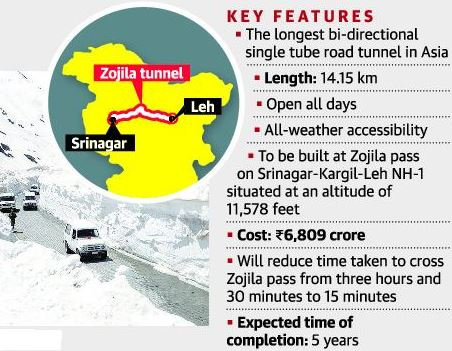
- The Zojila Tunnel achieved its final breakthrough in June 2026, marking a significant milestone in India’s efforts to establish all-weather connectivity between Kashmir and Ladakh.
Zojila Tunnel
- The Zojila Tunnel is a 14-km-long single-tube, bi-directional road tunnel being constructed beneath the Zojila Pass in the Himalayas.
- It is located at an altitude of approximately 11,578 feet and connects Baltal in Kashmir with Meenamarg in Ladakh.
- The tunnel is designed as a two-lane horseshoe-shaped structure and is among the world’s longest road tunnels at such a high altitude.
- The project is being executed by Megha Engineering & Infrastructures Ltd.
- The tunnel has been constructed using the New Austrian Tunnelling Method (NATM).
Strategic Importance
- It will provide all-weather connectivity between Kashmir Valley and Ladakh.
- It will reduce dependence on the snow-bound Zojila Pass, which remains closed during winter due to heavy snowfall and avalanches.
- It will improve military logistics and troop mobility in areas close to the Line of Actual Control.
Pradhan Mantri Surakshit Matritva Abhiyaan (PMSMA)
Government Schemes
Context
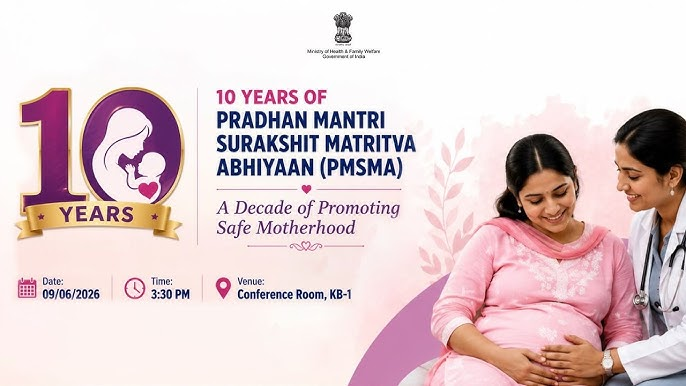
- The 10th anniversary of the Pradhan Mantri Surakshit Matritva Abhiyan (PMSMA) was observed.
Pradhan Mantri Surakshit Matritva Abhiyan (PMSMA)
- Launched on – June 9, 2016,
- Objective – It provides free, comprehensive antenatal care to pregnant women — particularly those in their second and third trimesters — at designated government health facilities on the 9th of every month.
- Key Services: Under PMSMA, pregnant women receive:
- Clinical examinations and risk assessment;
- Blood and urine tests;
- Ultrasonography;
- Essential medicines and supplements;
- Counselling on nutrition, birth preparedness, and safe pregnancy practices.
- The Doctor Volunteer System: The programme encourages voluntary participation of private-sector specialists, including obstetricians, gynaecologists, radiologists, and physicians, to provide antenatal care services on the 9th of every month.
- In 2022, the government launched the Extended PMSMA (e-PMSMA) to strengthen tracking and follow-up of high-risk pregnancies.
- Note – India’s Maternal Mortality Ratio (MMR) declined from 130 per lakh live births (2014–16) to 87 per lakh live births (2022–24).
Additional Information- Maternal Health Initiatives
- Janani Suraksha Yojana (JSY): Gives cash to poor women who choose to give birth in a hospital instead of at home.
- Janani Shishu Suraksha Karyakram (JSSK) – Makes hospital births 100% free. Covers medicine, food, tests, and free rides to and from the hospital.
- Surakshit Matritva Aashwasan (SUMAN) – It Promises dignified care with zero tolerance for being turned away by a hospital.
- Pradhan Mantri Matru Vandana Yojana (PMMVY) – Gives direct cash (₹5,000 for the first child and ₹6,000 for a second girl child) to buy nutritious food.
- LaQshya: Upgrades the quality and safety of hospital delivery rooms.
Preventive Detentions
Polity
Context
- The Allahabad High Court recently raised concerns over the alleged misuse of preventive detention laws.
Preventive Detention
- Preventive detention refers to the detention of a person without trial in order to prevent them from committing an act that may threaten public order, national security, or other vital state interests.
- Unlike punitive detention, which is imposed as punishment after conviction by a court of law, preventive detention is based on the apprehension that a person may engage in activities prejudicial to:
- Security of the State;
- Defence of India;
- Public order;
- Foreign affairs; or
- Maintenance of essential supplies and services.
- The Constitution divides the legislative power to enact preventive detention laws between the Union and the States.
Constitutional Provisions
- Article 22(3) of the Constitution provides for preventive detention laws,
- Article 22(4) contain the following safeguards against abuse of this power:
- No law providing for preventive detention shall authorise the detention of a person for a longer period than three months. Detention beyond this 3-month period requires clearance from an Advisory Board.
- The 44th Amendment Act of 1978 has reduced the period of detention without obtaining the opinion of an advisory board from three to two months.
- However, this provision has not yet been brought into force, hence, the original period of three months still continues.
Pradhan Mantri Ujjwala Yojana
Government Schemes
Context
- The Union Ministry of Petroleum & Natural Gas has indicated that subsidised LPG cylinders for households under the Pradhan Mantri Ujjwala Yojana (PMUY) have been reduced from nine to four.
Pradhan Mantri Ujjwala Yojana
- Launched in – May 2016
- Implementation – Ministry of Petroleum and Natural Gas.
- Objective -To give free LPG (gas) connections to poor women to replace dirty cooking fuels.
- Key Benefits: The government pays ₹1,600 for the connection setup. In Ujjwala 2.0, the first refill and stove are free.
- There is also a ₹300 subsidy per cylinder for up to 12 refills a year.
- Eligibility: Only adult women from poor households (like SC/ST or low-income families) who do not already have a gas connection.
- Scale: Over 10.3 crore connections have been given out so far.
Gallantry Awards
Defence
Context
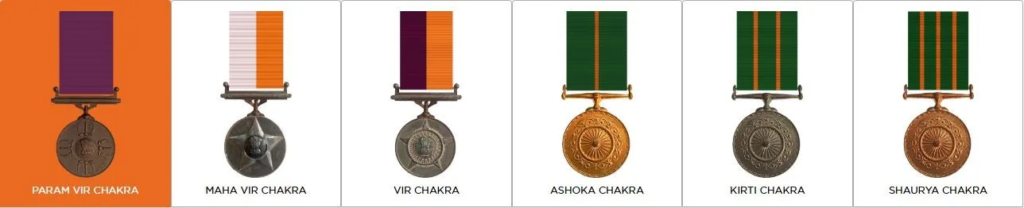
- President conferred Gallantry Awards to the personnel of the Armed Forces, Central Armed Police Forces, and State and Union Territory Police during the Defence Investiture Ceremony at Rashtrapati Bhawan.
Gallantry Awards
- Honoured by – Government of India
- It is given to honour acts of bravery, sacrifice, and exceptional courage by members of the armed forces, paramilitary forces, and civilians.
- They are classified as wartime (gallantry in the face of enemy) and peacetime awards.
- Administered by: Ministry of Defence (for armed forces) and Ministry of Home Affairs (for police and civilians).
- Awarded by: President of India.
- These gallantry awards are announced twice in a year – first on the occasion of the Republic Day and then on the occasion of the Independence Day.
- Wartime Gallantry Awards: Param Vir Chakra (PVC), Mahavir Chakra (MVC) and Vir Chakra.
- Peacetime Gallantry Awards: Ashok Chakra, Kirti Chakra, Shaurya Chakra.
Gallantry Awards
- Order of Precedence: Param Vir Chakra (PVC), Ashoka Chakra (AC), Maha Vir Chakra (MVC), Kirti Chakra (KC), Vir Chakra (VrC), Shaurya Chakra (SC).
- All six awards can be conferred posthumously.
Tejas
Syllabus: GS3/Defence
Context
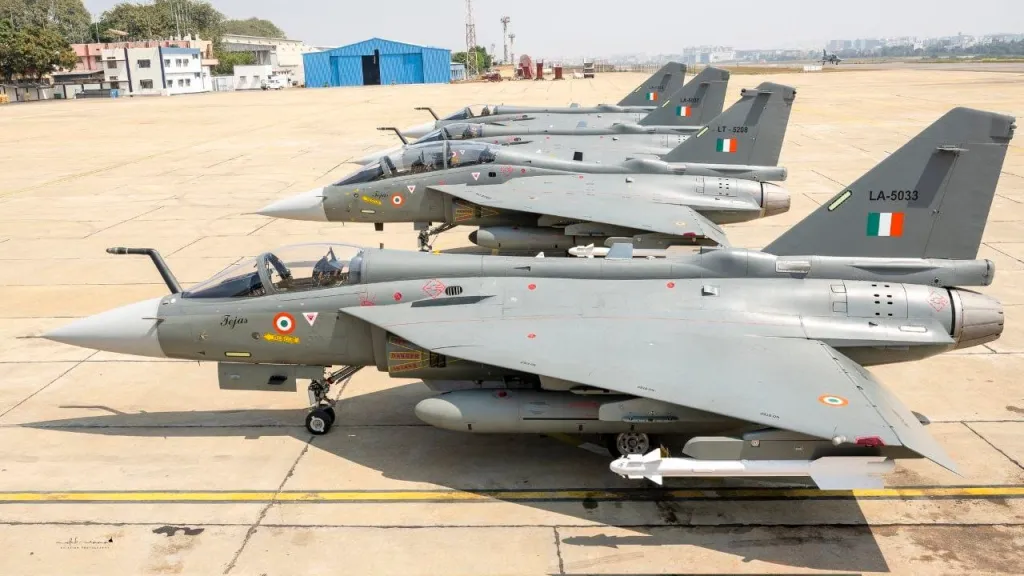
- The Defence Minister reviewed the progress of major ongoing projects of Hindustan Aeronautics Limited (HAL) where delays in the delivery of Light Combat Aircraft (LCA) Tejas Mk1A was also discussed.
Light Combat Aircraft (LCA) Tejas Mk1A
- It is an advanced, 5-generation multirole fighter jet built in India.
- Developed by- Hindustan Aeronautics Limited (HAL)
- The aircraft is designed to be a multi-role aircraft capable of taking up offensive air support, close combat and ground attack roles at ease.
- Advanced Radar: Uses an AESA Radar (including the indigenous Uttam radar) to track multiple targets at once.
- Electronic Warfare: Equipped with a jamming suite to protect the jet from enemy missiles.
- Smart Weapons: Can fire Beyond Visual Range (BVR) missiles like the Indian-made Astra.
- Mid-Air Refueling: Features a probe to refuel in the sky, which helps it fly longer distances.
- Engine: Powered by the American GE F404-IN20 turbofan engine.
Herbicide-Tolerant Mustard Hybrids
Syllabus: GS3/ Agriculture
Context
- India is set to begin large-scale cultivation of imidazolinone-resistant (IMI-resistant) mustard hybrids during the 2026–27 rabi season.
IMI-Resistant Mustard Hybrids
- These are mustard hybrids resistant to imidazolinone (IMI) herbicides.
- They have been developed through mutation breeding, not through genetic modification (GM).
- Mutation breeding involves selecting and preserving naturally occurring genetic mutations that confer desirable traits.
Connect with the basics – Gene Editing Technology
- It refers to technology that permits the change of an organism’s DNA by allowing genetic material to be added, removed, or altered at particular locations in the genome.
CRISPR Cas9 Technology
- Acronym – Clustered Regularly Interspaced Short Palindromic Repeats.
- Significance – With the use of the gene editing technique CRISPR, researchers can modify the DNA of living things.
- An enzyme called Cas9 functions as molecular scissors, guided by RNA molecules created to precisely match a certain DNA sequence.
- GE (Genome Editing): Involves precise modification of specific genes within an organism’s genome without introducing foreign genes, resulting in targeted genetic changes.
- GM (Genetically Modified): Involves the insertion of foreign genes from unrelated organisms into an organism’s genome to confer specific traits or characteristics.
Regulatory Bodies
- GEAC (Genetic Engineering Appraisal Committee): It is a regulatory body under the Ministry of Environment, Forest and Climate Change (MoEFCC).GEAC is responsible for evaluating and approving genetically modified organisms (GMOs)
- Cartagena Protocol on Biosafety (CPB): Ensures safe handling of GMOs that may impact biodiversity under the Convention on Biological Diversity. Nagoya-Kuala Lumpur.







Leave a Reply