
Abathsahayeswarar Temple
History and Culture
In News
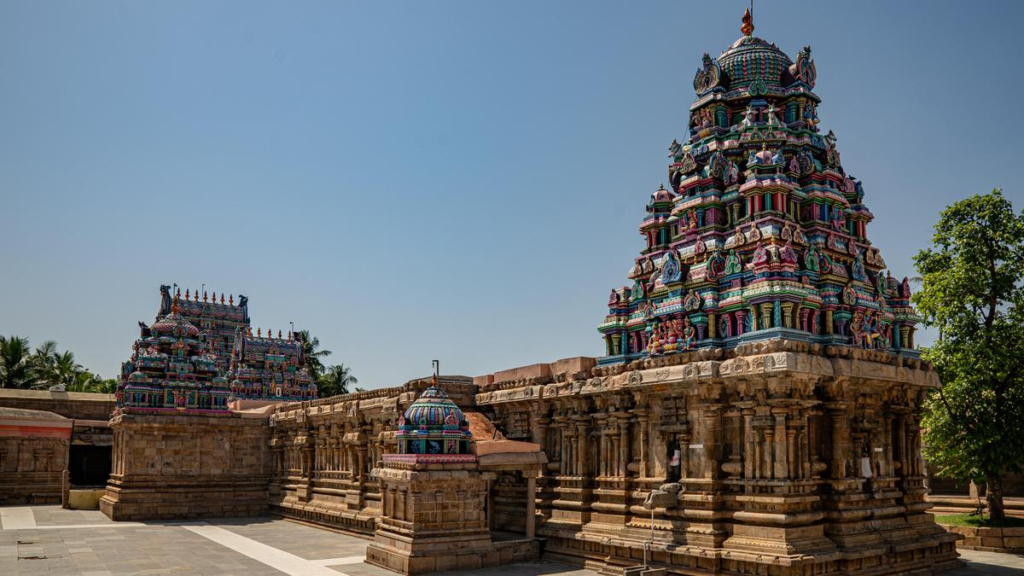
- The 12th-century Abathsahayeswarar Temple at Thukkachi was restored after decades of neglect.
Abathsahayeswarar Temple
- It is situated at Thukkachi, near Kumbakonam in Thanjavur district of Tamil Nadu.
- It is one of the most significant monuments of the later Chola period—closely associated with Kulotunga I and Vikrama Chola
- It is designed as a Kara Kovil—a temple conceived in the form of a chariot
- It also houses the idol of Lord Sarabeshwarar which is considered one of the oldest depictions of the deity.
Temple’s restoration
- The temple’s restoration earned the UNESCO Asia Pacific Award of Distinction (2024) for its attempt to maintain the temple’s heritage while reinforcing its structural integrity.
- The project combined traditional temple building practices (Sthapatya Veda, Agama Shastra, lime mortars) with modern technologies like drone surveys, digital mapping, photogrammetry and structural engineering.
- Every granite block was numbered, disassembled and then reassembled in its original position to preserve historical authenticity.
Jagannath Rath Yatra
Art & Culture

Context
- The world-famous Rath Yatra of Lord Jagannath has commenced in Puri, Odisha.
Rath Yatra
- Known as – Gundicha Jatra, Ghosa Jatra and Navadina Jatra.
- It is a significant Hindu festival dedicated to Lord Jagannath, an incarnation of Lord Vishnu.
Jagannath Puri Temple
-
- Shree Jagannath Puri Temple is one of the most impressive monuments of the State of Odisha.
- The temple was built in the 12th Century AD by King Anatavarman Chodaganga Deva of the Eastern Ganga Dynasty.
- Jagannath Puri temple is called ‘Yamanika Tirtha’ where, according to the Hindu beliefs, the power of ‘Yama’, the god of death has been nullified in Puri due to the presence of Lord Jagannath, popularly known as Lord Krishna.
- It is one of the Dhammas (Holiest of the holy place) out of four Dhamas i.e. Puri, Dwarika, Badrinath & Rameswar, in India.
- This temple was called the “White Pagoda” and is a part of Char Dham pilgrimages (Badrinath, Dwaraka, Puri, Rameswaram).
Mobile Phone Manufacturing Scheme (MPMS)
Economy
In News
- The Union Cabinet approved a new Mobile Phone Manufacturing Scheme (MPMS) with a budgetary outlay of ₹62,500 crore.
Objective –
- It has been launched to scale up domestic production, deepen component localization, and foster indigenous smartphone design and R&D.
- Launched by: It has been launched by Ministry of Electronics and Information Technology (MeitY).
- Duration: It is a five-year scheme, which will run from FY 2026-27 to FY 2030-31.
- Budget Outlay: Its budgetary outlay is of Rs. 62,500 crore.
Features
- Production-Linked Incentives: The scheme provides incentive support on eligible sales of mobile phones manufactured in India, with differentiated incentive rates ranging from 2.25% to 5%, based on the applicable eligibility criteria.
- Incentive for Domestic Value Addition: Manufacturers can receive an additional incentive of up to 1.5% for increasing domestic sourcing of key components and sub-assemblies, thereby promoting local manufacturing ecosystems.
- Support for Design and Innovation: To foster indigenous innovation and brand creation, the scheme offers an additional 3% incentive on eligible sales for companies undertaking product design and R&D activities in India.
Semicon 2.0
Economy
Context
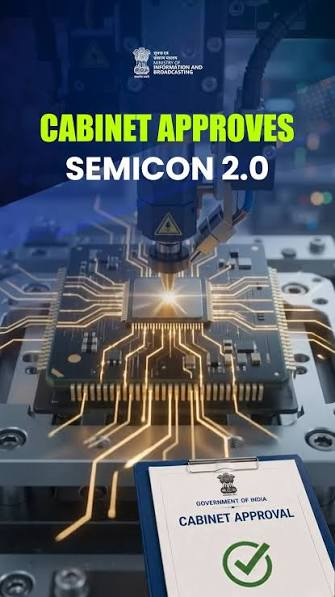
- The Union Cabinet approved Semicon 2.0 (India Semiconductor Mission 2.0) with a ₹1,27,500 crore outlay to develop India’s semiconductor ecosystem.
Six Strategic Pillars:
- Design:
- Machines & Materials:
- Fabrication:
- Expanding Assembly, Testing, Marking, and Packaging (ATMP) and Outsourced Semiconductor Assembly and Test (OSAT) units to establish India as a global alternative.
- R&D
- Talent Development
India Semiconductor Mission (ISM)
- Launched by – Ministry of Electronics and Information Technology.
- Aim – To build a vibrant semiconductor manufacturing ecosystem to enable India’s emergence as a global hub for electronics manufacturing and design.
Connect with the basics – Semiconductor Chips
- These are materials which have a conductivity between conductors and insulators.
- Example – They can be pure elements, silicon or germanium or compounds; gallium, arsenide or cadmium selenide.
- Significance of Semiconductor Chips – They are the basic building blocks that serve as the heart and brain of all modern electronics and information and communication technology products.
- Applications – These chips are now an integral part of contemporary automobiles, household gadgets and essential medical devices such as ECG machines.
12th BRICS Labour & Employment Ministers’ Meeting
International
Context –
-
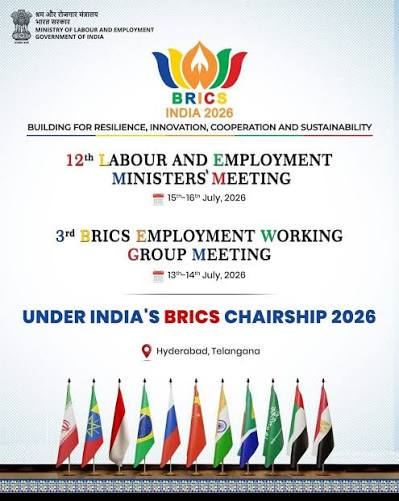
- India hosted the 12th BRICS Labour & Employment Ministers’ Meeting in Hyderabad.
- Theme 2026 – “Building for Resilience, Innovation, Cooperation and Sustainability“.
Outcomes –
- BRICS Labour and Employment Ministers’ Declaration – to promote decent work, broaden social protection systems, and support inclusive, resilient economic growth.
- BRICS CONNECT, a collaborative, tech-driven platform, was launched by India to modernise, align, and strengthen labour frameworks (South-South cooperation) across member states.
Additional Information – BRICS
-
- Founded in – 2009
- HeadQuarters – Shanghai
- It is an acronym for the grouping of the world’s leading emerging economies, namely Brazil, Russia, India, China, and South Africa (included in 2010)
- Origin – The term “BRIC” was coined by the British Economist Jim O’Neill in 2001 to describe the four emerging economies of Brazil, Russia, India, and China.
- Recent Expansion (BRICS+): In 2024–2025, the bloc expanded to include Egypt, Ethiopia, Iran, the UAE, and Indonesia. Saudi Arabia has received an invitation but has not yet formalized its membership.
- Share of BRICS – BRICS brings together five of the largest developing countries, representing 41% of the global population, 24% of the global GDP, and 16% of the global trade (By 2028, BRICS is expected to make up 35 percent of the global economy)
- Chairmanship – The chairmanship of the forum is rotated annually among the members.
Initiatives of BRICS
- New Development Bank (NDB)
- Contingent Reserve Arrangement (CRA)
- BRICS Payment System
- Customs Agreements
- Constellation of Remote Sensing Satellites












Leave a Reply