
Taj Mahal
History and Culture
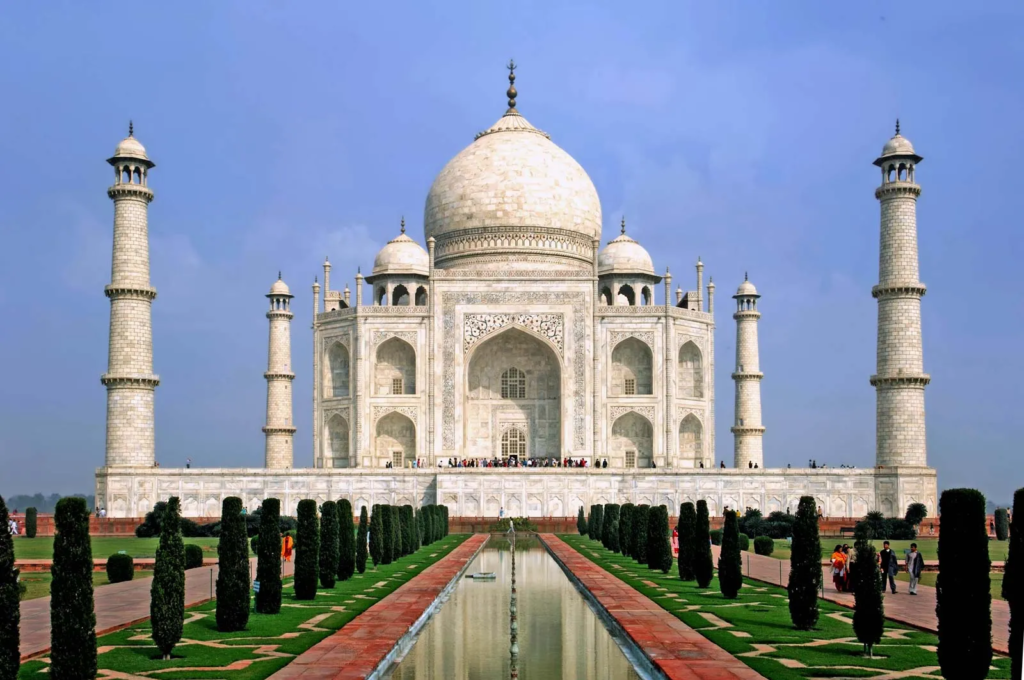
Context
- The Allahabad High Court has issued notices to the Union Government and the Archaeological Survey of India (ASI) on a petition seeking a survey of the Taj Mahal, claiming it is a Hindu temple called “Tejo Mahalaya.”
Taj Mahal
-
- The Taj Mahal is a 17th-century Mughal mausoleum located on the right bank of the Yamuna River in Agra and was declared a UNESCO World Heritage Site in 1983.
- It was built by Mughal Emperor Shah Jahan in memory of his wife Mumtaz Mahal (Arjumand Bano Begum) with construction starting in 1632 AD and completed in 1648 AD.
- In Mughal records, it was referred to as “Rauza-i-Munavvara” (Illuminated Tomb).
- Chief architect: Ustad Ahmad Lahori.
- The land for the monument was acquired from Mirza Raja Jai Singh of Amber, who was compensated by Shah Jahan.
- Architectural Features: The Taj Mahal represents the zenith of Mughal architecture, combining Persian, Timurid, and Indian architectural traditions.
Key features include:
- White Makrana marble
- Perfect bilateral symmetry
- Charbagh garden layout
- Quranic calligraphy
- Islamic funerary design elements
- Extensive Pietra dura, a decorative technique in which semi-precious stones are inlaid into marble to create intricate floral and geometric patterns.
Birth Anniversary of Mangal Pandey
History
Context
- Prime Minister Narendra Modi has paid tribute to the great revolutionary and freedom fighter Mangal Pandey on his birth anniversary.
Mangal Pandey
- Born on 19 July 1827 in Nagwa village, Ballia (present-day UP), into a Bhumihar Brahmin family.
- He joined the East India Company’s army at 22, serving in the 34th Bengal Native Infantry.
- The spark of Revolt: The British had just introduced the Enfield rifle, whose cartridges had to be bitten open to load and word spread that they were greased with beef and pork fat.
- For Hindu and Muslim sepoys alike, this was deeply offensive. Mangal Pandey refused to use it, and on 29 March 1857 at Barrackpore, he fired the first shot of rebellion at his Sergeant Major.
- That one act set off the Revolt of 1857 variously called the Sepoy Mutiny or India’s First War of Independence.
- Pandey was court-martialled and hanged on 8 April 1857. His regiment was disbanded later.
- Aftermath: On 10 May 1857, sepoys in Meerut rose up, and things escalated quickly into a full-blown national revolt. They marched to Delhi and convinced the elderly Bahadur Shah II, the last Mughal emperor to become their symbolic leader.
- The British recaptured the Red Fort by September 1857, and Bahadur Shah was exiled to Rangoon, where he died in 1862.
- As a Result: The revolt ended East India Company rule for good. The British Crown took direct charge through Queen Victoria’s Proclamation of 1858 and the Government of India Act, 1858 replacing the Governor-General with a Viceroy. Lord Canning became India’s first Viceroy.
Museum of Word
Polity
Context
- The Union Home Minister inaugurated the first phase of the ‘Museum of Word’ in Kolkata.
About
- It is developed by the National Library under the aegis of the Union Culture Ministry.
- It is the first immersive language museum in the country, also known as Shabdalok.
- It celebrates India’s 22 official languages and traces their journey from oral traditions and ancient manuscripts to printed works and modern electronic texts.
- The museum features nine galleries exploring different facets of the history of languages and their influence on India’s civilisation and culture.
- Significance – It seeks to present language as a living entity that has continuously shaped society while also being shaped by it.
Eighth Schedule
- The Eighth Schedule to the Constitution of India lists the official languages of the Republic of India.
- Part XVII of the Indian Constitution deals with the official languages in Articles 343 to 351.
The Eighth Schedule includes the recognition of the following 22 languages:
- Assamese, Bengali, Gujarati, Hindi, Kannada, Kashmiri, Konkani, Malayalam, Manipuri, Marathi, Nepali, Odia, Punjabi, Sanskrit, Sindhi, Tamil, Telugu, Urdu, Bodo, Santhali, Maithili and Dogri are the 22 languages presently in the Eighth Schedule to the Constitution.
- Of these languages, 14 were initially included in the Constitution.
- Subsequently, Sindhi was added in 1967; Konkani, Manipuri and Nepali were added in 1992; and Bodo, Dogri, Maithili and Santali were added by the 92nd Amendment Act of 2003.
Right to Protest
Polity
In News
- Recently, Delhi Police stated that the Cockroach Janta Party (CJP) has no permission to continue the protest at Jantar Mantar or to hold the proposed march to Parliament.
Laws governing the right to protest
-
- In India, the right to protest is protected under Article 19(1)(a) of the Constitution that guarantees freedom of speech and expression and
- Article 19(1)(b) that guarantees the right to assemble peacefully without arms.
- But it is subject to such reasonable restrictions as are necessary for maintaining public order, security and other constitutional interests.
- Conditions : Law and order is a State subject and each state has its own rules for granting permission for protests and public gatherings.
- Section 163 of the Bharatiya Nagarik Suraksha Sanhita (BNSS) too allows authorities to issue prohibitory orders and bar any continuing protests.
- But there must be reasons for any refusal or withdrawal of permission, stating the risks or threats involved.
72nd National Film Awards for the year 2024
Miscellaneous
Context
- The 72nd National Film Awards, which honoured films that received certification from the Central Board of Film Certification (CBFC) during the 2024 calendar year, were announced.
About
- National Film Awards are the most prestigious awards, which are announced annually to honor the best filmmaking talent across the country.
- It aims at encouraging the production of films of aesthetic and technical excellence and social relevance.
- The awards are given in three sections – Features, Non-Features and Best Writing on Cinema.
History
- The awards were first presented in 1954 and were known as the ‘State Awards’.
- At the time, only best films in different regional languages were recognised and awarded.
- Separate awards for artists and technicians were instituted in 1968 for the films of 1967.
- Nargis Dutt and Uttam Kumar being the first actress and actor to get the Best Actress and Best Actor Awards respectively.
Key Recipient of the Awards
- Best Feature Film: Article 370 (Hindi)
- Best Non-feature film: Bhangaar (Marathi & English)
- Best Documentary: Ram-Nami (Hindi)
- Best Actor: Mammootty (Bramayugam) and Kartik Aaryan (Chandu Champion).
- Best Actress: Yami Gautam (Article 370)









Leave a Reply