
Corporate Mitra Scheme
Government Schemes
Context
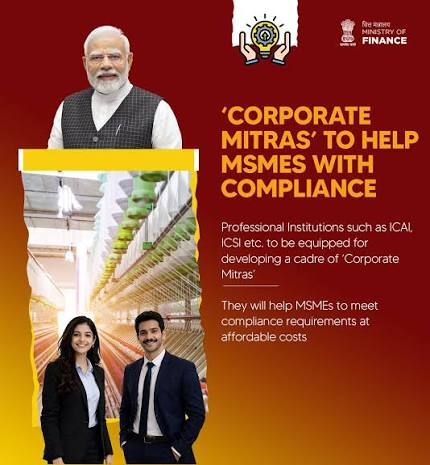
- The Indian Institute of Corporate Affairs (IICA), Shillong organised a webinar for awareness of the Corporate Mitra Scheme.
Corporate Mitra Scheme
- Launched in – Budget 2026–27
- Implementation – It is an initiative of the Ministry of Corporate Affairs (MCA) and administered by Indian Institute of Corporate Affairs (IICA).
- Objective – It trains young graduates to provide affordable regulatory and accounting compliance support to MSMEs in Tier-2 and Tier-3 cities.
Ecologically Sensitive Area (ESA) in the Western Ghats
Environment
News
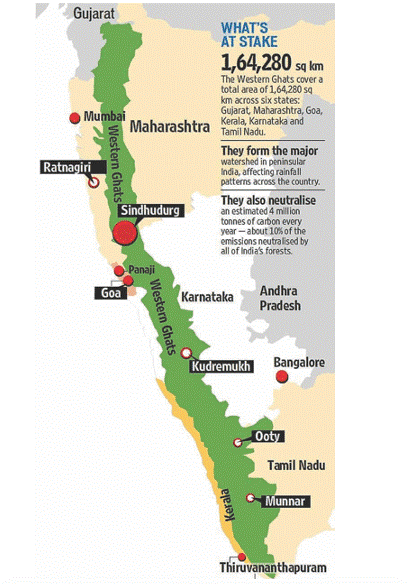
- The Centre has issued the seventh draft notification to notify 56,825.7 sq km of Western Ghats across Gujarat, Maharashtra, Goa, Karnataka, Kerala and Tamil Nadu as an Ecologically Sensitive Area (ESA).
Western Ghats
-
- Forests – The region of Western Ghats has moist deciduous forests and rainforests.
- Endemism – The region shows high species diversity as well as high levels of endemism.
- Nearly 77% of the amphibians and 62% of the reptile species found here are found nowhere else.
|
Facts on Western Ghats
|
Additional Information – Committees related to Western Ghats
Sanjay Kumar Committee:
- Objective – It is formed to review state objections on Ecologically sensitive zones demarcations and validate proposed exclusions.
- Significance- It seeks to finalize the ESA status for villages, restricting activities harmful to biodiversity.
Madhav Gadgil Committee (2011):
-
- Objective – to propose protection measures for the Western Ghats.
- It recommended designating the entire Western Ghats as ecologically sensitive.
- It proposed the creation of a dedicated ecological authority to regulate development.
- The Report suggested rigorous conservation, but its recommendations were not fully adopted.
Kasturirangan Committee (2012):
-
- It is formed as a follow-up to the Gadgil Committee to provide a more moderate approach.
- It recommended demarcating 37% of theWestern Ghats as eco sensitive zones.
- It emphasizes a balance between conservation and developmental needs, allowing limited activity in specific areas.
Eco Sensitive Zones
- Notified by – These are notified by the Ministry of Environment, Forest and Climate Change (MoEFCC) under the Environmental (Protection) Act, 1986.
- Definition – The land falling within 10 km of the boundaries of national parks and wildlife sanctuaries are notified as eco-fragile zones or Eco-Sensitive Zones (ESZs).
Activities in ESZs
- Prohibited Activities: Commercial mining, saw mills, industries causing pollution (air, water, soil, noise etc), establishment of major hydroelectric projects (HEP), commercial use of wood.
- Regulated Activities: Felling of trees, establishment of hotels and resorts, commercial use of natural water, erection of electrical cables, drastic change of agriculture system.
- Permitted Activities: Ongoing agricultural or horticultural practices, rainwater harvesting, organic farming.
DWEEPTI Yojana
Government Schemes

Context
- Chhattisgarh has launched the DWEEPTI Yojana.
About
- Full form – Decentralised Women Empowerment on Energy and Policy for Transformative Inclusion)
- Objective – It is the first state-level policy in India to formally integrate women-led SHGs into the distributed renewable energy value chain.
- The scheme is aimed at creating 5,000 enterprises in the sector of women-led renewable energy in five years, along with 50,000 jobs, while extending energy to 5 lakh families and 10,000 public institutions across the state.
- Significance – The scheme helps women acquire technical skills for the installation of roof top solar power systems, their maintenance, operation, and interactions with communities through a cluster of skilled “Solar Didis” for decentralized renewable energy systems deployment.
















Leave a Reply