
Closure of FRA Cells in Odisha Triggers Central Scrutiny
Syllabus: GS2/ Governance
Context
- The Union Ministry of Tribal Affairs has initiated inquiries into the directives given by the State government of Odisha to shutdown of Forest Rights Act (FRA) Cells at multiple administrative levels.
Forest Rights Act, 2006
- The Scheduled Tribes and Other Traditional Forest Dwellers (Recognition of Forest Rights) Act, 2006, popularly known as the Forest Rights Act (FRA).
- It legally recognizes the rights of forest-dwelling Scheduled Tribes and other traditional forest dwellers over forest land and resources they have traditionally used for generations.
VoicERA Launched on BHASHINI National Infrastructure
Governance
In News
- The Digital India BHASHINI Division (DIBD), under the Digital India Corporation (DIC), Ministry of Electronics and Information Technology (MeitY) launched VoicERA.
India’s National Voice AI Stack (VoicERA)
- It is an open-source, end-to-end technology framework designed as DigitalDigital Public Infrastructure (DPI)
- Public Platform: Deployed on the BHASHINI National Language Infrastructure to provide a national execution layer for multilingual voice services.
- Purpose: To enable government departments and innovators to build voice-based citizen services—such as agricultural advice, education support, and grievance redressal—in local Indian languages.
Food Corporation of India (FCI) and the World Food Programme (WFP)
Economy
In News
- The Food Corporation of India (FCI) and the World Food Programme (WFP) have signed a Memorandum of Understanding (MoU) for the supply of rice in support of global humanitarian operations aimed at combating hunger.
World Food Programme
- It was established in 1961.
- Mandate – It serves as the United Nations’ primary food-assistance branch and the world’s largest humanitarian organization focused on combating hunger and enhancing global food security.
Food Corporation of India (FCI)
- It is a statutory body established under the Food Corporations Act, 1964.
- It functions under India’s Ministry of Consumer Affairs, Food and Public Distribution.
- Objective – It ensures national food security via procurement, storage, distribution under the Public Distribution System (PDS), and buffer stock management for contingencies like droughts or floods.
- Headquartered in New Delhi.
Municipal Bonds
Syllabus: GS3/ Economy
In News
- The Ministry of Housing and Urban Affairs (MoHUA) recently organized a high-level consultation to deepen India’s municipal bond market, aligning with efforts to boost urban infrastructure financing.
Municipal Bonds
- Municipal bonds are marketable debt instruments issued by ULBs, either directly or via intermediaries like corporate municipal entities or special purpose vehicles.
- First issued by Bengaluru in 1997, they finance capital projects (e.g., water supply, sewerage), refinance loans, and cover working capital needs.
Project Vault
Syllabus: GS3/Economy
Context
- The United States unveiled Project Vault, an independently governed and operated public-private partnership.
Project Vault
- It is aimed at establishing a strategic domestic reserve of critical minerals in the United States.
- Significance – to reduce dependence on foreign-controlled supply chains.
Additional Information – Critical Minerals
- These are minerals that are essential for economic development and national security.
- The lack of availability of these minerals could potentially lead to “supply chain vulnerabilities and even disruption of supplies”.
List of Critical Minerals
- A total of 30 minerals were found to be most critical for India : Antimony, Beryllium, Bismuth, Cobalt, Copper, Gallium, Germanium, Graphite, Hafnium, Indium, Lithium, Molybdenum, Niobium, Nickel, PGE, Phosphorous, Potash, Rare Earth Elements (REEs), Rhenium, Silicon, Strontium, Tantalum, Tellurium, Tin, Titanium, Tungsten, Vanadium, Zirconium, Selenium and Cadmium.
India’s Policy Push for Mineral Exploration
- Domestic Reserves: India has vast untapped mineral potential, with lithium in Jammu and Kashmir (J&K) and Rajasthan, and REEs in Odisha and Andhra Pradesh.
- Policy Initiatives: National Mineral Exploration Policy (NMEP), 2016 and Mines and Minerals (Development and Regulation) Act, 2021 have accelerated exploration through private participation and advanced surveys.
- KABIL (Khanij Bidesh India Ltd) is acquiring overseas mineral assets to ensure supply security.
- National Critical Mineral Mission (NCMM) – It aims to strengthen the value chain from exploration to recovery.
Google’s America-India Connect Initiative
Syllabus: GS3/Science and Technology
Context
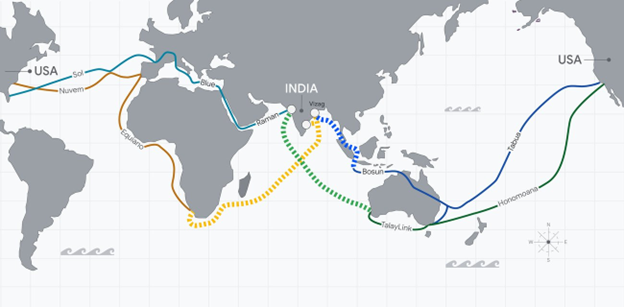
- Google announced the collaborative infrastructure initiative named America-India Connect.
America-India Connect Initiative
- A new international subsea gateway will be established in Vizag.
- Three new subsea paths connecting India to Singapore, South Africa, and Australia.
- Significance – The new infrastructure is expected to support rising demand for cloud computing and AI services in India, while also strengthening connections with Africa, Australia and parts of Southeast Asia.
Vibrant Villages Programme–II
Syllabus: GS2/ Governance
In News
- The Vibrant Villages Programme–II is a Central Sector Scheme launched by the Union Home Minister at Nathanpur village in Assam’s Cachar district.
Vibrant Village Programme(VVP)
- LAunched by – Ministry of Home Affairs (MHA).
- Aim: To enhance infrastructure in villages along India’s border with China, in states like Himachal Pradesh, Uttarakhand, and Arunachal Pradesh.
- Activities under the VVP include: building infrastructures such as housing, tourist centres, road connectivity, providing decentralized renewable energy, direct-to-home access for Doordarshan and educational channels, and support for livelihood generation.
Trump’s Board of Peace
Syllabus: GS2/ IR
In News
- India participated as an observer in the recent inaugural meeting of US President Donald Trump’s Board of Peace on Gaza, held in Washington DC and hosted at the Donald J Trump Institute of Peace.
Board of Peace
- It is an international body chaired by US President Donald Trump, created to oversee the October 2025 ceasefire in the Israel-Hamas war and manage Gaza’s post-war transition.
- The initiative was proposed in October 2025 and was endorsed the following month by the United Nations Security Council.
Members
- Around 35 global leaders have agreed to join the proposed Board of Peace, out of about 50 invited.
- Participants include key Middle Eastern allies such as Israel, Saudi Arabia, the UAE, Bahrain, Jordan, Qatar and Egypt, along with NATO members Turkey and Hungary. Several other countries across Asia, Africa, Europe and Latin America—including Pakistan, Indonesia, Vietnam, Morocco, Armenia and Azerbaijan—have also joined.
- Membership terms would run for three years, with the option of renewal.
- Countries seeking to extend their participation beyond the initial term may be required to contribute $1 billion, while short-term participation would not involve any financial commitment.
Mandate of Board
- The Board will supervise a transitional Palestinian technocratic administration in the Gaza Strip, known as the National Committee for the Administration of Gaza (NCAG).
- The Board’s mandate also includes efforts to disarm Hamas and oversee the deployment of an International Stabilization Force (ISF), a multinational peacekeeping mission tasked with maintaining security and training a new Palestinian police force.
Bharat GI
Syllabus: GS3/ Economy
In News
- ‘Bharat GI’, a national initiative to promote India’s Geographical Indication-tagged products globally, was highlighted at the India AI Impact Summit 2026.
Bharat GI
- It serves as an umbrella brand showcasing unique Indian GI products like Coorg coffee and Darjeeling tea on international platforms.
- It is launched by the Department for Promotion of Industry and Internal Trade (DPIIT), Ministry of Commerce.
- It leverages digital tools, including AI-driven traceability and market analytics, to connect artisans directly with global buyers.
Additional Information – Geographical Indication or GI Tag
- It is a name or a sign given to certain products related to a specific geographical location or origins like a region, town, or country.
- A certification for unique products – GI Tag may be regarded as a certification for a particular product with certain specific qualities or has a specific reputation because of its geographical origin.
- GI Tags can be issued for wine and spirit drinks, foodstuffs, agricultural products, handicrafts, and industrial products.
- Trade-Related Aspects of Intellectual Property Rights (TRIPS) – At the International level, GI is governed by the World Trade Organisation’s (WTO’s) Agreement on Trade-Related Aspects of Intellectual Property Rights (TRIPS).
- Geographical Indications of Goods (Registration and Protection) Act – In India, Geographical Indications registration is administered by the Geographical Indications of Goods (Registration and Protection) Act, 1999, which came into force in September 2003.
- Darjeeling tea – The first product in India to be accorded with the GI tag was Darjeeling tea in 2004-05.
India–UK Offshore Wind Taskforce
Syllabus: GS2/IR
News
- India and the United Kingdom launched the India–UK Offshore Wind Taskforce.
India–UK Offshore Wind Taskforce
- Objective – to provide strategic leadership and coordination for building India’s offshore wind ecosystem.
- Significance- It is aimed at accelerating cooperation in offshore wind development as part of their broader clean energy partnership under Vision 2035.
|
Do you know? ● Global Rank: India ranks 4th in the world for total installed wind power capacity after China, USA, and Germany. ● Installed Capacity: As of late 2025, India’s cumulative wind power capacity reached approximately 54 GW. ● Top States: Gujarat currently leads in installed capacity, followed by Tamil Nadu, Karnataka, Maharashtra, and Rajasthan |














Leave a Reply