
Nobel Prize in Physics 2026
Science & Technology
Context
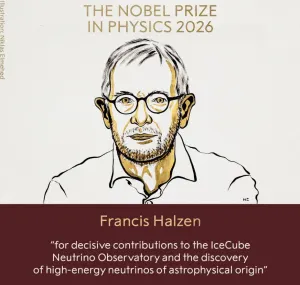
- The 2026 Nobel Prize in Physics has been awarded to Francis Halzen for his pioneering contribution to the IceCube Neutrino Observatory and the discovery of high-energy neutrinos of astrophysical origin.
IceCube Neutrino Observatory
- Location: South Pole, Antarctica.
- Objective: Detect high-energy astrophysical neutrinos.
- Scale: Approximately 1 cubic kilometre of Antarctic ice.
- Components: 5,160 optical sensors called Digital Optical Modules (DOMs).
- Completed: 2010.
- Significance: Helps identify distant astrophysical sources and study extreme cosmic events.
Connect with the basics – Neutrinos
- Definition: Electrically neutral, extremely light subatomic particles that interact very weakly with matter.
- Origin: Produced in the Sun, stars, supernovae, nuclear reactors and radioactive decay.
- Types (Flavours): Electron neutrino, muon neutrino and tau neutrino.
- Key Property: Neutrino oscillation — neutrinos change from one flavour to another as they travel.
- Detection: Requires highly sensitive detectors, often located deep underground to reduce background interference.
- Significance: Helps study the Sun, supernovae, the early universe and fundamental particle physics.
India-based Neutrino Observatory (INO):
- Proposed at Pottipuram, Theni district, Tamil Nadu.
-
- Planned a 50,000-tonne magnetised Iron Calorimeter (ICAL) detector.
- Intended to study atmospheric neutrino oscillations and matter effects inside the Earth.
India’s First-Ever Household Travel Survey
Economy
Context
- The National Statistics Office (NSO) of the Ministry of Statistics and Programme Implementation has conducted the first-ever all-India survey on household travel between July 2025 and June 2026.
All-India Household Travel Survey (2025–26)
- Conducted by: National Statistics Office (NSO), MoSPI.
- Purpose: To collect data on household travel patterns, mobility, transport choices and travel expenditure across India.
- Key Focus: Trip frequency, purpose of travel, mode of transport, distance travelled and associated costs.
- Significance: Helps assess transport accessibility, urban and rural mobility, infrastructure needs and sustainable transport planning.
Key Findings
- Work commute: Two-wheelers are the predominant mode, used by 42.6% of workers.
- Overnight travel: Buses and railways account for 73.5%; cars 15.1%; two-wheelers 8.8%.
- Gender gap: Daily work trips exceeding 1 km are undertaken by 61.9% of male workers and 41.9% of female workers.
- Average monthly commuting expenditure: ₹785 per worker.
- Urban: ₹1,044; Rural: ₹612.
- Male: ₹835; Female: ₹533.
Indian Navy’s first indigenous fleet support ship ‘Surya’
Defence

Context
- Defence Minister Rajnath Singh launched ‘Surya’, the Indian Navy’s first indigenously built Fleet Support Ship (FSS-1), in Visakhapatnam.
About
- Builder: Hindustan Shipyard Limited (HSL), Visakhapatnam.
- Significance: First of five indigenously built Fleet Support Ships for the Indian Navy.
- Displacement: ~43,500 tonnes; speed: 20 knots.
- Role: Supplies fuel, fresh water, ammunition, spare parts and provisions to warships at sea.
- Features: Helicopter deck and self-defence systems.
- Importance: Enhances naval operational endurance and India’s maritime presence across the Indian Ocean Region (IOR).
Nobel Prize in Chemistry 2026
Science & Technology

Context
- The 2026 Nobel Prize in Chemistry has brought global attention to chirality and homochirality, highlighting how chemical reactions can selectively produce one mirror-image form of a molecule.
Nobel Prize in Chemistry 2026 — UPSC
- Recipients: Henri B. Kagan and Kenso Soai.
- Recognised for: Research on generating and amplifying one enantiomer over its mirror image.
- Applications: Pharmaceuticals, agriculture, flavours and fragrances.
Chirality
- Definition: Property of a molecule that cannot be superimposed on its mirror image, like left and right hands.
- Enantiomers: Mirror-image forms of a chiral molecule with different three-dimensional arrangements.
- Homochirality: Preference for one molecular form in living organisms.
- Proteins: Predominantly contain L-amino acids.
- Sugars: Most biological sugars belong to the D-series.
- Significance: Helps explain molecular handedness, the origin of life and the synthesis of specialised chemicals.
Living Planet Report, 2026
Environment

Context
- The World Wide Fund for Nature (WWF) released the Living Planet Report 2026, reporting an average 73% decline in monitored vertebrate population sizes between 1970 and 2022.
Living Planet Report 2026
- Released by – World Wide Fund for Nature (WWF) based on the Living Planet Index (LPI) produced by the Zoological Society of London (ZSL).
- Coverage: 35,803 population trends across 5,790 vertebrate species (1970–2022).
Key Findings
-
- Overall decline: 73% average decline in monitored vertebrate population sizes between 1970 and 2022.
- Ecosystem-wise decline:
-
- Freshwater: 85%
- Terrestrial: 69%
- Marine: 59%
- Around half of monitored populations remained stable or increased, highlighting the potential of conservation interventions.
Major Threats
- Habitat loss and degradation.
- Overexploitation of natural resources.
- Climate change.
- Invasive alien species.
- Pollution and disease.
Significance: Highlights biodiversity loss and the need for ecosystem restoration, sustainable resource use and effective conservation measures.
Ghana
Places in News
Context
- India and Ghana have signed a five-year Memorandum of Understanding (MoU) to strengthen cooperation in agricultural research, education, technology transfer and commercialisation.
Ghana (Capital: Accra) — UPSC
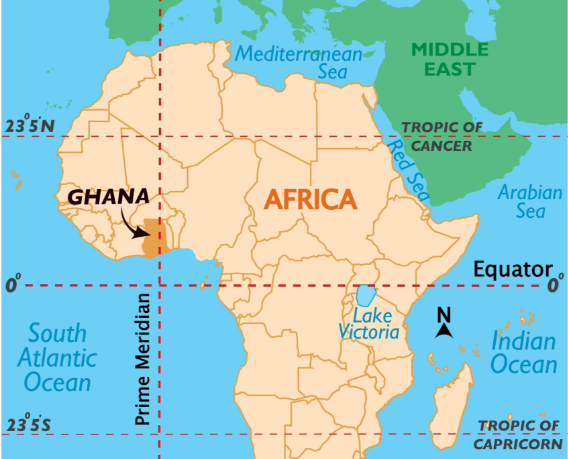
- Location: West Africa, along the Gulf of Guinea (Atlantic Ocean); crossed by the Prime Meridian and located north of the Equator.
- Political History: Gained independence from British rule on 6 March 1957 under Kwame Nkrumah; formerly known as the Gold Coast.
- Political System: Unitary multiparty republic.
- Major River: Volta River system.
- Lake Volta: One of the world’s largest artificial reservoirs; supports hydropower generation through the Akosombo Dam.
- Mineral Resources: Gold, bauxite, manganese and diamonds; also has offshore petroleum reserves.
- Agriculture: Major producer and exporter of cocoa.
- Climate:
- ITCZ: Seasonal movement influences rainfall patterns.
- Harmattan winds: Dry, dusty winds originating from the Sahara.
- Southwesterly monsoon winds: Bring moisture from the Atlantic Ocean.
Central Armed Police Forces Act Comes into Force
Polity and Governance
Context
- The Central Armed Police Forces (General Administration) Act, 2026 came into force from October 8, 2026.
Central Armed Police Forces (General Administration) Act, 2026 — UPSC
- Effective Date: 8 October 2026.
- Objective: Regulates recruitment, promotion, deputation and service conditions of officers in CAPFs.
- CAPFs Covered: BSF, CRPF, CISF, ITBP and SSB.
- IPS Deputation:
- 67% of Additional DG posts and 50% of IG posts reserved for IPS officers on deputation.
- Special DG and DG posts filled exclusively through deputation.
- Background: In 2025, the Supreme Court recognised Group A CAPF officers as an Organised Service and directed progressive reduction of IPS deputation to IG-level posts within two years.
- Significance: Highlights the debate over IPS deputation, internal promotions and career progression of CAPF cadre officers.










Leave a Reply