
Sanand as India’s Semiconductor Hub
Economy
Context
- Recently, the Prime Minister of India inaugurated a semiconductor assembly and test facility by Kaynes Semicon in Sanand, Gujarat.
-
- The project is part of the India Semiconductor Mission (ISM)
- It marks India’s push toward becoming a global semiconductor manufacturing hub.
- Sanand is being positioned as a critical link in the global semiconductor supply chain.
India Semiconductor Mission (ISM)
- Launched in – December 2021
- Implementation- Ministry of Electronics and Information Technology (MeitY). Launched in December 2021
- Objective – to build a sustainable semiconductor and display ecosystem
India-Semiconductor Mission 2.0
- It was unveiled in the Union Budget 2026–27,
- It focuses on semiconductor equipment and materials to create a “full-stack Indian semiconductor ecosystem.”
Additional Information – Government Schemes
- Design Linked Incentive (DLI) Scheme: Financial and infrastructure su pport for chip design startups; target of 100+ domestic semiconductor design firms.
- PLI Scheme for Electronics Manufacturing: Boosts demand-side ecosystem, linked with mobile manufacturing growth.
- Chips-to-Startup Programme: Access to EDA tools and fabrication support; covers 300+ institutions.
- National Critical Minerals Mission & Rare Earth Corridor: To reduce dependence on China (rare earths) and Taiwan (fabs).
Global Supply Chain & Strategic Positioning
- India’s membership in Pax Silica — a U.S.-led initiative — aims to secure supply chains for critical technologies including semiconductors and AI.
Pax Silica Initiative
- Objective – It is a US-led strategic initiative to build a secure, prosperous, and innovation-driven silicon supply chain from critical minerals.
- Members – Japan, Republic of Korea, Singapore, the Netherlands, The United Kingdom, Israel, United Arab Emirates, and Australia.
Cooperatives of India
Economy
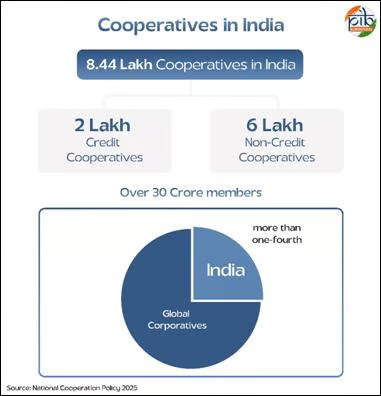
Context
- Centre has informed Lok Sabha that only 3.49 lakh cooperatives are in profit.
Connect with the basics – Cooperatives
- A cooperative (or co-op) is an organization or business that is owned and operated by a group of individuals who share a common interest, goal, or need.
- The main purpose of a cooperative is to meet the economic, social, or cultural needs of its members, rather than to maximize profits for external shareholders.
Benefits of Cooperatives
- Democratic Control: Members have a voice in decision-making.
- Economic Participation: Profits are distributed based on usage or contribution, not capital invested.
- Community Focus: Co-ops often aim to benefit local communities by keeping resources and profits within the group.
- Better Services/Prices: By pooling resources, cooperatives often offer better services or prices than for-profit businesses.
97th Constitutional Amendment Act 2011
- It established the right to form cooperative societies as a fundamental right (Article 19).
- It included a new Directive Principle of State Policy on the Promotion of Cooperative Societies (Article 43-B).
- It added a new Part IX-B to the Constitution titled “The Co-operative Societies” (Articles 243-ZH to 243-ZT).
Legal Framework and Support for Cooperatives:
- In India, cooperatives are governed by the Cooperative Societies Act, which is implemented at both the state and national levels.
- The Multi-State Cooperative Societies Act (2002): This law regulates cooperatives that operate in more than one state.
- The National Cooperative Policy (2002): Aimed at creating an enabling environment for the cooperative movement, it focuses on improving governance, member participation, and financial sustainability.
- The Ministry of Cooperation: Established in 2021, this ministry focuses on supporting the growth of cooperatives in India, including reforming their governance and providing financial support.
- National Cooperation Policy 2025: It aims to build on the unique strengths of India’s cooperative tradition, promote economic democratization, and uplift rural economies through collective participation.
Bab el-Mandab Strait
Geography
In News
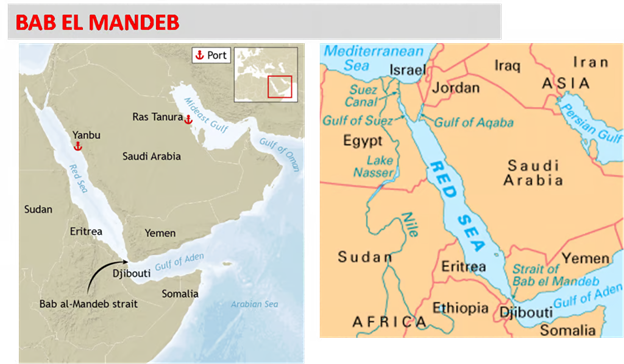
- Concerns have risen over the possible disruption of the Bab el-Mandab Strait, following the entry of the Iran-backed Houthis of Yemen into the ongoing Middle East conflict.
Bab el-Mandab Strait
- It is also known in Arabic as the “Gate of Tears,” is located at the southern tip of the Red Sea.
- It lies between Yemen on one side and the Horn of Africa on the other.
- It connects the Red Sea with the Gulf of Aden, and further with the Indian Ocean.
- It is one of the world’s most important maritime chokepoints.
Strategic Importance
- The Bab el-Mandab accounts for roughly 10–12% of global oil and natural gas shipments.
- It is strategically important because it connects with the Suez Canal, which further links it to the Mediterranean Sea.
- It is also linked to the SUMED pipeline, making it a vital corridor for global energy and trade flows.
Additional Information – SUMED (Suez-Mediterranean) pipeline
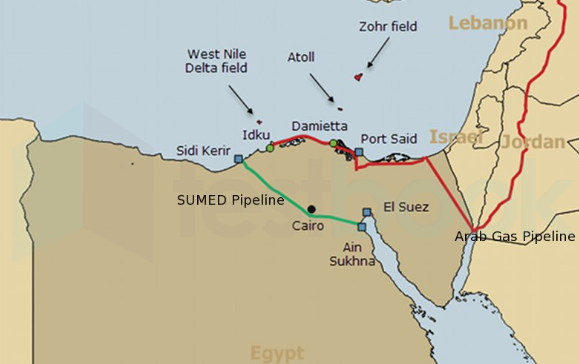
- It is a 200-mile pipeline in Egypt connecting Ain Sukhna on the Red Sea to Sidi Kerir on the Mediterranean.
- It is a strategic alternative to the Suez Canal for transporting Persian Gulf oil to Europe and North America,
Key Details :
- Purpose: Key crude oil transportation route to bypass the Suez Canal, vital for energy security during congestion.
- Route: Connects Ain Sukhna (Gulf of Suez, Red Sea) to Sidi Kerir (near Alexandria, Mediterranean).
- Capacity: Roughly 2.5 million barrels per day.
- Ownership: Operated by the Arab Petroleum Pipeline Company (joint venture between Egypt, Saudi Arabia, Kuwait, UAE, and Qatar).
Samrat Samprati
Art & Culture
In News
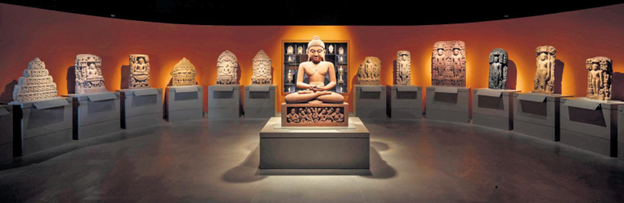
- The Prime Minister inaugurated the Samrat Samprati Sangrahalay (Jain Heritage Museum) at Koba Tirth in Gandhinagar, Gujarat.
Samrat Samprati
-
- A Mauryan emperor and grandson of emperor Ashoka.
- Also known by the names Indrapalit, Sangat, and Vigatashok.
- His life is described in Jain scriptures including Sampratikatha, Parishistaparva, and Prabhavakcharita.
- Referred to as ‘Jain Ashoka’ for his pivotal role in spreading Jainism and the principle of ahimsa (non-violence) across the subcontinent.
- PM Modi noted that Samrat Samprati expanded ahimsa from the throne and propagated Satya (Truth), Asteya (non-stealing), and Aparigraha (non-possessiveness) with detachment and selflessness — treating power as service and sadhana. Prime Minister of India
- Known to have built and repaired many Jain temples across the subcontinent.
Indian National Space Promotion and Authorization Centre (IN-SPACe)
Science & Technology
In News
- The Indian National Space Promotion and Authorization Centre (IN-SPACe) has opened applications for the second edition of IN-SPACe’s Model Rocketry Competition.
Indian National Space Promotion and Authorisation Centre (IN-SPACe)
- It is a single-window, autonomous nodal agency under the Department of Space (DOS).
- Established by the Government of India in June 2020,
- It acts as a bridge between the Indian Space Research Organisation (ISRO) and Non-Governmental Entities (NGEs), including private companies and academia.
- Chairman: Dr. Pawan Kumar Goenka.
- Headquarters: Located in Bopal, Ahmedabad, Gujarat.
Key Functions & Roles
- IN-SPACe is responsible for promoting, enabling, authorising, and supervising the space activities of private players in India:
- Facilitation: Provides NGEs with access to ISRO infrastructure and technical expertise to build and launch space missions.
- Promotion: Focuses on expanding the Indian space economy through initiatives like the ₹500 crore Technology Adoption Fund (TAF) and the Satellite Bus as a Service (SBaaS).
Solid Waste Management (SWM) Rules, 2026
Environment
Context
- The Ministry of Environment, Forest and Climate Change has notified the Solid Waste Management (SWM) Rules, 2026.
The Solid Waste Management (SWM) Rules, 2026
- Notified by – Ministry of Environment, Forest and Climate Change (MoEFCC)
- It will come into full effect on April 1, 2026.
- These rules supersede the SWM Rules, 2016 and aim to transition India toward a Circular Economy and a “Zero Waste” model.
Key Provisions of SWM Rules, 2026
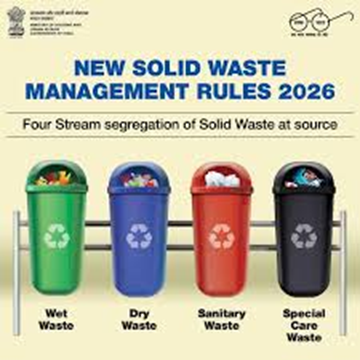
- Source Segregation: Mandates separating waste into four streams: wet, dry, sanitary, and special care (hazardous).
- Bulk Generators: Entities producing 100 kg/day must handle wet waste locally or adopt Extended Producer Responsibility (EPR).
- Fuel Usage: Industries and cement plants must increase Refuse Derived Fuel (RDF) usage from 5% to 15% within six years.
- Digital Monitoring: A centralized CPCB portal will track the entire waste life cycle.
- Compliance: Stricter “Polluter Pays” enforcement and mandatory, time-bound remediation of legacy landfill sites.











Leave a Reply