
Project Chetak celebrates 47th Raising Day
Defence
Context
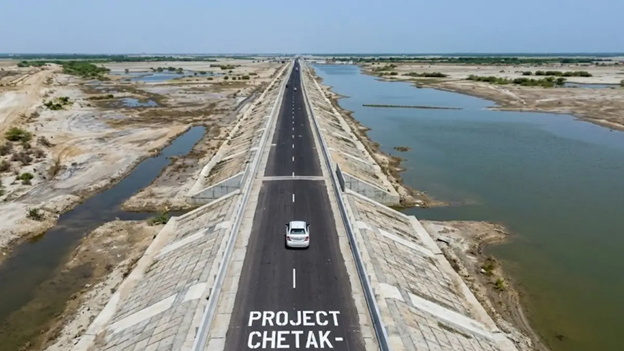
- Project Chetak of the Border Roads Organisation (BRO) celebrated its 47th Raising Day.
Project Chetak
- It is one of the largest projects of the BRO in terms of geographical area.
- Raised in 1980, it has played a key role in developing and maintaining road networks across Rajasthan, Punjab and northern parts of Gujarat.
- It supports the Defence Forces by maintaining key feeder roads towards the International Border.
Additional Information – Border Roads Organisation (BRO)
- Established in – It was formed in 1960 by Pandit Jawaharlal Nehru
- Objective – To coordinate the speedy development of an adequate road communication network of roads in the North and the North-Eastern border regions of the country.
- Functions under – It works under the administrative control of the Ministry of Defence.
- Significance – Support the armed forces meet their strategic needs by committed, dedicated and cost-effective development and sustenance of the infrastructure.
- Recent and upcoming Projects: This includes the construction of Sela Tunnel in Arunachal Pradesh on Balipara-Chariduar-Tawang Road.
BioNEST
Science and Technology
ContextProbiotics and postbiotics
- Recently, the BIRAC-BioNEST Incubation Centre was inaugurated at CSIR-CFTRI, Mysuru.
BIRAC-BioNEST Incubation Centre
- Objective – to support food bioprocessing, biotechnology research, scale-up validation, and regulatory support.
- Its main goal is to convert scientific research into market-ready products.
- Focus Areas: The startups are working in emerging areas such as Nutraceuticals, Precision fermentation, , CRISPR-based technologies and Botanicals.
|
CFTRI |
BIRAC |
|
Central Food Technological Research Institute (CFTRI), Mysuru It is a constituent laboratory of Council of Scientific and Industrial Research, New Delhi. – It came into existence during 1950. – Its vision is to pursue in-depth research and development in the areas of food science and technology. – Key areas of research CSIR-CFTRI include: a. Engineering Sciences b. Technology Development c. Translational Research d. Food Protection and Safety
– CFTRI has its Resource Centres at Hyderabad, Lucknow and Mumbai. |
Biotechnology Industry Research Assistance Council (BIRAC) – It is a not-for-profit Public Sector Enterprise, set up by the Department of Biotechnology (DBT), Government of India as an Interface Agency. – It strengthens and empowers the emerging Biotech enterprise to undertake strategic research and innovation, addressing nationally relevant product development needs.
|
Bharat Tribes Fest 2026
Polity and Governance
Context
- Bharat Tribes Fest 2026 was concluded recently.
About
- It is a flagship initiative of the Ministry of Tribal Affairs organised in association with TRIFED.
- Objective – The 19-day festival brought together tribal artisans, entrepreneurs, and self-help groups from across the country, showcasing India’s diverse tribal heritage and products.
Additional Information – Tribes of Karnataka
- Karnataka is home to approximately 50 notified Scheduled Tribes, representing about 95% of the state’s total population.
- These communities are primarily concentrated in the districts of Bellary, Raichur, Mysore , Chitradurga, and Belgaum.
Major Tribal Communities
- Naikda / Nayaka / Bedar: This is the largest tribal group in Karnataka. Historically a warrior and hunter community, they are also known by names like Valmiki and Beda.
- Gond: The second-largest tribal group in the state, primarily settled in northern districts like Bidar and Uttara Kannada.
- Jenu Kuruba: Their name literally translates to “honey people” (Jenu means honey), reflecting their traditional expertise in honey gathering in the Western Ghats.
- Soliga (Sholaga): Primarily inhabiting the Biligiriranga Hills (BR Hills), they have a deep spiritual connection to the forest and are known for practicing shifting cultivation.
- Hakkipikki: Historically semi-nomadic “bird catchers” (Hakki means bird, Pikki means catch), they claim ancestral links to the warrior clans of Rajasthan.
- Siddi: A unique ethnic group of African descent, brought to India centuries ago. They are mostly found in the forests of Uttara Kannada and are known for their distinct culture and “Kawandi” quilting art.
- Koraga: Identified as a Particularly Vulnerable Tribal Group (PVTG), they are native to coastal districts like Udupi and Dakshina Kannada and are traditional basket weavers and drum beaters.
- Yerava: Mostly found in Kodagu and Mysore, they are traditionally forest-dwellers who now often work in coffee and tea plantations.












Leave a Reply