
World Buddhist Peace Conference 2026
Syllabus: GS1/Ancient History
Context
- Hyderabad hosted the inaugural of the World Buddhist Peace Conference 2026.
About
- It is organised by Buddhavanam and Telangana Tourism Development Corporation, in association with Vietnam Buddhist Sangha.
- It brings together ministers, monks, scholars and delegates from over 20 countries in a bid to advance dialogue on peace, reconciliation and ethical leadership.
- Aim: To showcase Buddhavanam as a Buddhist Heritage Theme Park to world Buddhist countries, and to encourage them to have their monasteries and educational institutions at Buddhavanam to attract maximum footfalls from India.
- It is part of a larger global initiative aimed at positioning Telangana as a centre for Buddhist heritage diplomacy and peace-building.
Buddhavanam
- It is located in Telangana, and is India’s first Buddhist Heritage Theme Park.
- It is located on the banks of the Krishna River, it showcases the life and teachings of Lord Buddha through art, sculptures, meditation zones, and thematic installations.
- It is developed by the Telangana State Tourism Development Corporation.
Buddhism
- Buddhism is a spiritual and philosophical tradition based on the teachings of Siddhartha Gautama, known as the Buddha, who lived between roughly 563 and 483 BCE in what is now Nepal and India.
- The core of Buddhism is the understanding of human suffering, its causes, and the path to overcome it.
- Buddhism offers a path to enlightenment, which is seen as liberation from suffering and the cycle of birth, death, and rebirth (samsara).
- The ultimate goal in Buddhism is to attain Nirvana, a state of liberation from the cycle of birth, death, and rebirth.
Buddhism
- Core Teachings of the Buddha
- The Four Noble Truths
- Dukkha: Life is suffering or unsatisfactory.
- Samudaya: Suffering is caused by craving and attachment (tanhā).
- Nirodha: The cessation of suffering is possible by letting go of craving.
- Magga: The path to the cessation of suffering is the Eightfold Path.
- The Noble Eightfold Path: Grouped into three categories: wisdom, ethical conduct, and mental discipline.
The Three Marks of Existence
- Anicca (Impermanence): All things are in constant change.
- Dukkha (Suffering): Existence is filled with dissatisfaction.
- Anattā (Non-self): There is no permanent, unchanging self.
- The Goal: Nirvana (Nibbāna)
- A state beyond suffering and rebirth.
- Achieved through wisdom, ethical living, and mental discipline.
- Nirvana is the ultimate liberation and peace.
Buddhist Circuits
- In 2016, the Ministry of Tourism announced the Buddhist Circuit as the country’s first transnational tourism circuit, covering sites in Nepal and Sri Lanka alongside those in India.
- The Buddhist Circuit seeks to help tourists and pilgrims experience first-hand the teachings of Lord Buddha and trace the footsteps of Buddha.
- The main sites covered under the circuit span the life of Buddha from his birth to his Parinirvana and comprise Bodh Gaya, Vaishali, Rajgir, Kushinagar, Sarnath and Shravasti, along with Kapilavastu and Lumbini.
- Four Holiest Buddhist Sites (Chaturmahāsthāna):
- Lumbini (Nepal): Birthplace of Gautama Buddha.
- Bodh Gaya (Bihar): Attained Enlightenment under the Bodhi Tree.
- Sarnath (Uttar Pradesh): First sermon (Dhammachakra Pravartana).
- Kushinagar (Uttar Pradesh): Mahaparinirvana (death).
- About the International Buddhist Confederation (IBC)
- It was founded in 2012 following the Global Buddhist Congregation in New Delhi.
- The IBC is the world’s first organization that brings together Buddhist organizations, monastic orders, and lay institutions across 39 countries and over 320 member bodies.
- Mission: Embed Buddhist values into global conversations and foster harmony, the IBC upholds a vision of unity, compassion, and spiritual dialogue.
- Headquarters: New Delhi.
- Governing Structure: Includes both monastic and lay participation, truly reflecting the principle of collective responsibility in preserving and propagating the Buddha Dhamma.
- Source: TH
Olive Ridley Turtle Conservation in Andhra Pradesh
Syllabus: GS3/Environment
Context
- The officials of the Wildlife Management Authority and Coringa Wildlife Sanctuary have conserved nearly 20,000 eggs of Olive Ridley Turtles on Hope Island in the Kakinada Bay.
About Olive Ridley Turtles
- The olive ridley gets its name from the olive green color of its heart-shaped shell.
- These are carnivores and feed mainly on jellyfish, shrimp etc.
- Distribution: Olive ridleys are found throughout the world primarily in the tropical regions of the Pacific, Indian, and Atlantic oceans.
- Major nesting sites in India are located along the coasts of Odisha, Andhra Pradesh, and Tamil Nadu including Rushikulya rookery coast (Odisha) and Gahirmatha beach (Bhitarkanika National park).
- Features: They are known for their unique mass nesting called Arribada, where thousands of females come together on the same beach to lay eggs.
- Conservation Status:
- IUCN Red List: Vulnerable
- CITES Appendix I
- Schedule I of the Indian Wildlife (Protection) Act, 1972.
- olive ridley turtles
- Coringa Wildlife Sanctuary
- It is India’s second-largest mangrove forest, located near Kakinada in Andhra Pradesh.
- The sanctuary lies in the Godavari estuarine region, where the Godavari River meets the Bay of Bengal.
- Keystone Species: Fishing cat, smooth-coated otter, and golden jackal.
- Hope Island
- Hope Island (Krachchu Lanka) is a small tadpole shaped Island situated off the coast of Kakinada.
- It is formed from the sediment outflow carried by the waters of the Koringa River, a distributary of the Godavari.
- It is one of the safe nesting grounds of Olive Ridley Turtles in Andhra Pradesh.
- Source: TH
Khelo India Tribal Games
Syllabus: Miscellaneous
Context
- The inaugural edition of the Khelo India Tribal Games (KITG) is being held in Chhattisgarh, across three host cities—Raipur, Jagdalpur and Sarguja.
- The Games are being conducted over a ten-day period.
About
- It is the first national multi-sport event under the Khelo India programme dedicated exclusively to tribal athletes.
- The Games feature seven medal sports- athletics, football, hockey, weightlifting, archery, swimming and wrestling- along with demonstration events such as mallakhamb and kabaddi.
- Over 60,000 athletes from 30 states and UTs will play for 338 medals in the Games.
- The Games serve as a platform for talent identification, with a dedicated Talent Identification and Development committee (TIDC) deployed to scout promising athletes for further training and development under the Khelo India framework.
- Mascot: The official mascot is Morveer, derived from Chhattisgarhi words Mor (our own) and Veer (bravery).
- National Level Competitions Under Khelo India Scheme
- Khelo India Youth Games
- Khelo India University Games
- Khelo India Para Games
- Khelo India Winter Games
- Khelo India Beach Games
- Source: PIB
Tunguska Air Defence Missile System
Syllabus: GS3/Defence
Context
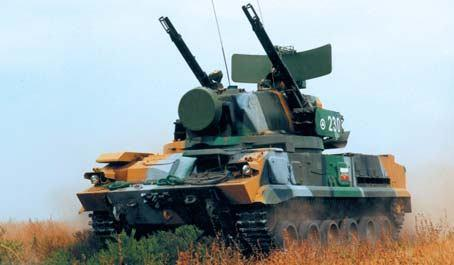
- The Ministry of Defence has signed contracts for the procurement of the Tunguska Air Defence Missile System.
About
- The Tunguska is a Soviet-origin (Inducted in early 1980s), tracked, self-propelled air defence system designed to protect ground forces from low-flying aerial threats.
- Upgraded variants: 2K22M, 2K22M1 with improved fire control and missile capability.
- NATO designation: SA-19 “Grison.”
- It uniquely combines missiles and guns on a single platform.
- Key Features
- Hybrid System: Integrates surface-to-air missiles with twin 30 mm autocannons, effective against helicopters, drones, and cruise missiles.
- Missiles:
- 9M311 series
- Range: 8–10 km
- Altitude: up to 3,500 m
- Guidance: Radio command
- Autocannons:
- Fire rate: 3,900–5,000 rounds/min
- Radar & Tracking: 360° target acquisition radar with detection range up to 18 km.
- Source: ET
Red-Crowned Roofed Turtle
Syllabus: GS3/Environment
Context
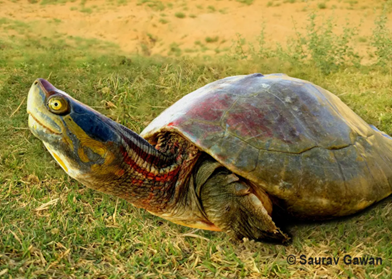
- Once a jewel of the Ganga, the Red-Crowned Roofed Turtle now survives in a rapidly shrinking habitat.
About Red-crowned roofed turtle
- Scientific Name: Batagur kachuga
- Genus: Batagur (one of three large freshwater species in India).
- Habitat: Beyond India, Bangladesh and Nepal hold only marginal habitat, with no confirmed wild populations.
- Diet: Primarily herbivorous; helps regulate aquatic vegetation and maintain nutrient cycling, supporting balanced freshwater ecosystems.
- Threats: Rampant harvest of adults and eggs, illegal trade, and habitat degradation.
- Conservation Status: Critically Endangered (IUCN Red List); protected under Schedule I of the Wild Life (Protection) Act, 1972; listed in Appendix I of CITES.
- Do you Know?
- The Indian Turtle Conservation Program, supported by Namami Gange and the Uttar Pradesh and Rajasthan forest departments, works to restore the species’ former glory.
- red-crowned roofed turtle
M e-DRIVE Scheme
Syllabus: GS3/Environment
Context
- The government has revised the PM Electric Drive Revolution in Innovative Vehicle Enhancement (PM E-DRIVE) scheme to set new deadlines and unit caps for e-scooters and e-rickshaws.
Revision of the Scheme
- The Ministry of Heavy Industries has extended subsidies for electric two-wheelers till 31 July 2026, and for electric rickshaw and electric carts till 31 March 2028.
- The maximum ex-factory price to avail an incentive is capped at ₹1.5 lakh for electric two-wheelers and ₹2.5 lakh for electric three-wheelers (e-rickshaws and e-carts).
About PM E-DRIVE Scheme
- The scheme was launched in 2024 by The Ministry of Heavy Industry.
- The scheme duration was from October, 2024 till 31st March, 2026 and is now extended to March 31, 2028.
- The EMPS-2024 (Electric Mobility Promotion Scheme) was also subsumed under the PM E-DRIVE scheme.
- The PM E-DRIVE scheme is proposed to be implemented through the following components:
- Subsidies: Demand Incentives for e-2W, e-3W, e-ambulances, e-trucks and other new emerging EV categories.
- Grants for creation of capital assets: e-buses, establishment of network of charging stations & upgradation of testing agencies of MHI, and;
- Administration of the Scheme including IEC (Information, Education & Communication) activities and fee for project management agency (PMA).
- The following categories of vehicles are eligible for support:
- Buses (only electric buses) (e-bus);
- Three-Wheelers (electric) including registered e-rickshaws & e-carts and L5 (e-3W);
- Two wheelers (electric) – e-2W;
- e-ambulances (electric, plug in hybrid & strong hybrid); and
- e-trucks and other new emerging EV categories (to be notified subsequently).
- Charging Stations: The scheme addresses range anxiety of EV buyers by promoting in a big way the installation of electric vehicle public charging stations (EVPCS).
What are Electric Vehicles?
- An electric vehicle (EV) operates on an electric motor, instead of an internal-combustion engine that generates power by burning a mix of fuel and gases.
- They are seen as a possible replacement for current-generation automobiles in order to address the issue of rising pollution, global warming, depleting natural resources, etc.
Government Initiatives
- National Electric Mobility Mission Plan (2020) and FAME-I: NEMMP was brought into effect to accelerate the adoption and production of electric vehicles (EVs).
- As part of this mission, the FAME India Scheme (Faster Adoption and Manufacturing of Hybrid and Electric Vehicles) was implemented from 2015 to 2019 to encourage the adoption of electric and hybrid vehicles.
- FAME II (Faster Adoption and Manufacturing of Electric Vehicles) — Phase II: Launched in 2019, the scheme focuses on increasing EV adoption, expanding the e-bus network, and strengthening the charging infrastructure.
- Production Linked Incentive (PLI) Scheme for Automobile and Auto Component Industry in India (PLI-Auto): Launched in 2021, the scheme aims to boost domestic manufacturing of Advanced Automotive Technologies (AAT).
- Major players like Tata Motors and Mahindra & Mahindra have stepped up with significant EV production investments.
- A key mandate is that companies must ensure at least 50% domestic value addition (DVA) to qualify for incentives.
- Scheme for Promotion of Manufacturing of Electric Passenger Cars in India 2024 (SPMEPCI): To draw global automakers to invest, the scheme grants approved applicants a five-year window to import Completely Built-in Units (CBUs) of electric four-wheelers (e-4W) valued at a minimum CIF (Cost, Insurance, and Freight) of USD 35,000 at a significantly reduced customs duty of 15%.
- India Electric Mobility Index (IEMI): NITI Aayog unveiled the India Electric Mobility Index (IEMI) in 2025. It is designed to track, measure, and compare how States and Union Territories are progressing on their electric mobility ambitions.
- Based on these results, regions are ranked as frontrunners with thriving ecosystems; Delhi, Maharashtra, and Chandigarh are leading as ‘Frontrunners’ in the recent IEMI score.
- PM e-Bus Sewa-Payment Security Mechanism (PSM) Scheme: It was notified in 2024, aims to support deployment of more than 38,000 electric buses.
- The objective of the scheme is to provide payment security to e-bus operators in case of default by Public Transport Authorities (PTAs).
- Source: TH
Birsa Munda
Syllabus: GS1/ Modern History
Context
- The Vice-President of India visited the birthplace of Birsa Munda in Jharkhand.
About
- Birsa Munda was born on 15th November 1875 in Ulihatu of the erstwhile Bengal Presidency (present day Jharkhand) .
- He was a legendary Indian tribal freedom fighter, religious leader, and folk hero from the Munda tribe.
- Birsait religion: He founded a new religion called “Birsait“ and declared himself as God’s messenger. He believed in One God.
- People of Munda and Oraon community joined the sect and challenged British conversion activities of tribals.
- He was referred to as ‘Dharti Abba or Father of Earth’ by his followers.
- Munda Rebellion: It was the tribal movement led by Birsa Munda against the oppressions of the British Raj and local exploiters (Dikus).
- It is also referred to as ‘Ulgulan’ or the ‘Great Tumult’.
- In 1900 he was arrested in Jamkopai forest and passed away in custody (due to cholera).
- Outcome: The British government introduced the Chotanagpur Tenancy Act in 1908, to prohibit the transfer of tribal land to non-tribals (Dikus).
- Janjatiya Gaurav Divas: Observed on November 15 since 2021 to honor his legacy.
- Source: HT
Zojila Pass
Syllabus: GS1/Geography
Context
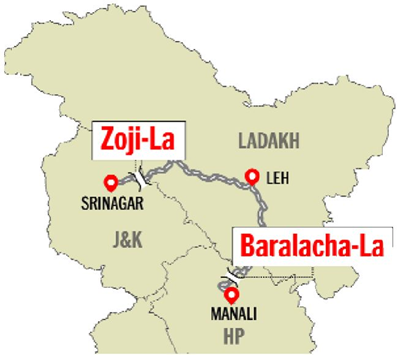
- An avalanche at the Zojila Pass claimed multiple lives, raising concerns over traffic management and safety protocols on this high-risk mountain highway.
- An avalanche is a rapid flow of snow down a slope, such as a hill or mountain.
Zojila Pass
- It is one of the most critical and challenging high-altitude passes in the world.
- It is located at 3,528 metres in Jammu and Kashmir.
- It is a vital link between the Kashmir Valley and Ladakh.
- It is known for its strategic importance and stunning Himalayan scenery.
Zojila Tunnel Project
- It is an under-construction tunnel situated at an altitude of 11,578 ft (around 3,500 metres) on the Srinagar-Leh Highway in Jammu and Kashmir.
- It will be India’s longest road tunnel, and Asia’s longest bi-directional tunnel.
- Source: AIR


Leave a Reply