
Ambedkar Jayanti
History
Context
- On April 14, India commemorates Ambedkar Jayanti, marking the 135th birth anniversary of Dr. BR Ambedkar.
Dr. Bhimrao Ambedkar
- Babasaheb Dr. Bhimrao Ambedkar was a social reformer, jurist, economist, author, polyglot (knowing or using several languages), orator, a scholar and thinker of comparative religions.
- Birth – He was born in 1891 in Mhow, Central Province (now Madhya Pradesh).
Brief Profile
- He is known as the Father of the Indian Constitution and was India’s first Law Minister.
- He was the Chairman of the Drafting Committee of the Constitution.
- He was a well-known statesman who fought for the rights of the Dalits and other socially backward classes.
Contributions
- He led the Mahad Satyagraha in March 1927 against Hindus who were opposing the decision of the Municipal Board which had barred the untouchables from using water from the mahad tank.
- In 1926, the Municipal Board of Mahad (Maharashtra) passed an order to open the tank to all communities.
- He participated in all three Round Table Conferences.
- In 1932, Dr. Ambedkar signed the Poona pact with Mahatma Gandhiji, which abandoned the idea of separate electorates for the depressed classes (Communal Award).
- However, the seats reserved for the depressed classes were increased from 71 to 147 in provincial legislatures and to 18% of the total in the Central Legislature.
- His ideas before the Hilton Young Commission served as the foundation of the Reserve Bank of India (RBI).
Election and Designation
- In 1937, he was elected to the Bombay Legislative Assembly as a legislator (MLA).
- He was appointed to the Executive Council of Viceroy as a Labour member in 1942.
- In 1947, Dr. Ambedkar accepted PM Nehru’s invitation to become Minister of Law in the first Cabinet of independent India.
Shift to Buddhism
- He resigned from the cabinet in 1951, over differences on the Hindu Code Bill. He converted to Buddhism in 1956.
- He was awarded India’s highest civilian honour the Bharat Ratna in 1990.
Important Works
Journals
- Mooknayak (1920), Bahishkrit Bharat (1927), Samatha (1929), Janata (1930).
Books
- Annihilation of Caste, Buddha or Karl Marx, The Untouchable: Who are They and Why They Have Become Untouchables
- Buddha and His Dhamma
- The Rise and Fall of Hindu Women
Organizations
- Bahishkrit Hitkarini Sabha (1923)
- Independent Labor Party (1936)
- Scheduled Castes Federation (1942)
Death
- He died on 6th December 1956.
- Chaitya Bhoomi is a memorial to B R Ambedkar, located in Mumbai.
Relevance of Ambedkar in Present Times
- Caste-based inequality in India still persists. While Dalits have acquired a political identity through reservation and forming their own political parties, they lag behind in social (health and education) and economic dimension.
9th Indian Ocean Conference
Defence/Security
Context
- The External Affairs Minister addressed the 9th Indian Ocean Conference, which was centered on the theme “Collective Stewardship for Indian Ocean Governance.”
Indian Ocean Conference
- It is a premier annual consultative forum launched in 2016 by the India Foundation
- Objective – to discuss regional cooperation, maritime security, and economic development in the Indian Ocean Region (IOR).
- Significance – It connects over 40 countries—including ministers and experts—focused on the SAGAR (Security and Growth for All in the Region) vision.
- The 9th edition was held in Mauritius (April 2026), with the 8th held in Oman.
Additional Information – Government Initiatives
- Sagarmala Programme-Supports port infrastructure, coastal development, and connectivity.
- Maritime India Vision 2030 (MIV 2030): Aiming for India to become a top 10 shipbuilding nation by 2030 and create a world-class, efficient, and sustainable maritime ecosystem.
- Sagarmanthan Dialogue: An annual maritime strategic dialogue to position India as a global center for maritime conversations.
- Maritime Development Fund: ₹25,000 crore fund for long-term financing to modernize ports and shipping infrastructure, encouraging private investment.
- Launch of MAHASAGAR (Mutual and Holistic Advancement for Security and Growth for All in the Region) reflects India’s strategic rebranding in the IOR.
- Naval Modernisation and Indigenous Development: India is modernising naval capabilities:
- Commissioning indigenous warships (e.g., INS Vikrant, INS Visakhapatnam).
- Boosting maritime domain awareness and power projection.
India Rejects China’s Fictitious Naming of Places in Arunachal Pradesh
International
In News
- India has strongly rejected China’s attempts to assign “fictitious names” to places it considers part of its territory, calling such actions “mischievous” and harmful to bilateral relations.
China’s actions
- China claims Arunachal Pradesh as “southern Tibet” (Zangnan)
- It has issued multiple lists of renamed locations since 2017, which India consistently rejects as invalid.
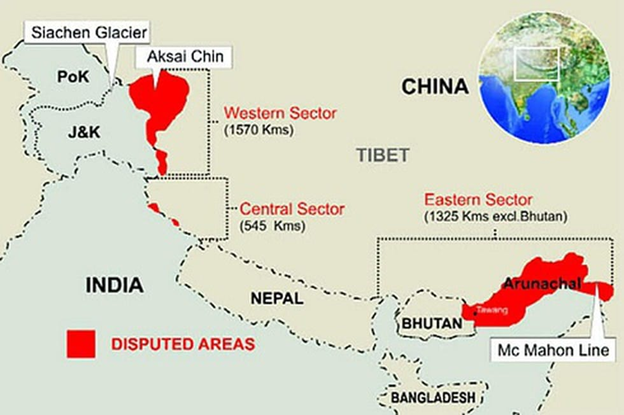
- China is creating administrative units such as He’an and Hekang counties in areas of Ladakh, including parts of Aksai Chin, which is a long-standing border dispute region.
- China has also reportedly created a new county, Cenling.
Cenling
- It is located near the Karakoram mountain range, which falls in the vicinity of Pakistan-occupied Kashmir (PoK) and Afghanistan’s Wakhan corridor.
- He’an – It included parts of the Aksai Chin plateau, which has been in focus because of the long-running India-China border issue.
- India’s Response – The Ministry of External Affairs (MEA) reiterated that regions like Arunachal Pradesh and other disputed areas are “integral and inalienable” parts of India.
Line of Actual Control (LAC)
- The LAC is the demarcation that separates Indian-controlled territory from Chinese-controlled territory.
- India considers the LAC to be 3,488 km long, while the Chinese consider it to be only around 2,000 km.
- It is divided into three sectors: the eastern sector which spans Arunachal Pradesh and Sikkim, the middle sector in Uttarakhand and Himachal Pradesh, and the western sector in Ladakh.
Project HIM SAROVAR
Environment
Context
- Project Him Sarovar has been launched in Ladakh.
Project Him Sarovar
- It is a scientific water conservation initiative launched on April 10, 2026,
- The project aims to address chronic water scarcity in the region by creating 50 small water bodies to capture and store annual snowmelt and rainwater.
Key Objectives & Impact
- Water Security: To provide year-round water availability for irrigation and rural needs in the high-altitude cold desert, where melting snow often goes to waste.
- Climate Resilience: Serving as a “shield” against the visible impacts of climate change, such as receding glaciers and falling water tables.
- Infrastructure Plan: The goal is to construct 50 reservoirs—30 in Leh and 20 in Kargil—within the next year.
- Restoration Goals: Aligns with the national vision of restoring 2.6 crore hectares of degraded land by 2030
National Agriculture Market (e-NAM)
Economy
Context
- The e-NAM portal reflects increasing market integration, with the number of connected mandis rising from 1,389 in 2024 to 1,656 as of March 2026, spanning 23 States and 4 Union Territories.
National Agriculture Market (e-NAM)
- It is a pan-India electronic trading portal launched on April 14, 2016.
- It functions as a “central sector scheme” fully funded by the Central Government via the Agri-Tech Infrastructure Fund (ATIF).
- Its primary goal is to create a unified national market for agricultural commodities by networking existing Agricultural Produce Market Committee (APMC) mandis.
Core Objectives
- Unified National Market: Integrating state-level markets to facilitate pan-India trade, moving towards the vision of “One Nation, One Market”.
- Transparent Price Discovery: Enabling real-time price discovery based on actual demand and supply through transparent online auctions.
- Reducing Intermediaries: Minimising the role of middlemen to ensure farmers receive a larger share of the final consumer price.
- Quality Assuring: Implementing quality assaying and grading so that prices are commensurate with produce quality.




Leave a Reply