
River Basin Management Scheme
Syllabus: GS2/ Polity
News
- The Government of India has approved the continuation of the River Basin Management (RBM) Scheme for the 16th Finance Commission period spanning 2026–27 to 2030–31 with financial outlay of ₹2,183 crore.
River Basin Management Scheme
- Financing – Central Sector Scheme
- Implementation – Ministry of Jal Shakti
- Objective – It adopts a holistic approach, managing entire river systems—including tributaries and groundwater—as integrated hydrological units.
Key Developments (2026–2031)
- Enhanced Funding: The budget for the 16th Finance Commission period (2026–2031) has been increased to ₹2,183 crore.
- Strategic Focus: Priority is placed on the North Eastern Region and the Indus Basin (J&K/Ladakh) for national security and transboundary management.
- Modernization: The project utilizes technologies such as GIS, LiDAR, and drones for improved planning.
Jagadguru Basaveshwara
Syllabus: GS1/Culture
Context
- Prime Minister Narendra Modi paid homage to Jagadguru Basaveshwara on the occasion of Basava Jayanthi.
About
- Basaveshwara, also known as Basavanna.
- He was a 12th-century philosopher, social reformer, and key figure of the Bhakti movement, primarily active in the Kalyana region of present-day Karnataka.
- Lingayata Movement:- He is regarded as the founder of Lingayatism and advocated equality, social justice, and the rejection of caste hierarchy and social discrimination.
- He served as a finance minister under King Bijjala II of the Kalachuri dynasty, and his teachings are preserved in poetic compositions known as Vachanas.
- Basaveshwara introduced the concept of Ishtalinga, promoting a direct and personal connection with the divine, transcending social divisions.
- He also established the Anubhava Mantapa (often referred to as the first Parliament of the world), a pioneering forum for open dialogue, where people from diverse backgrounds, including women, could participate in discussions on spiritual and social issues.
Pradhan Mantri Gram Sadak Yojana-III (PMGSY-III)
Syllabus: GS2/Government Initiatives
Context
- The Union Cabinet has extended the Pradhan Mantri Gram Sadak Yojana-III (PMGSY-III) beyond March 2025 till 2028–29.
Pradhan Mantri Gram Sadak Yojana-III (PMGSY-III)
- Launched in – 2000
- Financing – Centrally Sponsored Scheme,
- Implementation – Ministry of Rural Development
- Objective – It is aimed at providing all-weather road connectivity to unconnected habitations in rural areas .
PMGSY has evolved through multiple phases:
- PMGSY-I (2000) focused on providing connectivity to unconnected habitations;
- PMGSY-II (2013) aimed at upgradation of existing rural roads;
- PMGSY-III (2019) focuses on consolidation of rural road networks;
Significance
- The extension will help complete targeted rural road upgradation.
- It improves market access for agricultural and non-farm products while reducing transportation costs.
- It will enhance access to education and healthcare services, particularly in remote areas, and contribute to inclusive growth by bridging the rural–urban divide in line with the vision of Viksit Bharat 2047.
Israel’s ‘Yellow Line’ in Southern Lebanon
Syllabus: GS2/ IR
Context
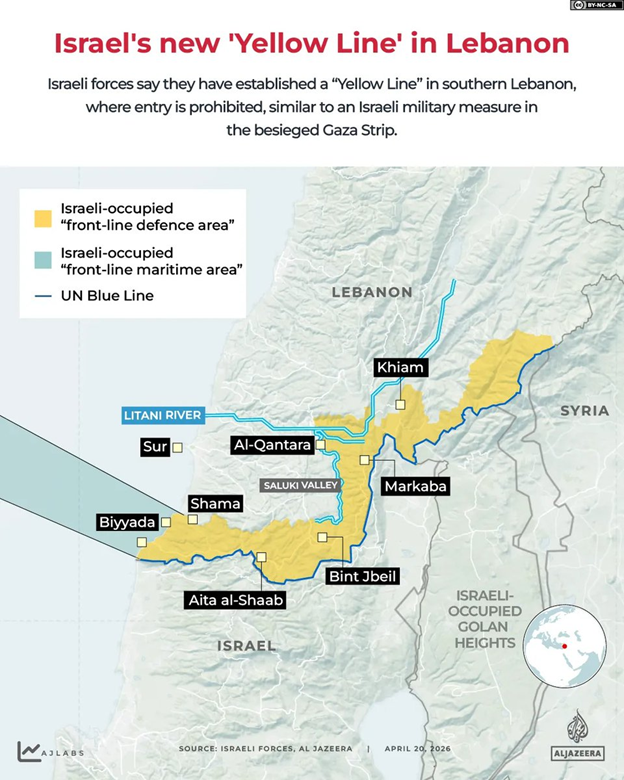
- Recently, Israel announced the establishment of a ‘Yellow Line’ in southern Lebanon, shortly after a 10-day ceasefire agreement between Israel and Lebanon.
What is the ‘Yellow Line’?
- It is a military demarcation line created by Israel to separate areas of control in a conflict zone.
- It is a temporary operational boundary that marks the limit of Israeli troop deployment.
- A threshold beyond which movement is treated as a potential security threat.
Comparison with Gaza
- A similar line has been used in Gaza since October 2023.
- There, it effectively divided territory between Israeli-controlled areas and Hamas-controlled zones.
India’s First Large-Scale Private Gold Mining Project
Syllabus: GS3/ Economy
In News
- The launch of India’s first large-scale private gold mine at Jonnagiri, Kurnool district, Andhra Pradesh, has brought renewed focus on India’s gold reserves, production deficit, and the strategic importance of domestic mining.
Gold
- It is a soft, dense, highly ductile, and corrosion-resistant precious metal found in nature in its native form.
- Gold is India’s second-largest import after oil, with nearly 1,000 tonnes imported annually to meet domestic demand.
- Bihar dominates reserves at ~43%, followed by Rajasthan (~25%) and Karnataka (~20%).
- Karnataka accounts for approximately 97% of India’s total gold output, primarily through the Hutti Gold Mines in Raichur.
- China leads global gold production with approximately 10% of world output, followed by Russia and Australia.
- Switzerland is the world’s largest gold importer.















Leave a Reply