
Komagata Maru Incident
Syllabus: GS1/History
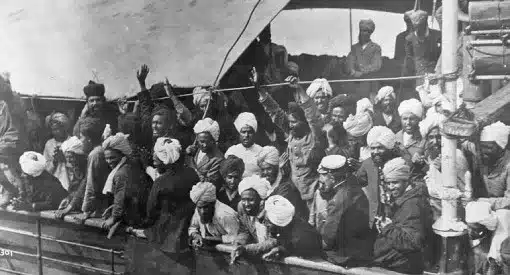
In News
- Recently a Punjabi Singer compared the 1914 Komagata Maru rejection of Indians in Canada with his own sold-out concert to highlight how attitudes have changed over time.
Komagata Maru Incident
- The Komagata Maru (also called Guru Nanak Jahaz) was a Japanese steamship chartered by Gurdit Singh in 1914, carrying 376 Indians seeking better opportunities in Canada.
- Early 20th century Punjab faced rural indebtedness, famines and epidemics and many ex-soldiers and peasants migrated abroad for livelihood.
- Most passengers were Sikhs, along with Muslims and Hindus, who faced severe restrictions under Canada’s immigration laws.
- On arrival in Vancouver, only 24 were allowed to disembark, and the rest were kept onboard without adequate food, water, or medical aid.
- Attempts by authorities to seize the ship were resisted, and a local support group raised funds to challenge the restrictions legally, but the ship was ultimately forced to leave.
Reasons for Passenger Denial
- Both India and Canada were under British rule, so Indian passengers believed they had the right to settle anywhere in the British Empire.
- However, in 1908 Canada introduced the “continuous journey regulation,” which required immigrants to arrive directly from their country of origin without stops—something practically impossible from India.
- This rule, influenced by anti-Asian sentiment after the 1907 Vancouver riots led by the Asiatic Exclusion League, was designed to restrict immigration, particularly targeting Asians, including Indians.
Return in India
- After being expelled from Vancouver and refused entry at other ports during World War I, the ship was sent back to India.
- At Budge Budge near Kolkata, British authorities tried to send the passengers to Punjab, but they resisted and marched toward the city.
- Troops opened fire, killing 20 and injuring several. Gurdit Singh initially escaped but later surrendered on Mahatma Gandhi’s advice and was imprisoned for five years.
Impact of Komagata Maru Incident on Indian Freedom Movement
- The Komagata Maru incident exposed the racial discrimination faced by Indians within the British Empire, first in Canada and later in India.
- The humiliation and violence against the passengers strengthened the belief that Indians could not secure equal rights under colonial rule, boosting demands for complete independence instead of reforms.
- It also energized revolutionary groups like the Ghadar Party, further encouraging resistance and the idea of armed struggle against British rule.
Lift Abortion Time Limit for Minor Rape Survivors: SC
Syllabus: GS2/Health
Context
- The Supreme Court has asked the Union government to amend the abortion law to remove the time limit on medical termination of unwanted pregnancies in the case of minor rape victims.
Medical Termination of Pregnancy (MTP) in India
- The act was passed in 1971 and was amended in 2021,
- It legalizes abortion in India under specific conditions, promoting reproductive autonomy and health.
It allows termination up to
- 20 weeks with one doctor’s opinion,
- 20–24 weeks for special categories with two opinions, and beyond
- 24 weeks via medical boards for fetal abnormalities.
Key Features of MTP (Amendment) Act, 2021
- Increased Limits: Enhanced gestation limits to 24 weeks for special categories, including rape survivors, victims of incest, minors, and women with disabilities.
- Unmarried Women Included: The 2021 amendment covers unmarried women, allowing them to terminate pregnancies caused by contraceptive failure.
- Confidentiality: The name and details of the woman must remain confidential.
- Legal & Constitutional BasisReproductive Autonomy: The Supreme Court has ruled that the right to reproductive autonomy is part of Article 21 (Right to Privacy and Dignity).
- Prior Legal Framework: Originally enacted in 1971 based on the Shantilal Shah Committee (1964) to reduce high maternal mortality from unsafe abortions.
‘Women and Men in India 2025’ Report
Syllabus: GS3/Economy
In News
- The Ministry of Statistics and Programme Implementation (MoSPI) released the 27th edition of its publication titled “Women and Men in India 2025: Selected Indicators and Data”.
Women and Men in India 2025’ Report Brief
- It provides a comprehensive statistical overview of gender-related conditions in India using official data from multiple ministries and agencies.
Key Highlights of the publication:
Demography and Population
- Sex Ratio at Birth (SRB): The national SRB improved from 904 (2017–19) to 917 (2021–23), signaling improved survival rates for female children.
- Regional Variations: Arunachal Pradesh recorded the highest sex ratio (1,085), while Jharkhand registered the lowest (899).
Health and Nutrition
- Infant Mortality Rate (IMR): Documented a steady, long-term decline for both male and female infants between 2008 and 2023. India’s Infant Mortality Rate (IMR) is approximately 25 deaths per 1,000 live births
- Maternal Mortality Ratio (MMR): Marked a steep decline from 254 (2004–06) down to 88 (2021–23).
EducationGender
Higher Education:
- The Gross Enrolment Ratio (GER) for females rose to 2, surpassing the male GER of 28.9.
- The Literacy Gap: A stark 14.4% gender gap persists, with male literacy at 84.7% and female literacy at 70.3%.4.
Economic Participation
- Rural Female LFPR: The Labour Force Participation Rate for rural women witnessed a major surge, climbing from 37.5% (2022) to 45.9% (2025).
- Agricultural Concentration:7% of all working rural females remain heavily concentrated in agricultural activities.
Major steps taken for women empowerment
- Constitutional and Legal Framework: The Indian Constitution guarantees gender equality through provisions in its Preamble, Fundamental Rights, and Directive Principles of State Policy.
- Article 14 ensures equality before the law, while Article 15 prohibits discrimination based on sex.
- Article 51(a)(e) encourages citizens to renounce practices derogatory to women’s dignity.
- The Directive Principles, particularly Articles 39 and 42, emphasize equal livelihood opportunities, equal pay, and maternity relief.
- Poshan Abhiyaan: It launched in 2018, is a flagship government programme aimed at improving nutrition for children, adolescent girls, pregnant women, and lactating mothers by reducing malnutrition
- Beti Bachao Beti Padhao (BBBP): The scheme aims to prevent gender biased sex selective elimination, ensure survival and protection of girl child and also to ensure education of the girl child.
- The Pradhan Mantri Matru Vandana Yojana (PMMVY) provides financial compensation for loss of wages due to pregnancy and childbirth.
- The scheme, previously limited to the first child, has now been extended to cover the second child if the child is a girl—a progressive step towards promoting gender equality.
- Mission Saksham Anganwadi : to improve nutrition, health, and immunity and reduce malnutrition among children, adolescent girls, pregnant women, and lactating mothers.
- Kasturba Gandhi Balika Vidyalayas (KGBVs) are residential schools for girls from socio-economically disadvantaged groups in educationally backward areas, offering safe education from classes VI to XII and supporting their transition to higher secondary schooling.
- Vigyan Jyoti, run by the Department of Science & Technology, encourages meritorious girls (classes IX–XII), especially in rural areas, to pursue STEM careers.
- Nurturing Aspirations through Vocational Training for Young Adolescent Girls (NAVYA): NAVYA, launched in 2025 is a skill development programme for adolescent girls (16–18 years, Class 10 pass).
- Mission Shakti : It aims at ensuring the safety, security, and empowerment of women through two key components: Sambal (safety and security) and Samarthya (empowerment).












Leave a Reply