
Andaman Sets two Guinness World Records
Syllabus: GS1/Places in News

Context
- The Andaman and Nicobar Islands created another Guinness World Record with the formation of the tallest human stack underwater at Swaraj Dweep, formerly known as Havelock Island.
About
- The feat comes a day after the Union Territory administration achieved a landmark by unfurling the world’s largest underwater national flag, measuring approximately 60 by 40 metres.
- Both the Guinness World Records are expected to draw national and international attention and will boost the profile of the Andaman and Nicobar Islands as a hub for scuba diving and eco-tourism.
Andaman and Nicobar Islands
- Location: The islands are located 1,300 km southeast of the Indian mainland in the Bay of Bengal.
- It extends from 6° 45′ N to 13° 41′ N and from 92° 12′ E to 93° 57′ E.
- The Southernmost Island is Great Nicobar whose southernmost tip is only 150 km away from Sumatra, Indonesia.
- The highest point is Saddle Peak in North Andaman (732 metre), Mount Thullier in Great Nicobar (642 metre).
- Pandunus or Nicobar Breadfruit is a rare fruit found in the Andaman and Nicobar islands.
- Barren Island of the Andaman & Nicobar Island group is the only confirmed active volcano not just in India but the whole of South Asia.
- Indira Point in Great Nicobar is the Southern-most point of India.
Lipulekh Pass
Syllabus: GS1/Geography
In News
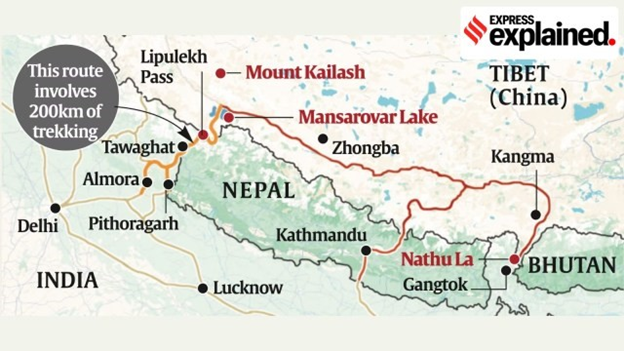
- Nepal has objected to India’s plan to conduct the Kailash Mansarovar Yatra through the Lipulekh pass, which Nepal considers disputed territory.
Lipulekh Pass
- It is a high-altitude Himalayan pass in Pithoragarh district, Uttarakhand (India).
- It serves as a strategic tri-junction connecting India, China (Tibet), and Nepal.
- It is accessed from India through Dharchula.
- It is strategically and culturally important as a traditional route for Indian pilgrims on the Kailash Mansarovar Yatra.
- It also has historical commercial value, as it became the first India–China border trade post when trade opened in 1992.
What is the Dispute
- The tension between India and Nepal over the Lipulekh Pass is a complex boundary dispute rooted in the 1816 Treaty of Sugauli.
- The Treaty was signed between the British East India Company and the Kingdom of Nepal and established the Kali River (Mahakali) as Nepal’s western border.
- Nepal claims the river originates at Limpiyadhura, which would place the Lipulekh and Kalapani regions within its territory.
Fugitive Economic Offenders
Syllabus: GS2/ Governance
Context
- The Enforcement Directorate (ED) has declared 21 individuals as Fugitive Economic Offenders (FEOs).
Fugitive Economic Offender (FEO)
- A Fugitive Economic Offender (FEO) is an individual against whom an Indian court has issued an arrest warrant for a specified economic offence involving ₹100 crore or more, and who has either left India to evade criminal prosecution or refuses to return from abroad to face the law.
- This legal status was established under the Fugitive Economic Offenders Act, 2018 (FEOA) to deter economic offenders from evading justice by staying outside the jurisdiction of Indian courts
Fugitive Economic Offenders Act, 2018
- Confiscation of Property: The Act empowers authorities to attach and confiscate properties of the offender located both in India and abroad.
- The law also covers benami properties and assets indirectly controlled by the offender.
- Bar on Civil Claims: The Act disallows declared FEOs from initiating or defending any civil claims in Indian courts.
- Special Court Mechanism: The Act provides for adjudication of cases through special courts established under the Prevention of Money Laundering Act, 2002.
Enforcement Directorate
- Established in – On 1st May 1956, an ‘Enforcement Unit’ was formed. In the year 1957, this Unit was renamed as ‘Enforcement Directorate’.
- Established under – It is a specialized financial investigation agency under the Department of Revenue, Ministry of Finance.
- Functions – ED enforces the following laws
- Foreign Exchange Management Act, 1999 (FEMA)
- Prevention of Money Laundering Act, 2002 (PMLA)
- The Fugitive Economic Offenders Act, 2018 (FEOA).




















Leave a Reply