
Rules Governing Election Symbols in India
Polity

Context
- The satirical Cockroach Janta Party (CJP) has sparked debate over whether a cockroach can be allotted as an election symbol if it registers as a political party.
Election Symbols in India
- Election symbols are governed by the Election Symbols (Reservation and Allotment) Order, 1968, administered by the Election Commission of India.
Types of Symbols:
- Reserved Symbols: Exclusively allotted to recognised national and state parties (e.g., lotus, hand).
- Free Symbols: Allotted to registered unrecognised parties and independent candidates from a notified list.
What Symbols Are Available?
- The EC’s latest free-symbol list (May 2025) contains 184 symbols.
- These include household items, fruits, vegetables, sports equipment, and tools such as air-conditioner, dustbin, frying pan, grapes, toothbrush, TV remote, etc.
The Cockroach Janta Party (CJP)
- It is a satirical, youth-led Indian political movement that emerged in May 2026. It was started by political communication strategist Abhijeet Dipke
- It started as a joke after a judge reportedly called internet-active youth “cockroaches.”
- It quickly gained millions of online followers to protest youth unemployment and exam scams.
Prime Minister of India
Polity
In News
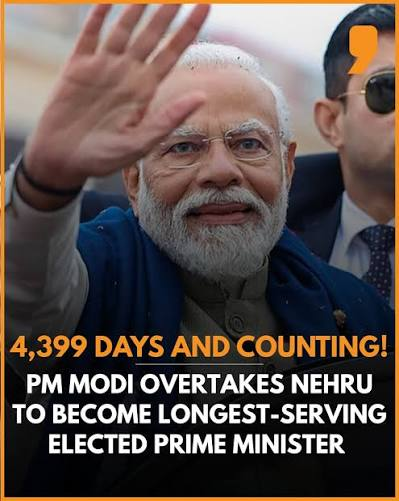
- Prime Minister Narendra Modi has overtaken Jawaharlal Nehru as the longest-serving Prime Minister in India to remain in office through consecutive electoral mandates.
Prime Minister of India
- Constitutional Position (Article 75): The Prime Minister is appointed by the President and serves as the head of the Union government, exercising actual executive authority.
- Leader of the Council of Ministers (Article 74): The Prime Minister leads the Council of Ministers, which assists and advises the President in carrying out constitutional functions.
- Role: The Prime Minister acts as the chief link between the President and the Council of Ministers,conveying decisions of the Cabinet and advising the President on matters such as appointments, convening Parliament, and dissolution of the Lok Sabha.
- Head of Key Bodies: The Prime Minister presides over several major institutions and councils, including NITI Aayog, the National Integration Council, and the Inter-State Council.
Ayushman Bharat Scheme
Government Schemes
Context
- West Bengal has formally joined the flagship health insurance programme, Ayushman Bharat Pradhan Mantri Jan Arogya Yojana (AB-PMJAY), becoming the last state in India to come under its ambit.
Ayushman Bharat
- Launched in – It was launched in 2018
- Objective – To achieve universal health coverage.
It has two key components
- Ayushman Bharat Pradhan Mantri- Jan Arogya Yojana (AB PM-JAY)
- Ayushman Arogya Mandir
Ayushman Arogya Mandir
- Launched in – The Government of India in 2018 announced the creation of 1,50,000 Health and Wellness Centres (HWCs) by transforming existing Sub Centres and Primary Health Centres.
- Functions – These centres would deliver Comprehensive Primary Health Care (CPHC) bringing healthcare closer to the homes of people covering both maternal and child health services and non-communicable diseases, including free essential drugs and diagnostic services.
Pradhan Mantri Jan Arogya Yojana (PM-JAY)
- Objective – The world’s largest health insurance/assurance scheme fully financed by the government.
- Feature – It provides cover of Rs 5 lakhs per family per year, for secondary and tertiary care hospitalization across public and private empaneled hospitals in India.
- Coverage – Over 10.74 crore poor and vulnerable entitled families (approximately 50 crore beneficiaries) are eligible for these benefits.
- Implementation – The National Health Authority (NHA) is the nodal agency responsible for the nationwide roll-out and implementation of the AB-PMJAY scheme.
- Financing – This scheme is a Centrally sponsored scheme with some Central sector components.
- Note – First Ayushman Arogya Mandir inaugurated in Bijapur, Chhattisgarh.
Viksit Bharat-Guarantee for Rozgar and Ajeevika Mission Gramin (VB-G RAM G)
Government schemes
Context
- The government has proposed an interim budget allocation of 95,692 crore rupees to states and union territories to ensure a smooth transition from MNREGA to Viksit Bharat-Guarantee for Rozgar and Ajeevika Mission Gramin (VB-G RAM G).
Key Differences
|
Feature |
MGNREGA (2005) |
VB-G RAM G (2025 Act) |
|
Days Guaranteed |
At least 100 days of work per year. |
At least 125 days of work per year. |
|
Funding Model |
Demand-driven. The centre paid 100% of unskilled wages. |
Normative allocation. General cost-sharing is 60:40 between Centre and States. |
|
Work Pauses |
Continuous work throughout the year. |
Allows a 60-day pause for farming seasons. |
|
Technology |
Basic digital systems over time. |
Advanced AI, biometrics, and GPS tracking. |
|
Planning Approach |
Handled locally by Gram Sabhas. |
Integrated into the national PM Gati Shakti plan. |
Land Port Management System (LPMS): Vinimay
Economy
In News
- Union Home Minister Amit Shah inaugurated the Land Port Management System (LPMS), named ‘Vinimay’, in New Delhi under the Smart Borders initiative.
About
- It is a unified digital platform launched to modernise operations across India’s international land borders.
- Developed by – Land Ports Authority of India (LPAI), a statutory body under the Ministry of Home Affairs established through the Land Ports Authority of India Act, 2010.
- Significance – It achieve Smart Border Management by replacing manual paperwork with end-to-end digital workflows
Additional Information – The Smart Borders Initiative
- It is an Indian government project to secure international borders using advanced technology.
- Implementation – Ministry of Home Affairs to secure India’s borders with Pakistan and Bangladesh. It uses technology instead of just human patrolling.
Key features
- Quadrangular Security Grid: Links local people, police, civil officials, and the military with the Border Security Force (BSF).
- High-Tech Tools: Uses drones, anti-drone systems, underground sensors, and thermal cameras. It protects tough areas like rivers and swamps.
- VINIMAY System: A digital platform by the Land Ports Authority of India. It cuts paper paperwork by 90% and tracks trade data in real time.
Shiv Shakti Point
Science and Technology
Context
- Data from Chandrayaan-3’s Pragyan rover has revealed that the soil at Shiv Shakti Point near the Moon’s South Pole is chemically very similar to a lunar meteorite (ALHA 81005) discovered in Antarctica.
- The findings are based on observations made by the Alpha Particle X-ray Spectrometer (APXS) onboard the rover.
Shiv Shakti Point
- It is the official name of the place on the Moon where India’s Chandrayaan-3 mission landed.
- The mission’s lander, Vikram, successfully touched down at this spot on 23 August 2023.
- With this achievement, India became the first country to land a spacecraft near the lunar south pole.
Chandrayaan-3
- It is India’s third moon mission.
- It was made by the Indian Space Research Organisation (ISRO).
- On August 23, 2023, it landed near the Moon’s South Pole. This made India the first country to reach the south polar region and the fourth country to land on the Moon. August 23 is now celebrated as National Space Day in India.
Key Quick Facts
- Launch Rocket: LVM3-M4 rocket.
- Landing Site: Named Shiv Shakti Point.
- Mission Life: 1 Lunar Day (about 14 Earth days).
The Three Spacecraft Parts
Propulsion Module: Carried the lander close to the Moon. It has 1 payload
- SHAPE (Spectro-polarimetry of Habitable Planet Earth): Studies Earth from orbit.
Vikram Lander: The main box that made the soft landing.It has 4 payloads
- ChaSTE (Chandra’s Surface Thermophysical Experiment) : Measures surface temperature.
- ILSA (Instrument for Lunar Seismic Activity): Records moonquakes.
- RAMBHA-LP (Radio Anatomy of Moon Bound Hypersensitive Ionosphere and Atmosphere – Langmuir Probe) :Measures plasma density.
- LRA (Laser Retroreflector Array) : Measures Moon distance (NASA)
Pragyan Rover: A small 6-wheeled robot. It has 2 payloads.
- LIBS (Laser-Induced Breakdown Spectroscope): Finds elements (found Sulphur).
- APXS (Alpha Particle X-ray Spectrometer): Studies soil minerals.
Why the South Pole Matters
- Water Ice: Deep craters have ice that never melts.
- Resources: This ice can make drinking water, oxygen, and fuel for future astronauts.
- History: The cold preserves old solar system clues.
Battery Energy Storage System
Environment
In News
- The Defence Ministry has approved the establishment of a 250 MW Solar Power Project with Battery Energy Storage System (BESS) at Sitapur (Ex-Cantonment) in Uttar Pradesh.
Battery Energy Storage System
- Battery Energy Storage System (BESS) refers to a technology that stores electrical energy in rechargeable batteries for later use.
- It helps balance electricity demand and supply by storing excess power generated from renewable sources such as solar and wind energy.
- Significance – It improves grid stability, reduces power fluctuations, and supports peak load managemen
- It also enhances energy access in remote areas and strengthens energy securit
Major Storage Technologies
Electrochemical (Battery-Based):
- Lithium-ion: Most widely deployed globally, energy density 150 to 300 Wh/kg, round-trip efficiency 90 to 95%, used in EVs and gridscale storage but dependent on imported lithium and cobalt.
- Lithium Iron Phosphate (LFP): Safer, cheaper, longer life cycle, increasingly preferred for utility-scale Battery Energy Storage Systems (BESS) and electric buses.
- Sodium-ion: Abundant domestic sodium, lower cost and reduced geopolitical dependence. Strategically important for India given limited domestic lithium reserves.
- Solid-state: Next-generation with solid electrolyte, higher density and improved safety. Still high cost and limited scalability.
- Flow batteries (Vanadium Redox, ZincBromine): Long-duration storage, minimal degradation, suited for utility-scale renewable integration.
Mechanical and Thermal
- Pumped Storage Hydropower (PSH): Most mature large-scale technology globally, using height difference to store and release energy.
- Molten salt and ice thermal storage are used in concentrated solar and industrial applications.


















Leave a Reply