
PM Modi to Participate in 52nd G7 Summit in France
International
Context
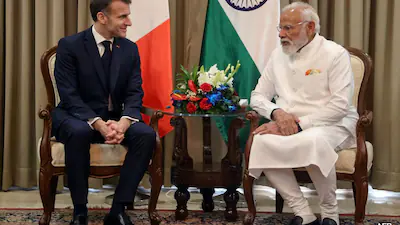
- Prime Minister Narendra Modi is going to participate in the 52nd G7 Summit in France.
About –
- Group of Seven (G7): An informal organization of seven of the world’s largest advanced economies, representing about 10% of the population and nearly 30% of global GDP.
- Members: Canada, France, Germany, Italy, Japan, United Kingdom, and the United States.
- Presidency: Rotates annually among member states.
Why is the G7 Summit Important?
- Economic Influence: Decisions impact global trade, financial stability, and climate policy.
- Crisis Coordination: Forum for addressing global challenges like pandemics, wars, and geopolitical tensions.
- Multilateralism: Reinforces a rules-based international order through consensus-building.
New Phase in India-Nepal Relations
International
Context
- Recent high-level exchanges between India and Nepal signal efforts by both sides to strengthen bilateral ties despite differences over boundary issues.
India- Nepal Border Disputes
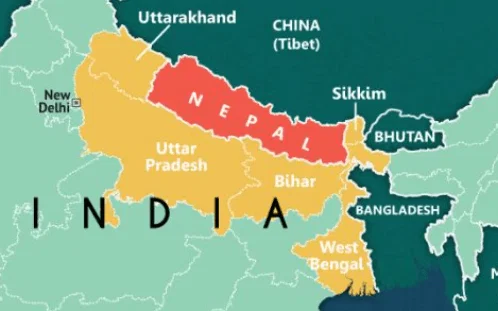
- India and Nepal argue over a few specific pieces of land. The main areas are Kalapani, Limpiyadhura, Lipulekh, and Susta.
India – Nepal Relations
- India and Nepal share an approximately 1,751 km border.
- Shared Border: The country shares a border with five Indian states – Sikkim, West Bengal, Bihar, Uttar Pradesh and Uttarakhand.
- India-Nepal Treaty of Peace and Friendship – Signed in 1950, it forms the special relations that exist between India and Nepal.
- Defence Cooperation: Both countries conduct Joint Military Exercise SURYA KIRAN alternately in India and in Nepal.
- The Gorkha regiments of the Indian Army are raised partly by recruitment from hill districts of Nepal.
- Trade and Economic: India remains Nepal’s largest trade partner and Investment where Indian firms account for 33.5 % of total FDI stock in Nepal.
- Operation Maitri & post-earthquake reconstruction assistance: In the wake of the 2015 earthquake in Nepal, GoI was the first responder and carried out its largest disaster relief operation abroad (Operation Maitri).
- Cultural Ties: The leaders of the two countries have often noted the age-old ‘roti beti’ relationship, which refers to cross-border marriages between people of the two countries.
Project Kusha
GS3/Defence
Context
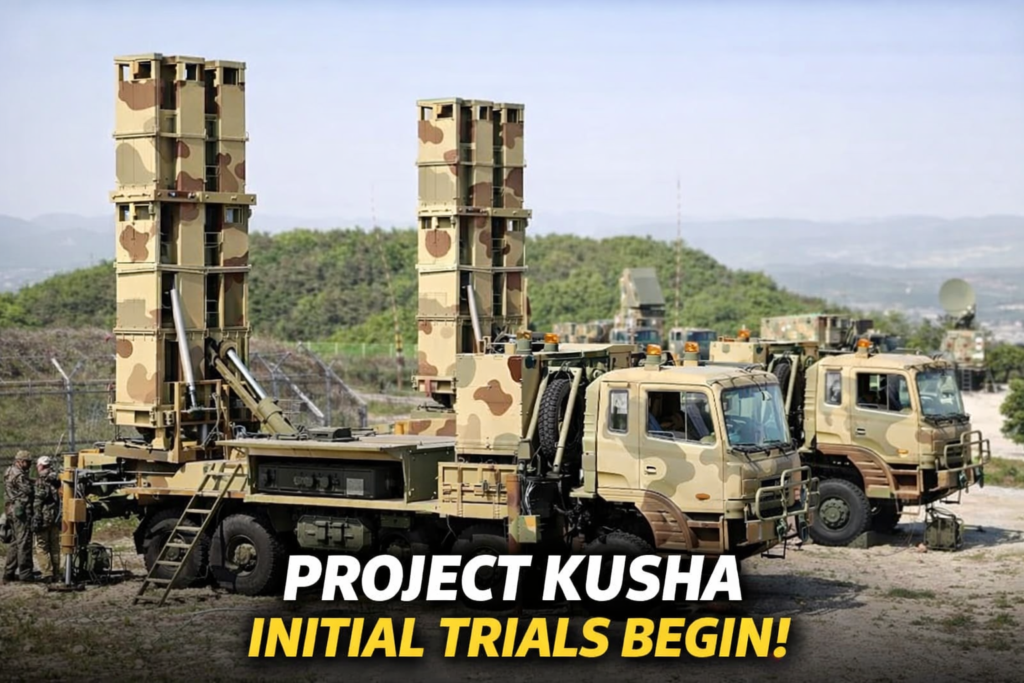
- Defence Minister Rajnath Singh has described the indigenous Project Kusha air defence system as a potential game changer for India’s security architecture.
Project Kusha
- It is an ambitious, indigenous long-range surface-to-air missile (SAM) defence system.
- It is designed to act as a powerful, multi-layered air defence shield that can detect and destroy advanced enemy targets at long distances.
- Developed by – Defence Research and Development Organisation (DRDO).
- Multi-Tier Interception: The system features three types of interceptor missiles to stop threats at different distances:
- M1 interceptor with a range of around 150 km
- M2 interceptor with a range of around 250 km
- M3 interceptor with a range of 350-400 km
Significance –
- Countering the S-400 and Global Comparisons – Project Kusha is often called India’s homegrown answer to Russia’s famous S-400 Triumf air defence system.
- The project is also linked to the broader “Mission Sudarshan Chakra”, an initiative aimed at building a multi-layered air and missile defence shield for India by 2035.
Indigenous AI Model Varya
Science and Technology

Context
- The IndiaAI Mission has supported the launch of Varya, an indigenous AI-powered video generation model developed by Avataar.
Varya
- Varya is a distilled video generation model that converts text prompts and images into videos.
- It is designed to generate culturally relevant visual content reflecting India’s regions, festivals, traditions, clothing, food, and everyday life.
- The platform follows the workflow, from Idea to Video to Story, allowing users to create and extend visual narratives through simple prompts.
Four Sites on Nicobar West Coast Identified for Coral Translocation
GS3/Environment
Context
- Coral colonies and giant clams that will be impacted due to the work on the transhipment port proposed at Galathea Bay as part of the Great Nicobar Island (GNI) mega project will be translocated to four sites on the west coast.
The Great Nicobar Island (GNI) Project
- It is conceived by NITI Aayog and launched in 2021.
- It is a ₹72,000–₹81,000 crore mega-infrastructure initiative.
- It is aimed at transforming India’s southernmost island into a major strategic and economic hub.
- Significance – The project is a centerpiece of India’s Maritime Vision 2030 and Amrit Kaal Vision 2047.
Core Components
- International Container Transshipment Terminal (ICTT): At Galathea Bay, aiming to handle 14.2 million TEUs to capture regional cargo.
- Greenfield International Airport: A dual-use facility for tourism and defense.
- Integrated Township: Planned development to accommodate a projected population of 6.5 lakh by 2050.
- Power Plant: A 450 MVA gas and solar-based facility.
Connect with the basics – CORAL REEFS
- Coral reefs are the most biologically diverse ecosystems of the planet.
Formation & Symbiotic relationship – (Coral polyps + zooxanthellae)
- They are formed when Coral polyps, the animals primarily responsible for building reefs, develop a symbiotic relationship with photosynthetic algae called zooxanthellae, which live in its tissues.
- Formation – Coral reefs begin to form when free-swimming coral larvae attach to submerged rocks or other hard surfaces along the edges of islands or continents.
- The coral provides a protected environment and the compounds zooxanthellae need for photosynthesis.
- In return, the algae produce carbohydrates that the coral uses for food, as well as oxygen. The algae also helps the coral remove waste.
FAVOURABLE CONDITIONS FOR FORMATION
- Warm tropical oceans with minimum temperature of 20 degree (30 degree north and 25 degree south latitudes)
- Oceanic water free of sedimentation
- Transparent parts of ocean bodies
- Relatively low salinity ocean bodies
TYPES OF REEF FORMATIONS
- Fringing reefs – They are the most common, projecting seaward directly from the shore, forming borders along the shoreline and surrounding islands.
- Barrier reefs – Grow at border shorelines, but at a greater distance. They are separated from their adjacent land mass by a lagoon of open, often deep water.
- Atoll – If a fringing reef forms around a volcanic island that subsides completely below sea level while the coral continues to grow upward, an atoll forms. Atolls are usually circular or oval, with a central lagoon.
DISTRIBUTION IN INDIA
- The Gulf of Kutch
- The West Coast of India
- The Lakshadweep Islands
- The Gulf of Mannar
- Palk Bay
- Andaman and Nicobar Group of Islands
THREATS
- Destructive fishing practices, Overfishing, Careless tourism, Pollution, Sedimentation, Coral mining, Climate change.
CORAL BLEACHING
- When corals face stress by changes in conditions such as temperature, light, or nutrients, they expel the symbiotic algae zooxanthellae living in their tissues, causing them to turn completely white. This phenomenon is called coral bleaching.
Causes of Coral Bleaching
radiation
|
(Turbidity)
|
CORAL REEFS
- Coral reefs are the most biologically diverse ecosystems of the planet.
Formation & Symbiotic relationship – (Coral polyps + zooxanthellae)
- They are formed when Coral polyps, the animals primarily responsible for building reefs, develop a symbiotic relationship with photosynthetic algae called zooxanthellae, which live in its tissues.
- Formation – Coral reefs begin to form when free-swimming coral larvae attach to submerged rocks or other hard surfaces along the edges of islands or continents.
- The coral provides a protected environment and the compounds zooxanthellae need for photosynthesis.
- In return, the algae produce carbohydrates that the coral uses for food, as well as oxygen. The algae also helps the coral remove waste.
FAVOURABLE CONDITIONS FOR FORMATION
- Warm tropical oceans with minimum temperature of 20 degree (30 degree north and 25 degree south latitudes)
- Oceanic water free of sedimentation
- Transparent parts of ocean bodies
- Relatively low salinity ocean bodies
TYPES OF REEF FORMATIONS
- Fringing reefs – They are the most common, projecting seaward directly from the shore, forming borders along the shoreline and surrounding islands.
- Barrier reefs – Grow at border shorelines, but at a greater distance. They are separated from their adjacent land mass by a lagoon of open, often deep water.
- Atoll – If a fringing reef forms around a volcanic island that subsides completely below sea level while the coral continues to grow upward, an atoll forms. Atolls are usually circular or oval, with a central lagoon.
DISTRIBUTION IN INDIA
- The Gulf of Kutch
- The West Coast of India
- The Lakshadweep Islands
- The Gulf of Mannar
- Palk Bay
- Andaman and Nicobar Group of Islands
THREATS
- Destructive fishing practices, Overfishing, Careless tourism, Pollution, Sedimentation, Coral mining, Climate change.
CORAL BLEACHING
- When corals face stress by changes in conditions such as temperature, light, or nutrients, they expel the symbiotic algae zooxanthellae living in their tissues, causing them to turn completely white. This phenomenon is called coral bleaching.
Causes of Coral Bleaching
radiation
|
(Turbidity)
|






Leave a Reply