
Iran-United States Peace Deal
International
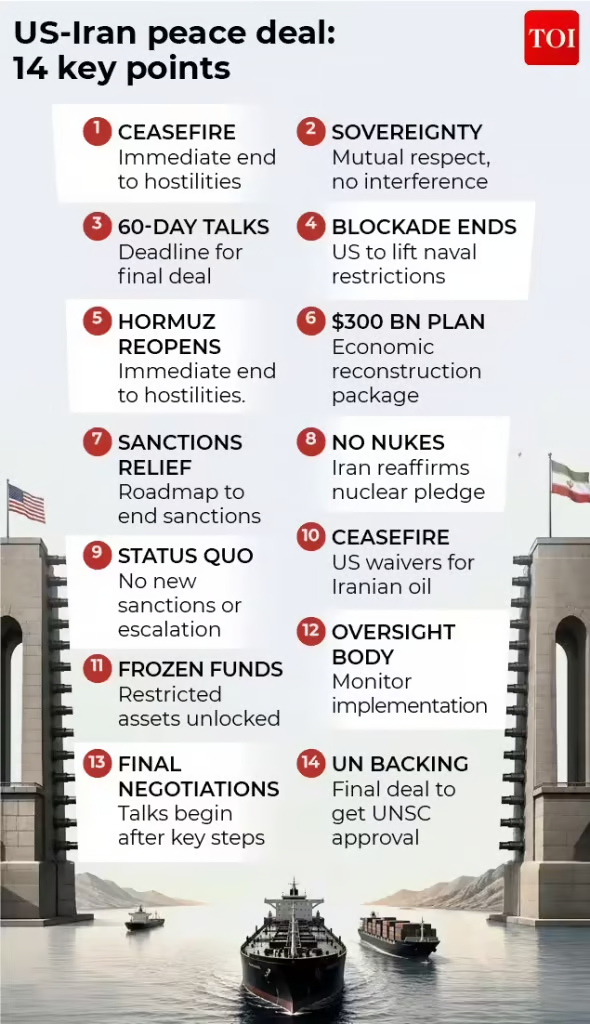
Context
- According to some recent reports Iran and the United States have reached a preliminary framework for renewed diplomatic engagement after a prolonged period of tensions.
Background
- The pact includes a 14-point Memorandum of Understanding (MoU) between the United States and Iran outlining a roadmap for de-escalation, restoration of commercial navigation through the Strait of Hormuz, and negotiations on sanctions relief etc.
- It also includes an immediate halt to military action, including in Lebanon, and a 60-day negotiation period.
Evolution of Iran–U.S. Nuclear Diplomacy
- The 2015 Nuclear Agreement: The Joint Comprehensive Plan of Action (JCPOA) was signed between Iran and the P5+1 countries.
- Iran agreed to limit uranium enrichment and accept enhanced inspections in exchange for sanctions relief.
- U.S. Withdrawal and Renewed Tensions: The United States withdrew from the JCPOA in 2018 and reimposed sanctions on Iran.
- In response, Iran gradually reduced its compliance with several provisions of the agreement.
Potential Opportunities of Iran–U.S. Agreement
- The reduction in tensions will lower the risk of military confrontation and proxy conflicts across the region.
- Also the stable conditions will ensure smoother energy flows and reduce volatility in global oil markets.
- Improved security conditions will encourage trade, investment, and reconstruction efforts in conflict affected areas.
- For India, improved regional conditions are necessary to boost the development of Chabahar Port and the International North-South Transport Corridor (INSTC).
Joint Crediting Mechanism under Paris Agreement
Environment
Context
- India and Japan have adopted the Rules of Implementation for the Joint Crediting Mechanism (JCM) under Article 6.2 of the Paris Agreement.
Joint Crediting Mechanism (JCM)
- It is a bilateral carbon market system proposed by Japan to help nations reduce greenhouse gas emissions through advanced low-carbon technologies.
- It operates under Article 6.2 of the Paris Agreement, which allows nations to trade carbon credits to meet their climate goals
Article 6.2 of the Paris Agreement
- It allows countries to work together to hit their climate goals by trading carbon credits.
- Under this rule, a country that cuts more greenhouse gases than planned can sell those extra savings to another country
Additional Information- Paris Agreement on Climate Change, 2015 (COP 21)
- It was adopted at the United framework convention on climate change(COP21) in Paris in 2015.
- Objective – To strengthen the global response to the threat of climate change and specify long-term goals regarding global average temperatures, adaptation to climate change, and finance flows.
Paris agreement Goals
- Temperature – To hold global warming below 2 degrees Celsius above pre-industrial levels and to put efforts to still limit the temperature increase even further to 1.5 degrees Celsius.
- Reduce emissions – To foster climate resilience and development through lower greenhouse gas emissions by 2030
Intended Nationally Determined Targets(INDCs)
- An Intended Nationally Determined Contribution is a public pledge from a country on collective action on climate change. These contributions are to be achieved before 2030
India’s Climate Action Targets at a Glance
|
Commitment Area |
Initial/Updated 2030 Targets |
Enhanced 2031-2035 Targets |
|
Emissions Intensity |
Reduce GDP emissions intensity by 45% (from 2005 levels). |
Reduce GDP emissions intensity by 47% (from 2005 levels). |
|
Non-Fossil Energy Capacity |
Achieve 50% of cumulative electric power capacity from non-fossil sources. |
Achieve 60% of cumulative electric power installed capacity from non-fossil sources. |
|
Carbon Sinks |
Create a sink of 2.5 to 3 billion tonnes of CO₂ equivalent. |
Create an additional sink of 3.5 to 4.0 billion tonnes of CO₂ equivalent. |
Bitumen
Economy
Context
- The recent conflict in West Asia has hit India’s push to expand road infrastructure as India imports 30-40% of Bitumen.
- Over 99% of India’s bitumen imports come from Iraq, UAE, Iran, Oman and Bahrain.
Bitumen
- Bitumen is a byproduct of crude oil.
- It is known for its waterproofing and adhesive properties.
- It is predominantly used in road construction and roofing.
- Canada has one of the largest natural deposits of bitumen in its oil sands, contributing significantly to global supply.
- It is produced in refineries to ensure purity, maintain consistent quality, and meet massive global construction demands at a lower cost.




















Leave a Reply