
11 Year of Digital India Programme
Polity
Context
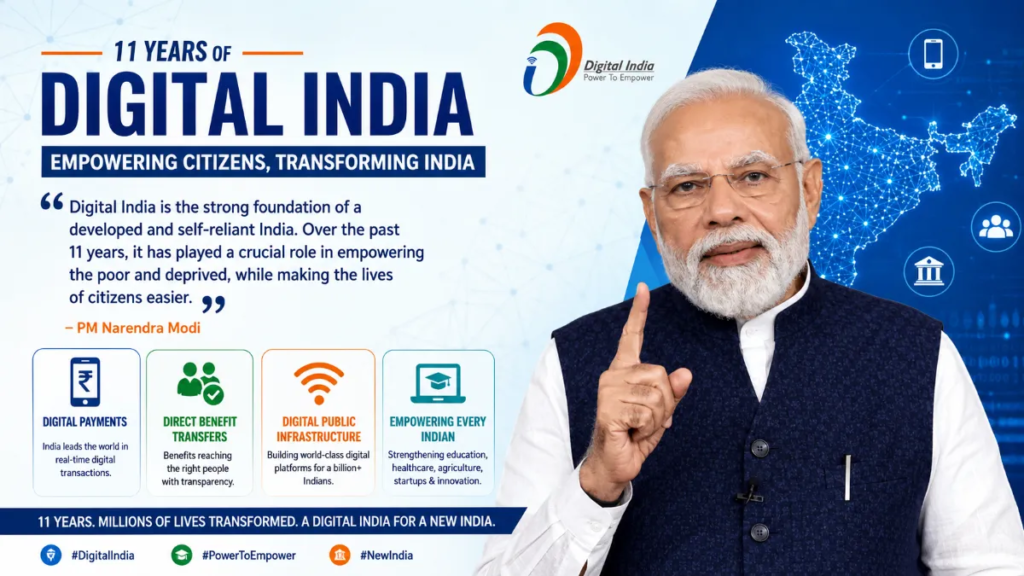
- The Digital India Programme completes 11 years as on 1 July 2026.
Digital India Programme,
- Launched on – 1 July 2015
- Implementation – Ministry of Electronics and Information Technology (MeitY)
- Objective – It is a flagship scheme aimed at transforming the country into a digitally empowered society and knowledge economy.
Flagship Initiatives under Digital India
- JAM Trinity: The Foundation of Digital India has revolutionised financial inclusion and welfare delivery in India. It brought millions into the formal banking system and enabled seamless access to government services.
- DigiLocker: DigiLocker is replacing physical documents with a secure digital wallet, and transforming document storage and verification across India.
- Unified Payments Interface (UPI): Completing ten years in 2026, UPI is transforming digital payments through instant and secure transactions for citizens and businesses.
- eSanjeevani: The telemedicine platform is connecting patients with doctors remotely, especially in rural and underserved regions.
- Tele MANAS provides free tele-counselling and mental health support nationwide.
- Government e-Marketplace (GeM) has transformed public procurement by making it transparent, efficient and paperless.
- Open Network for Digital Commerce (ONDC) is creating an open and interoperable digital commerce ecosystem that connects buyers and sellers across platforms.
- AgriStack – It is a farmer-centric DPI powering services such as e-NAM for online agricultural trading and Kisan e-Mitra, an AI-powered chatbot providing instant farming information and government scheme support.
- DIKSHA (Digital Infrastructure for Knowledge Sharing) is transforming school education through curriculum-linked digital learning resources and teacher training.
- SWAYAM (Study Webs of Active Learning for Young Aspiring Minds) and SWAYAM Prabha are expanding access to quality education beyond classrooms.
- PMGDISHA bridged the rural digital divide by training citizens in smartphone usage, internet access, digital payments and online services.
- FutureSkills Prime is preparing learners for emerging technologies such as AI, cloud computing, cybersecurity and data analytics.
- Skill India Digital Hub (SIDH) is a unified platform for skilling, certification and employment services.
- IndiaAI Mission is strengthening AI education, infrastructure and responsible AI adoption.
Matcha Tea
Economy

Context
- Assam has become the first state in India to commercially produce Matcha tea, with production commencing at the Chota Tingrai Tea Estate in eastern Assam’s Tinsukia district.
Matcha
-
- Matcha is made after shading Camellia sinensis tea leaves for three to four weeks before harvest.
- Blocking 90% of sunlight from the leaves boosts their chlorophyll and amino acid levels, and gives its characteristic bright green colour and rich umami flavour.
- Matcha originated through cultural exchanges between China and Japan during the premodern period.
- China is the largest producer of matcha tea.
Additional Information – Indian Tea Industry
-
- India is the 2nd largest tea producer and largest black tea producer.
- Export destinations – Iran, Iraq, Syria, Saudi Arabia, Russia etc. India is the 4th largest tea exporter in the World.
- Employment – The Indian tea Industry is employing 1.16 million workers directly.
- Note – Assam grows about 55% of the teas produced in India. India’s tea production has increased by 39% in 2022 from 2008.
- Prominent tea regions: Assam (Assam Valley, Cachar) and West Bengal (Dooars, Terai, Darjeeling).
- Global reputation: Indian teas, especially Assam, Darjeeling, and Nilgiri, are renowned for their quality.
Geographical Condition for Tea production
- The tea plant grows well in tropical and subtropical climates.
- Soil: It requires deep and fertile well-drained soil, rich in humus and organic matter.
- Temperature: The average annual temperature for tea plants to grow well is in the range of 15-23°C.
- Precipitation: The rainfall needed is between 150-200 cm.
- Frequent showers evenly distributed over the year ensure continuous growth of tender leaves.
- Major tea producing states are Assam, hills of Darjeeling and Jalpaiguri districts in West Bengal, Tamil Nadu and Kerala.
- Apart from these, Himachal Pradesh, Uttarakhand, Meghalaya, Andhra Pradesh and Tripura are also tea-producing states in the country.
Asia Tea Alliance
- Member countries – It is a coalition of tea associations from major tea-producing countries in Asia like India, China, Sri Lanka, Japan etc.
- Objective – It aims to promote the collective interests of member nations within the global tea market.
Tea Board of India
- It was set up as a statutory body in 1954 under the Tea Act, 1953.
- It was established for the purposes of regulating the Indian tea industry and protecting the interests of tea producers in India.
- Headquarters-Kolkata.
Mumbai-Ahmedabad High Speed Rail (MAHSR)
Economy
Context
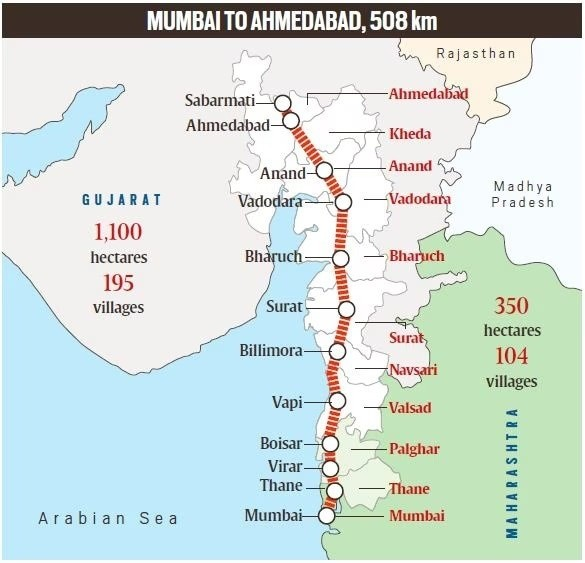
- India is nearing completion of its first bullet train corridor – the Mumbai-Ahmedabad High Speed Rail (MAHSR).
About
- The corridor will connect Mumbai and Ahmedabad in about 1 hour 58 minutes. It covers a total length of approximately 508 kilometres.
- 12 stations have been planned along the route.
- It is expected to commence in August 2027. The first section to open will be from Surat to Vapi.
- The corridor has a design speed of 350 kmph and an operational speed of 320 kmph.
- The MAHSR Project is being developed using Japanese Shinkansen technology and operational practices.
- Track System: J-Slab ballastless track technology is being introduced in India for the first time.
7th National Water Awards
Miscellaneous
Context
- Ministry of Jal Shakti has launched the 7th National Water Awards on the Rashtriya Puraskar portal of Ministry of Home Affairs.
National Water Awards
- The National Water Awards were first launched in 2018.
- Objective – The awards aim to recognize efforts in water management and conservation.
- Significance – The initiative supports the government’s vision of a ‘Jal Samridh Bharat’ (Water Prosperous India).
Simla Agreement
International Relations
Context
- The Simla Agreement completed 54 years on 2 July 2026.
About
- The Simla Agreement was signed in 1972 to establish lasting peace between India and Pakistan post the 1971 war.
- The agreement was signed between Indian Prime Minister Indira Gandhi and Pakistani President Zulfikar Ali Bhutto.
Key Provisions of Simla Agreement
- Peaceful resolution: Both countries agreed to resolve disputes through bilateral negotiations without involving third parties.
- Line of Control (LoC): The ceasefire line in Jammu and Kashmir was redefined as the Line of Control, with both sides committing not to alter it unilaterally.
- Release of prisoners: India agreed to release Pakistani prisoners of war, and Pakistan committed to normalising relations and recognising the sovereignty of Bangladesh.
MANAS Initiative
Government Schemes
Context
- The National Narcotics Helpline MANAS is strengthening India’s fight against drug abuse.
MANAS (Madak Padarth Nishedh Asoochna Kendra)
-
- It was launched in 2024 under the aegis of the Narcotics Control Bureau (NCB), Ministry of Home Affairs, in collaboration with the Digital India Corporation (DIC).
- It enables citizens to report drug-related activities, seek counselling, and access rehabilitation support at any time.
- The platform is accessible through the national helpline number 1933, the official portal, email and the UMANG app.
- MANAS brings together the vision of Digital India and the mission of a Nasha Mukt Bharat.
India’s War Against The Drug Menace
- Constitutional Basis: Article 47 states that the State not to promote consumption of intoxicating drinks and drugs that are injurious to health except for medicinal purposes.
- Global Commitment: India is a party to the 1961 Single Convention on Narcotic Drugs, the 1971 Convention on Psychotropic Substances and the 1988 UN Convention against Illicit Drug Trafficking.
- Legal Frameworks: The Drugs and Cosmetics Act, 1940, NDPS Act, 1985, PITNDPS Act, 1988.
- Key Initiatives: NIDAAN Portal for monitoring drug cases; Nasha Mukt Bharat Abhiyan for awareness, prevention and rehabilitation.
Hasdeo-Arand Forests
Environment
Context
- The Ministry of Environment, Forest and Climate Change (MoEFCC) has granted environmental clearance for mining in the Kente Extension Integrated Coal Block in Chhattisgarh’s Hasdeo-Arand forests.
Hasdeo-Arand forests
- The Hasdeo-Arand forests, spread across Chhattisgarh’s Korba, Surguja, and Surajpur districts, cover about 1.7 lakh hectares and are considered the Green Lungs of Central India.
- They are home to around 640 plant species and nine schedule-1 wildlife species, which are accorded highest legal protection.
- It is also the catchment area of the Hasdeo river, the largest tributary of the Mahanadi.


















Leave a Reply