
Green Hydrogen
Environment
Context –
- India secured long-term export agreements for green ammonia and green methanol with Japanese companies, marking a milestone in its National Green Hydrogen Mission (NGHM).
Green ammonia
- It is produced using green hydrogen, and is emerging as a leading clean fuel for fertilizers, energy, and marine applications.
Benefits of Green Ammonia
- Decarbonization of Fertilizers: India’s fertilizer sector, heavily dependent on imported ammonia, can significantly cut emissions by adopting green ammonia.
Additional Information – Green Hydrogen
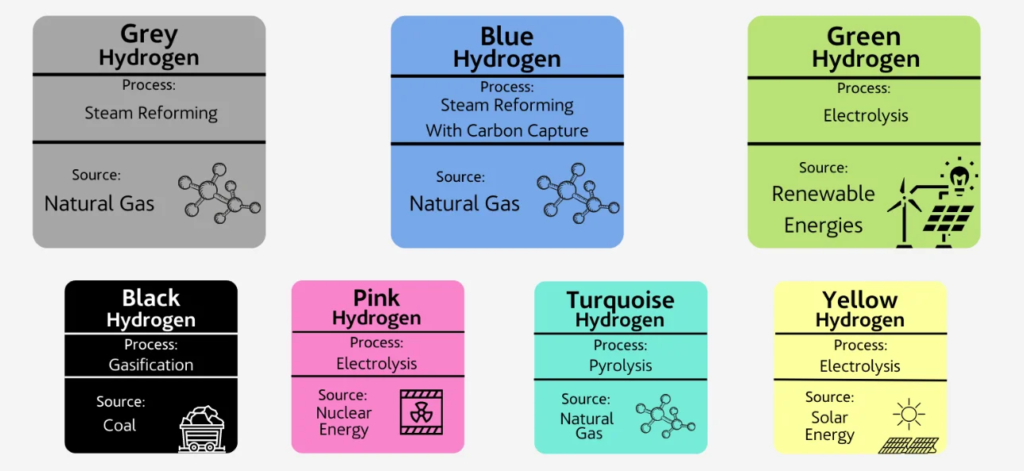
- Green Hydrogen: It is produced using electrolysis of water with electricity generated by renewable energy.
- Benefit: It is a clean burning element that can decarbonise a range of sectors including iron and steel, chemicals, and transportation.
- Hydrogen can be stored for long periods of time which can be used to produce electricity using fuel cells.
National Green Hydrogen Mission
- Aim: To make India a global hub for the production of green hydrogen.
- Implementing Ministry: Ministry of New and Renewable Energy(MNRE)
Hydrogen
- Symbol and Atomic number – Hydrogen is the chemical element with the symbol H and atomic number 1.
- Hydrogen is the lightest element and the most abundant chemical substance in the universe, constituting roughly 75% of all normal matter.
- It is colorless, odorless, tasteless, non-toxic, and highly combustible gas.
Employees’ Provident Fund Scheme 2026
Government Scheme
News
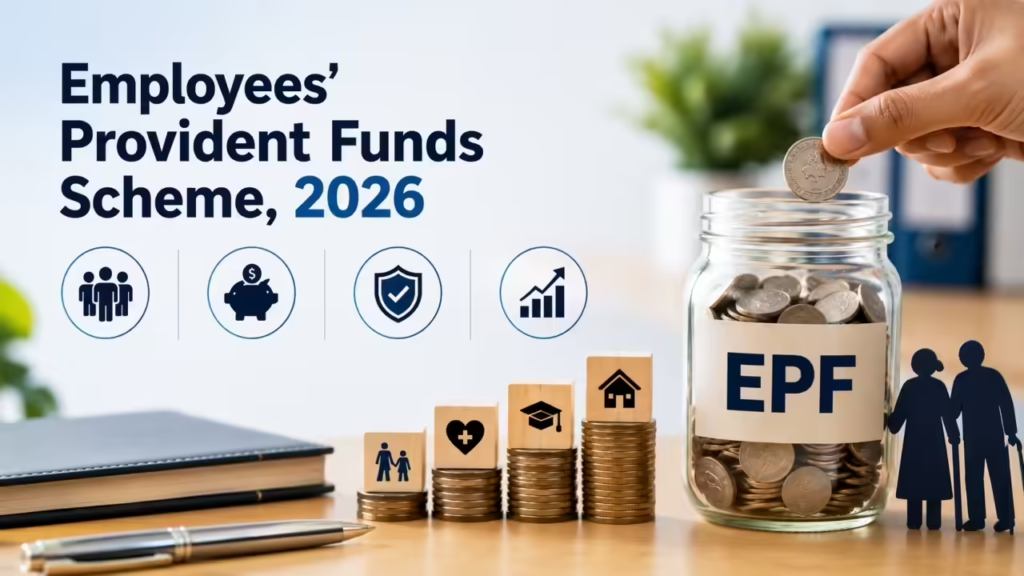
- The Central government notified the Employees’ Provident Fund (EPF) Scheme, 2026, replacing EPF Scheme, 1952.
Employees’ Provident Fund (EPF) Scheme, 2026,
- Implementation – Ministry of Labour and Employment.
- Cap: Mandatory 12% employee contribution stops at the ₹15,000 wage ceiling.
- Limit: Maximum mandatory monthly deduction is ₹1,800.
- Voluntary: Contributions above ₹1,800 are voluntary; employers need not match excess.
- Withdrawals: Partial withdrawals require keeping a 25% minimum balance.
- Portability: Account transfers between jobs are automatic and digital.
- Amnesty: Special schemes (VISHWAS, AMNESTY 2026) resolve past compliance disputes.
Advanced Therapeutic Products (ATPs)
Science & Technology
News
- The Central Government amended the Drugs Rules, 1945, to include Advanced Therapeutic Products (ATPs) under the Central License Approving Authority (CLAA) framework.
Advanced Therapeutic Products (ATPs)
- These are the innovative biopharmaceuticals based on genes, cells, or engineered tissues.
- They target, modify, or repair biological functions at a fundamental or genetic level to potentially cure a disease.
Key Domains:
- ATPs include gene therapies, cell-derived products and xenografts.
- Gene therapeutic products use gene replacement or gene editing (CRISPR-Cas9) to cure genetic defects (e.g., haemophilia and sickle cell anaemia).
- Cell- or stem cell-derived products include regenerative therapies and CAR-T cell therapies for blood cancers like leukaemias and lymphomas.
- Xenografts are medical products derived from animal tissues, including porcine heart valves used to replace human organs or tissues.
Gulf of Aden
International
News –
- INS Trikand thwarted a piracy attempt against the India-bound merchant vessel MV Golden Arsenal in the Gulf of Aden.
INS Trikand
- It is a Talwar-class stealth guided-missile frigate built in Russia for the Indian Navy.
Gulf of Aden
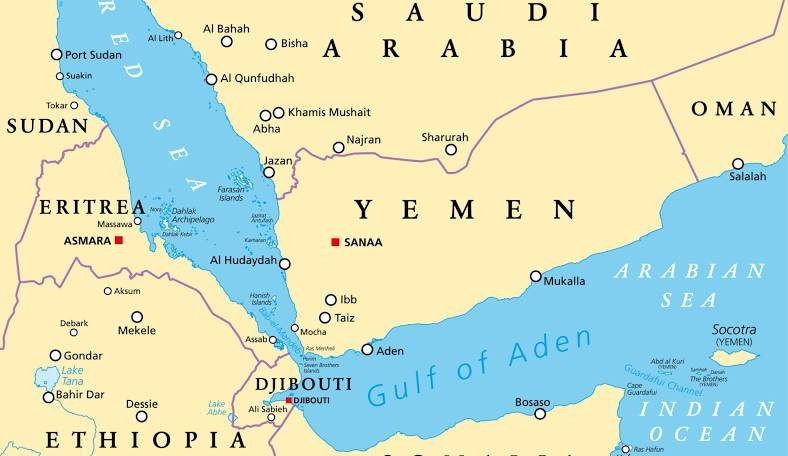
- Location – It is a deep-water gulf between Yemen (north) and Somalia (south in the Horn of Africa).
- Connectivity – It connects the Red Sea to the Arabian Sea and Indian Ocean via the Bab el-Mandeb Strait (Gate of Tears).
- Key Ports: Aden in Yemen, Djibouti City in Djibouti, and Berbera in Somalia.
- The gulf accounts for about 11% of global maritime trade and over $110 billion of India’s trade.
- Concerns – The region faces piracy from Somalia’s instability and missile threats from Yemen’s geopolitical conflict.
Civil Registration System (CRS) Report 2024
Polity
News –
- The Office of the Registrar General of India released the Civil Registration System Report 2024.
Key Highlights of CRS 2024
- Near Universal Registration Achieved: Birth and death registrations in India crossed 99% of estimated births and deaths for the first time in 2024.
- Sex Ratio at Birth (SRB): India’s national sex ratio at birth stands at 917 females per 1,000 males. SRB measures the number of girl children born for every 1,000 boys.
- State Level Disparities: Top performers include Kerala (970), Arunachal Pradesh (1,050), Andaman and Nicobar Islands (984), Meghalaya (974), and Mizoram (972). Lowest performers include Nagaland and Lakshadweep (865 each) and Jharkhand (890) recorded the weakest figures.
- Stillbirths: 81,117 stillbirths were recorded in 2024, with 69% occurring in urban areas. A stillbirth is the death of a fetus at or after 20 to 28 weeks of pregnancy. Most occur in the womb before labor
Additional Information – Civil Registration System (CRS)
- It is popularly known as birth and death registration system, is the recording of vital events i.e. Birth, Death & Still Birth.
- Mandated under the Registration of Births and Deaths (RBD) Act, 1969 (amended in 2023). It serves as vital statistics for government policymaking.
-
- Functions under – Ministry of Home Affairs. It is the central authority responsible for coordinating and unifying registration activities across states and UTs.
- CRS falls under the Concurrent list of the Constitution of India.
SHE-LEAPS
Government Scheme
News –
- The SHE-LEAPS platform was launched at Rashtriya Gramin Vikas Sammelan held in New Delhi.
SHE-LEAPS
- Full form – Self-Help Entrepreneur-Livelihoods and Enterprise Application for Prosperity and Sustainability
- It is a digital platform for empowering women associated with Self-Help Groups (SHGs) across rural India.
Objectives:
- Empowering rural SHG women entrepreneurs nationwide.
- Creating and strengthening women-led enterprises in rural areas.
- Integrating rural producers with formal value chains.
- Enhancing the financial inclusion of SHG households.
- Enabling data-driven rural entrepreneurship.
Green Urea
Science & Technology
News –
- The Department of Fertilisers has decided to establish Green Urea plants in India.
Green Urea
- Green urea is a sustainable fertilizer produced using green hydrogen, renewable energy, and captured carbon dioxide (instead of fossil fuel-based natural gas).
- It retains the same formula, nutrient value, and white appearance as grey urea; “green” denotes its production pathway.
- Production Pathway: Green hydrogen is produced by water electrolysis powered by renewable electricity, then combined with atmospheric nitrogen to form green ammonia for urea synthesis.
Why Green Urea Matters
- Import Reduction: India imports roughly 10 million tonnes (1 crore MT) of conventional urea annually. Indigenous green urea production aims to achieve Aatmanirbharta (self-reliance) in fertilizers.
- Decarbonization: The traditional Haber-Bosch process heavily relies on natural gas (fossil fuels). Shifting to green feedstocks drives toward India’s Net Zero 2070 goal.
- Green Hydrogen Mission: It is a vital downstream application of the National Green Hydrogen Mission, which allocated ₹19,744 crore to scale the ecosystem.
Climate Change Action Plan (CCAP)
Environment
News –
- The World Bank Board has retired the CCAP’s 45% climate co-benefits target and the original 35% target to replace fixed financing quotas with outcome-based development metrics.
Climate Change Action Plan (CCAP)
- Established in – 2021
- Objective – It is the World Bank Group’s strategic framework for integrating climate adaptation and mitigation.
- Significance – It initially required 35% of total World Bank financing to be allocated to projects with climate co-benefits. This target was raised to 45% at COP28 in 2023.
CCAP operates through 3 pillars:
- aligning climate and development via new diagnostics,
- prioritising key system transitions,
- mobilising finance.
Yamuna Water Project
Environment
News-
- Governments of Rajasthan and Haryana signed a Memorandum of Agreement to implement the Yamuna Water Project, operationalising a three-decade-old interstate water-sharing framework.
Yamuna Water Project
-
- Agreement: Signed in June 2026 between Haryana and Rajasthan.
- Objective: Realizes the 1994 Upper Yamuna Pact to give Rajasthan its allocated water share.
- Cost & Volume: ₹34,102 crore to transfer 580 MCM of surplus water annually.
- Timeline: Water will be drawn strictly during the monsoon season (July–October).
- Source: Hathnikund Barrage (Haryana) on the Yamuna River.
- Destination: Hansiyawas Reservoir in Churu district (Rajasthan).
- Beneficiaries: Churu, Sikar, and Jhunjhunu (Rajasthan); Bhiwani and Fatehabad (Haryana).
- Mechanism: A 295.5 km underground pipeline (not open canals) to prevent evaporation and leakage losses.
Additional Information – Yamuna River
- Origin: Yamunotri Glacier (Bandarpunch Peak, Uttarakhand, ~6,387m).
- Length: 1,376 km.
- Confluence: Merges with Ganga at Triveni Sangam, Prayagraj (UP).
- Basin States: Uttarakhand, Himachal Pradesh, Haryana, Delhi, Uttar Pradesh.
Major Tributaries (West to East Order)
Left Bank (Himalayan):
- Tons (Largest by volume; merges at Kalsi).
- Hindon (Entirely rain-fed; passes NCR).
Right Bank (Peninsular):
- Chambal (Largest right-bank; famous for Badland Topography/Ravines).
- Sindh (Originates in Malwa Plateau).
- Betwa (Vindhyan range origin; Ken-Betwa Interlinking Project is crucial).
- Ken (Passes through Panna Tiger Reserve area).
Key Riparian Areas
- Cities: Delhi, Noida, Mathura, Agra, Etawah, Prayagraj.
- Protected Areas: Kalesar National Park (Haryana), Okhla Bird Sanctuary (Delhi-UP).
Miniratna
Economy
News –
- The Ministry of Steel granted Miniratna Category-I status to MECON Limited, a leading engineering and consultancy Central Public Sector Enterprise (CPSE).
- Miniratna status was introduced in 1997 to give profit-making CPSEs more autonomy.
Maharatna vs. Navratna vs. Miniratna
|
Maharatna |
Navratna |
Miniratna (Category I & II) |
|
|
Hierarchy Level |
Highest tier. |
Mid-level tier. |
Entry-level tier. |
|
Current Strength |
14 companies. |
26 companies. |
74 companies (approx. Cat I & II). |
|
Pre-requisite Status |
Must already be a Navratna. |
Must be a Miniratna Cat-I and Schedule ‘A’. |
Profit-making for 3 consecutive years. |
|
Stock Exchange Listing |
Mandatory listing under SEBI regulations. |
Not strictly required for initial grant. |
Not strictly required for initial grant. |
|
Key Financial Criteria (Avg. of last 3 years) |
• Net Profit: > ₹5,000 cr • Net Worth: > ₹15,000 cr • Turnover: > ₹25,000 cr |
Score of 60/100 based on 6 efficiency parameters (e.g., Net Profit to Net Worth). |
• Cat-I: Pre-tax profit ≥ ₹30 cr in 1 of 3 years. • Cat-II: Continuous profit, positive net worth. |
|
Global Presence |
Mandatory international operations. |
Desirable but not mandatory. |
Focus is primarily domestic or regional. |
|
Financial Autonomy (Investment limit per project without Government approval) |
Up to ₹5,000 crore or 15% of net worth (whichever is lower). |
Up to ₹1,000 crore or 15% of net worth (whichever is lower). |
• Cat-I: Up to ₹500 crore or net worth. • Cat-II: Up to ₹300 crore or 50% of net worth. |
|
Prominent Examples |
NTPC, ONGC, SAIL, BHEL, HAL. |
BEL, CONCOR, MTNL, NMDC, IRCTC. |
Airports Authority of India (AAI), BSNL, IRCTC (formerly). |
International Big Cat Alliance (IBCA)
Environment
News –
- Bangladesh became the 27th member nation of the India-led, treaty-based International Big Cat Alliance (IBCA).
About-
- Headquarters – India,
- Objective – It is a multi-country, multi-agency coalition of 95 big cat range countries with an interest in big cat conservation.
- Genesis: IBCA was launched by the Prime Minister of India in 2023 during the event ‘Commemorating 50 years of Project Tiger’.
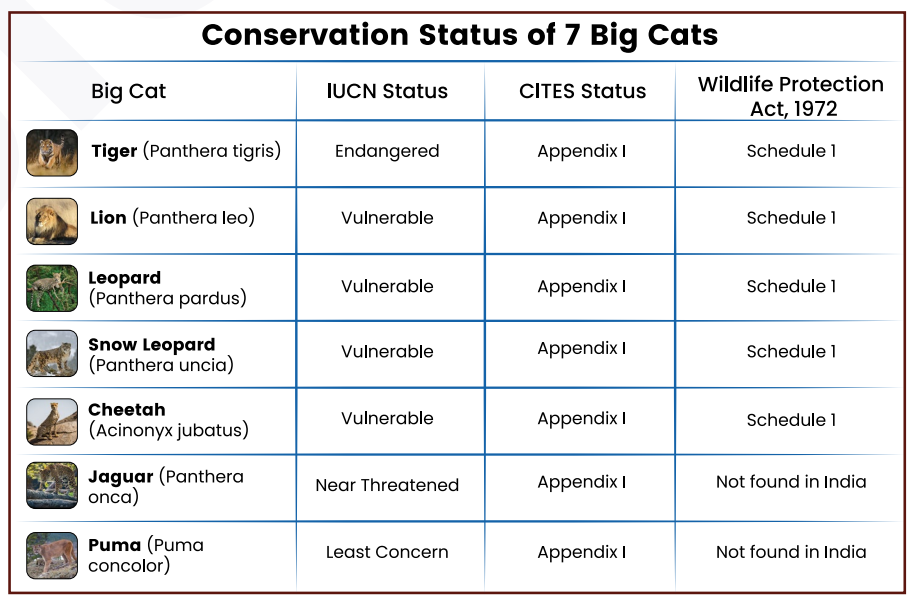
- Aim: Conserving seven big cats – Tiger, Lion, Leopard, Snow Leopard, Cheetah, Jaguar, and Puma.
- Members: Nicaragua, Eswatini, India, Somalia and Liberia have signed the Framework Agreement to formally become members of the IBCA.
IndiaSkills Competition 2026-27
Economy
News –
- The Union Minister launched IndiaSkills Competition 2026–27.
About –
-
- Objective – It is India’s flagship skill competition to identify, nurture and showcase India’s most talented youth across 63 industry-relevant skill categories.
- Implementation – Ministry of Skill Development and Entrepreneurship (MSDE) and supported by National Skill Development Corporation (NSDC) as knowledge and implementation partner.
- Skill India Digital Hub (SIDH) provides a transparent, accessible and digital platform for participation.
National Skill Development Corporation (NSDC)
- Not-for-profit public limited company under section 8 of Companies Act, 2013.
- Operates as a Public Private Partnership model under the Ministry of Skill Development & Entrepreneurship.
- 49% of share capital is held by the government and 51% by the private sector.












Leave a Reply