
DISHA 2.0
Polity

Context
- The Union Government has launched DISHA 2.0 (Designing Innovative Solutions for Holistic Access to Justice) Scheme with a financial outlay of ₹255 crore for the period 2026–31 for pan-India implementation.
DISHA 2.0
- Financing – It is a Central Sector Scheme
- Implementation – Department of Justice, Ministry of Law and Justice.
- DISHA 2.0 – It expands technology-driven legal aid.
Key Components
- Tele-Law: Pre-litigation advice via Common Service Centres (CSCs).
- Nyaya Bandhu: Pro bono legal services and lawyers.
- LLLAP: Legal Literacy and Legal Awareness Programme.
- VIDHI-Sanjeevani: Centralized platform featuring the AI multilingual Nyaya Setu chatbot.
Significance
- Constitutional Basis: Fulfills mandates under Articles 14, 21, and 39A (Free Legal Aid).
- Global Goals: Supports UN Sustainable Development Goal 16 (Peace, Justice, and Strong Institutions).
Geographical Indication (GI) Tags for ‘Unjha Cumin’ and ‘Unjha Fennel
Economy

Context
- Rajasthan’s cumin (jeera) and fennel (saunf) farmers have opposed the Geographical Indication (GI) registration of ‘Unjha Jeera’ and ‘Unjha Fennel’.
About
- Unjha is one of Asia’s largest agricultural markets for seed spices, especially cumin (jeera), fennel (saunf), and isabgol.
- A substantial quantity of jeera and saunf traded in the Unjha APMC originates from Rajasthan.
- Rajasthan farmers argue that Unjha in Gujarat is primarily a trading and marketing hub rather than the main production centre for these seed spices.
BHAVYA – Rasayan Scheme
Economy
In News
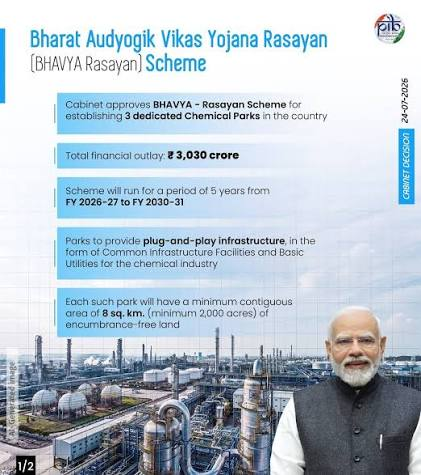
- The Union Cabinet chaired by the Prime Minister, has approved Bharat Audyogik Vikas Yojana Rasayan or BHAVYA – Rasayan Scheme for establishing three dedicated Chemical Parks in the country.
Bharat Audyogik Vikas Yojana Rasayan (BHAVYA-Rasayan)
-
- Objective – It is a newly approved Central Sector industrial park development scheme aimed at transforming India’s chemical and petro-chemical manufacturing landscape.
- Announced in – Union Budget 2026-27 with a total financial outlay of ₹3,030 crore.
- Objective – to establish three dedicated, world-class chemical parks across India over a five-year period.
- Nodal Ministry: Department of Chemicals and Petrochemicals under the Ministry of Chemicals and Fertilizers.
- Scheme Type: It is a Central Sector Scheme
- Implementation Timeline: Operational for a 5-year period spanning from FY 2026-27 to FY 2030-31.
Significance –
- Economics: Lowers production and logistics overheads.
- Trade: Promotes raw material import substitution.
- Ecology: Enforces centralized green waste processing.
- Vision: Aligns with Viksit Bharat @ 2047.
PRAXIS Mission
Science and Technology

Context
- NASA has selected PRAXIS, an innovative mission concept to develop the first spacecraft capable of directly collecting and studying particles from planetary rings, such as those around Saturn.
PRAXIS
- Full form – Planetary Rings Autonomous Exploration with In-situ Sampling.
-
- It proposes a bio-inspired robotic spacecraft powered by Artificial Intelligence (AI).
- Uniqueness- It aims to become the first mission to directly collect samples from planetary ring particles.
Key Features:
- Bio-inspired robotic explorer: Designed to mimic efficient movement and adaptability found in nature.
- AI-driven autonomy: Uses AI to identify suitable ring particles, plan sampling operations, and analyze collected data with minimal human intervention.
Start-up Village Entrepreneurship Programme (SVEP)
Government Schemes
Context
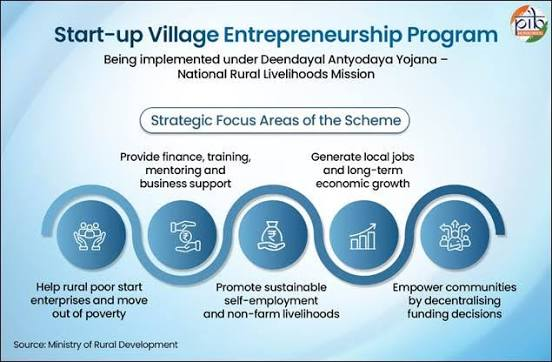
- Recently, the government highlighted the increasing impact of the Start-up Village Entrepreneurship Programme (SVEP) that has assisted more than 4.32 lakh rural firms and improved rural lives through community-led entrepreneurship under DAY-NRLM.
Start-up Village Entrepreneurship Programme (SVEP)
-
- It was launched in 2016 as a sub-scheme of the Deendayal Antyodaya Yojana–National Rural Livelihoods Mission (DAY-NRLM)
- Implementation – Ministry of Rural Development.
Objectives:
- To promote non-farm rural enterprises.
- To generate self-employment and sustainable livelihoods.
- To empower first generation entrepreneurs, especially women and marginalised populations.
- To diversify sources of income in rural areas to lessen dependence on agriculture.
- To create community-based enterprises that create strong local economies.
















Leave a Reply