Blog
-
MCQs Compilation on National & International, State Current Affairs and Misscelanious Current Affairs
MCQs Compilation on National & International, State Current Affairs and Miscellaneos Current Affairs
1. Indira Point, the southernmost point of the Indian Union, is located on:
A) Little Nicobar Island
B) Car Nicobar Island
C) Great Nicobar Island
D) South Andaman IslandAnswer: C) Great Nicobar Island
2. Indiahandmade operates under which Union Ministry?
A) Ministry of Culture
B) Ministry of Commerce and Industry
C) Ministry of Textiles
D) Ministry of Rural DevelopmentAnswer: C) Ministry of Textiles
3. Vikram-1 has been developed by:
A) Indian Space Research Organisation
B) NewSpace India Limited
C) Skyroot Aerospace
D) Digital India CorporationAnswer: C) Skyroot Aerospace
4. What is the objective of Project 17A?
A) To build six nuclear-powered submarines
B) To build seven advanced stealth guided-missile frigates
C) To construct eight guided-missile destroyers
D) To develop five aircraft carriersAnswer: B) To build seven advanced stealth guided-missile frigates
5. Which one of the following is the bilateral naval exercise between India and Indonesia?
A) Garuda Shakti
B) IND-INDO CORPAT
C) Samudra Shakti
D) KomodoAnswer: C) Samudra Shakti
6. Consider the following ports:
-
Kamarajar Port
-
Chennai Port
-
V.O. Chidambaranar Port
-
Visakhapatnam Port
How many of the above are located in Tamil Nadu?
A) Only one
B) Only two
C) Only three
D) All fourAnswer: C) Only three
7. Who was selected for the Ustad Bismillah Khan Yuva Puraskar 2025 for contributions to Haveli Sangeet?
A) Acharya Shri Ranchhodlalji Goswami
B) Taga Ram Bheel
C) Pandit Rajendra Gangani
D) Ustad Shahid ParvezAnswer: A) Acharya Shri Ranchhodlalji Goswami
-
-
Dr. Syama Prasad Mookerjee’s 125th Birth Anniversary | Hindkesari Pedgaon ‘Bailgada Sharyat’ | MY Bharat (Mera Yuva Bharat) | Unlawful Activities (Prevention) Act, 1967 (UAPA) | Right to Vote: Need for Fundamental Right Status | NASA’s Swift Boost Mission | India’s Fisheries Sector | Nameri Tiger Reserve | e-Jagriti
Dr. Syama Prasad Mookerjee’s 125th Birth Anniversary
History & Culture
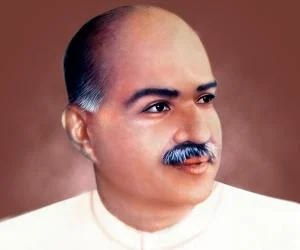
Context
- Prime Minister Narendra Modi paid tributes to Dr. Syama Prasad Mookerjee on his 125th birth anniversary.
Dr. Syama Prasad Mookerjee (1901- 1953)
-
- Initially a member of the Indian National Congress; later joined the Hindu Mahasabha in the 1930s.
- He became the youngest Vice-Chancellor of Calcutta University at age 33 in 1934.
- He served as Finance Minister of Bengal (1941–42) in the Fazlul Haq ministry.
- He was a strong critic of the Muslim League and the partition of India.
- He joined the cabinet of the interim government as Minister for Industry and Supply after independence (1947–1950), but resigned over differences.
- Founder of Bharatiya Jana Sangh: In 1951, founded the Bharatiya Jana Sangh, the ideological predecessor of today’s Bharatiya Janata Party (BJP).
- Advocated for national unity, cultural nationalism, and economic self-reliance.
- Legacy: He is remembered as a staunch nationalist, educationist, and advocate of cultural unity.
- The Syama Prasad Mookerjee Port in Kolkata and several institutions are named in his honor.
Hindkesari Pedgaon ‘Bailgada Sharyat’
History & Culture
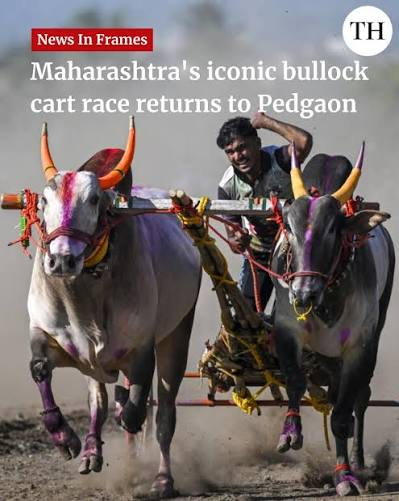
Context
- The Hindkesari Pedgaon ‘Bailgada Sharyat’ (bullock cart race) showcased Maharashtra’s deep-rooted rural sporting tradition, attracting more than 1,000 entrants and thousands of spectators from across the region.
About
- The bullock cart race is an event involving bulls or bullocks to conduct a race with the animals tied to a cart by a wooden yoke, with or without a cartman.
- The rural sport is known as ‘bailgada sharyat,’ ‘chhakadi’ or ‘shankarpath’ in the state.
- It is held annually in Pedgaon, Khatav Taluk, Satara district, Maharashtra.
Additional Information – Jallikattu
-
- It is also known as Eruthazhuvuthal.
- It is a bull-taming sport traditionally played in Tamil Nadu as part of the Pongal harvest festival.
- The history of this bullfight dates back to 400-100 BCE when it was played by the Ayars, an ethnic group in India.
- The name is coined from two words, Jalli (silver and gold coins) and Kattu (tied).
- In this festival, a bull is let loose among a crowd of people, and whoever tames it will get the coins tied to its horn.
- The people who participate in the sport try to hold on to the animal’s hump to stop it. Sometimes, they run along with the bull.
- Pulikulam or Kangayam is the breed of bulls used for the sport. This festival has been part of cultural tourism in the state.
- Vadi manjuviraṭṭu, Vēli viraṭṭu, and Vaṭam manjuviraṭṭu are the variants of this sport
Kambala
- The annual buffalo race Kambala is a unique festival observed by the farming community between November to March.
- Kambala is performed on two parallel race tracks, filled with slushy water.
- Traditionally, it is sponsored by local Tuluva landlords and households in the coastal districts of Dakshina Kannada, Udupi and Bhatkal of Karnataka and Kasaragod of Kerala, a region collectively known as Tulu Nadu.
MY Bharat (Mera Yuva Bharat)
Government Schemes
Context
- Union Minister for Youth Affairs and Sports Mansukh Mandaviya highlighted the role of MY Bharat in nurturing youth potential and directing it towards nation-building.
MY Bharat (Mera Yuva Bharat)
- It was launched in October 2023 under the Ministry of Youth Affairs and Sports as an autonomous body.
- It serves as a digital platform that connects the Government, educational institutions, non-profit organisations and industry to create meaningful youth engagement.
- It aims to place youth at the centre of nation-building by providing opportunities for volunteering, skill development, leadership, and civic participation.
- The initiative, aligned with the National Youth Policy, primarily engages individuals in the 15–29 year age group while also nurturing adolescents between 10–19 years to cultivate early participation and civic awareness.
Unlawful Activities (Prevention) Act, 1967 (UAPA).
Polity
Context
- The Ministry of Home Affairs has designated 23 more individuals as ‘terrorists’ under the Unlawful Activities (Prevention) Act, 1967 (UAPA).
UAPA Act
- Enacted: 1967
- Mandate: It is aimed at “more effective prevention of certain unlawful activities of individuals and associations for dealing with terrorist activities”.
- Unlawful activity: Unlawful activity means any conduct which constitutes a crime or which contravenes any law.
- Terrorist act: Section 15 of the Act defines “terrorist act” and is punishable with imprisonment for a term of at least five years and up to life.
- Power to central government – The Act assigns absolute power to the central government, by way of which the Centre deems an activity as unlawful.
- Applicability: The provisions of this Act apply also to—
(a) citizens of India outside India;
(b) persons in the service of the Government, wherever they may be; and
(c) persons on ships and aircrafts, registered in India, wherever they may be.
Unlawful Activities Prevention Act (UAPA) Amendment Act 2019
- The Act empowers the government to designate individuals as terrorists.
- Under the Act, the central government may designate an organisation as a terrorist organisation
Additional Information – National Investigation Agency (NIA)
- Established under: NIA Act, 2008 after 26/11 Mumbai attacks.
- Function: Central counter-terrorism law enforcement agency.
- Mandate: Investigates offences affecting India’s sovereignty, security, international treaties, etc.
NIA (Amendment) Act, 2019:
- Jurisdiction extended: Can investigate scheduled offences committed outside India involving Indian citizens/interests.
- Expanded mandate: Covers offences under Explosive Substances Act, 1908 Human Trafficking, Cyber Terrorism Arms Act, 1959.
- Headquarters: New Delhi
- Special Courts: Total NIA Special Courts: 52
- Exclusive NIA Courts: 3 (Ranchi, Jammu and Mumbai).
Right to Vote: Need for Fundamental Right Status
Polity
News –
- The Opposition advocated upgrading the Right to Vote from a statutory right to a Fundamental Right, reigniting debates on constitutionalising electoral rights.
Right to Vote in India
- Constitutional Basis: Article 326 grants universal adult suffrage, allowing citizens 18 or older to register to vote unless disqualified by law, making voting a constitutional right, not a Fundamental Right.
- Statutory Basis: Section 19 of the Representation of the People Act (RPA), 1950, governs electoral registration, while Section 62 of the 1951 Act governs voting eligibility.
- Paradox: Voting is a statutory right, but ‘Right to Know’ candidate information, voting choice, NOTA (right to reject), and ballot secrecy were recognised as fundamental rights under Article 19(1)(a).
Supreme Court (SC) Judgements on Voting Rights
- N.P. Ponnuswami (1952) and Jyoti Basu (1982): The SC held that electoral rights are statutory, not Fundamental or common-law rights.
- Kuldip Nayar v. UoI (2006): Reaffirmed that the right to vote remains statutory.
- Anoop Baranwal v. UoI (2023): A concurring opinion supported recognising voting as a Fundamental Right, indicating doctrinal evolution.
NASA’s Swift Boost Mission
Science & technology
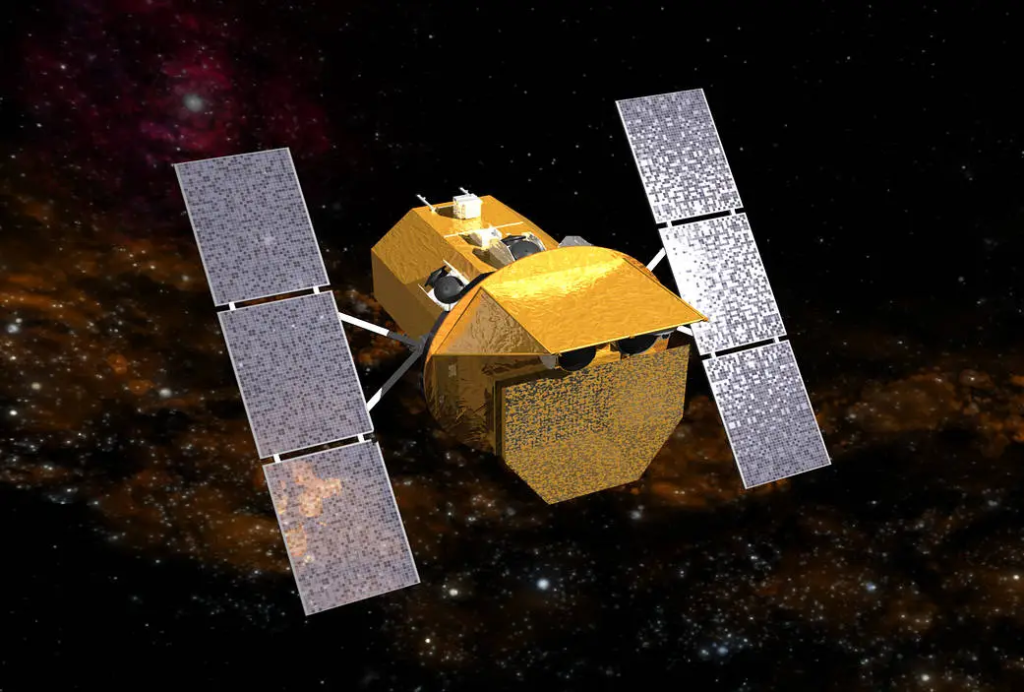
News –
- NASA launched the Swift Boost Mission, deploying the LINK spacecraft to prevent the Neil Gehrels Swift Observatory from burning up.
NASA’s Swift Boost Mission
- It is a NASA initiative that launched on July 3, 2026,
- Mandate – to rescue and reboost the aging Neil Gehrels Swift Observatory. Launched in 2004, the space telescope’s orbit had decayed due to heightened solar activity, risking atmospheric reentry and destruction.
- Objective: The mission uses a robotic spacecraft called LINK to autonomously rendezvous with, dock using robotic arms, and push the Swift observatory into a higher and safer orbit.
- Reboost Details: The LINK spacecraft was developed by a commercial startup, Katalyst Space Technologies, via a rapid and cost-effective $30 million NASA contract.
- Launch Vehicle: LINK was launched into space aboard a Northrop Grumman Pegasus XL rocket dropped from the belly of a Stargazer aircraft over the Pacific Ocean.
- Significance: It is the first commercial robotic satellite rescue attempt of its kind.
- If successful, it demonstrates crucial On-Orbit Servicing (OOS) capabilities—meaning satellites and space telescopes can be repaired, refueled, or repositioned in space rather than being abandoned, saving immense future replacement
India’s Fisheries Sector
Economy
News –
- India ranks as world’s 2nd largest fish producing nation accounting for 8% of global output.
- Fisheries account for nearly 7.43% Agricultural Gross Value Added (GVA), highest among the agriculture and allied sectors.
Initiatives to Promote Fisheries in India
- Pradhan Mantri Matsya Sampada Yojana (PMMSY): to usher in the “Blue Revolution” through the sustainable and responsible development of the fisheries sector.
- Pradhan Mantri Matsya Kisan Samridhi Sah-Yojana (PM-MKSSY): It aims to formalise the unorganised fisheries sector and support micro and small enterprises.
- Kisan Credit Card for Fisheries: Government has raised the lending limit under the scheme for fisheries and allied activities from Rs 2 lakh to Rs 5 lakh.
- Fisheries and Aquaculture Infrastructure Development Fund (FIDF): It offers a credit guarantee cover of up to Rs 12.50 crore and provides an interest subvention of up to 3% per year.
Nameri Tiger Reserve
Environment
News
- Tiger population in Assam’s Nameri Tiger Reserve rose fourfold, from 3 tigers in 2022 to 12 by the end of 2025.
Nameri Tiger Reserve
-
- It lies in northern Sonitpur district, Assam, along the Eastern Himalayan foothills.
- It is Assam’s second tiger reserve, after Manas, and is located within the Sonitpur Elephant Reserve.
- The glacier-fed Jia Bhoroli, a Brahmaputra tributary, defines the southern boundary of the core area.
- It is a habitat for the endangered Golden Mahseer.
- Vegetation: Tropical semi-evergreen forests, cane brakes, and riparian grasslands dominate the landscape, including Hollock, Nahor, and Simul.
- Faunal Diversity: Bengal tiger, Asian elephant, clouded leopard, gaur, and dhole; it is one of the last breeding sites of the endangered White-winged Wood Duck. The Potasali pre-release facility in Nameri trains captive-bred pygmy hogs for wild reintroduction.
- Its northern boundary connects the reserve with Arunachal Pradesh’s Pakke Tiger Reserve, facilitating transboundary megafauna movement.
e-Jagriti
Polity
News –
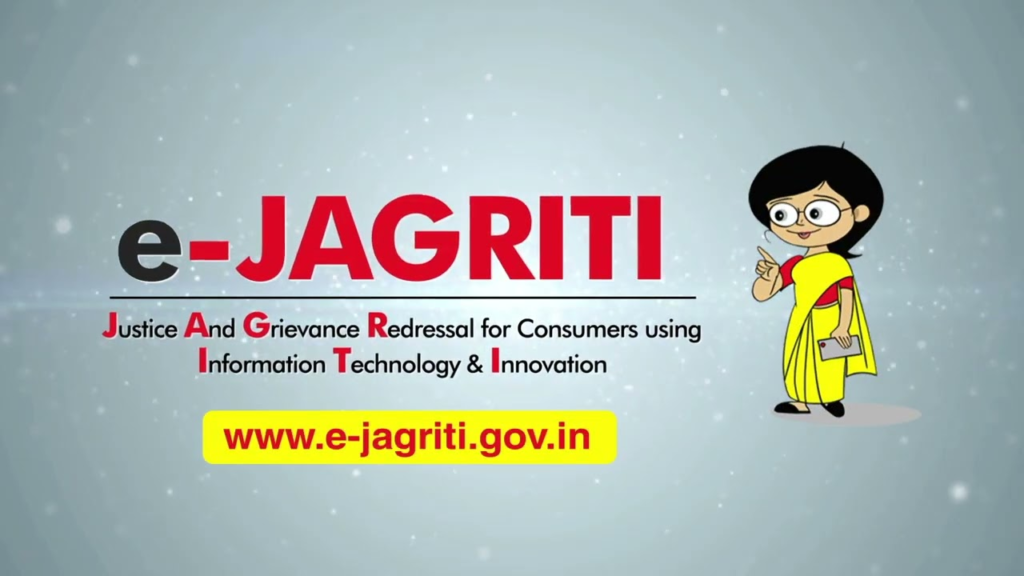
- The Prime Minister shared an article on the role of e-Jagriti (e-Justice and Grievance Redressal through Information Technology and Innovation) in addressing consumer complaints.
e-Jagriti
- e-Jagriti is the Department of Consumer Affairs’ integrated digital consumer grievance redressal platform, launched in January 2025.
- It provides paperless, AI-enabled, multilingual, and end-to-end online dispute resolution by integrating legacy consumer complaint systems.
- Key Components: Integrates legacy systems like OCMS, e-Daakhil, NCDRC CMS & CONFONET into a single, seamless interface.
- Key Features: Offers e-filing, virtual hearings, real-time case tracking, secure digital payments (Bharat Kosh/PayGov), and role-based access.
-
MCQs Compilation on National & International, State Current Affairs and Misscelanious Current Affairs
MCQs Compilation on National & International, State Current Affairs and Miscellaneos Current Affairs
1. India’s first bullet train corridor will connect:
A) Delhi and Mumbai
B) Mumbai and Pune
C) Mumbai and Ahmedabad
D) Ahmedabad and JaipurAnswer: C
2. Which Ministry launched the 7th National Water Awards?
A) Ministry of Environment, Forest and Climate Change
B) Ministry of Jal Shakti
C) Ministry of Rural Development
D) Ministry of Home AffairsAnswer: B
3. Who represented India in the Simla Agreement?
A) Jawaharlal Nehru
B) Lal Bahadur Shastri
C) Indira Gandhi
D) Morarji DesaiAnswer: C
4. The Narcotics Control Bureau functions under the:
A) Ministry of Health and Family Welfare
B) Ministry of Social Justice and Empowerment
C) Ministry of Home Affairs
D) Ministry of Law and JusticeAnswer: C
5.The Sardar Vallabhbhai Patel National Police Academy is located in:
A) New Delhi
B) Hyderabad
C) Bengaluru
D) BhopalAnswer: B) Hyderabad
-
Karnataka & Group C Current Affairs – July 7th, 2026
Appointments
New Chiefs Appointed for BPR&D, NCRB, and SVPNPA
Context: The Appointments Committee of the Cabinet (ACC) approved the appointment of three senior Indian Police Service (IPS) officers to lead premier police research, criminal intelligence, and training institutions under the Ministry of Home Affairs. Key Highlights:
- Bureau of Police Research and Development (BPR&D): Alok Kumar Mittal (1993-batch IPS officer, Haryana cadre) has been appointed as Director General. He takes charge at a critical juncture as the bureau oversees the nationwide rollout and training for the three new criminal laws.
- National Crime Records Bureau (NCRB): Amit Garg (1993-batch IPS officer, Andhra Pradesh cadre) has been named Director, succeeding Alok Ranjan. The post of NCRB Director has been temporarily upgraded to the rank of Director General on a personal basis for his tenure.
- Sardar Vallabhbhai Patel National Police Academy (SVPNPA): Sujeet Pandey (1994-batch IPS officer, Uttar Pradesh cadre) has been appointed to lead the country’s premier police training academy in Hyderabad, replacing Amit Garg.
- Institutional Framework: Operating directly under the Ministry of Home Affairs, BPR&D drives police modernization and policy research, NCRB (established in 1986) serves as the national repository for crime and criminal intelligence data, and SVPNPA trains Indian Police Service officer trainees and senior law enforcement leadership.
Awards
PM Modi Receives Indonesia’s Highest Civilian Honour
Context: Prime Minister Narendra Modi was conferred with Indonesia’s highest civilian decoration during his official state visit to Jakarta, marking a major milestone in bilateral diplomatic relations.
Key Highlights:
- Award: Bintang Adipurna (Star of the Republic of Indonesia).
- Awardee: Prime Minister Narendra Modi.
- Issuing Authority: Republic of Indonesia.
- Presenter: Indonesian President Prabowo Subianto at Istana Merdeka (the Presidential Palace) in Jakarta.
Key Achievement: Honoured for his outstanding leadership in advancing the India-Indonesia Comprehensive Strategic Partnership and promoting bilateral cooperation across defense, maritime security, critical minerals, and healthcare.
About the Award: Instituted in 1959 as the highest civilian order of the Republic of Indonesia. Conferred upon individuals who have rendered exceptional service to the unity, continuity, and prosperity of the nation, placing PM Modi alongside historical figures like Jawaharlal Nehru who also received Indonesia’s highest state decoration.
-
Karnataka & Group C Current Affairs – July 6th, 2026
Awards
ICMR-MINDS Wins Gold at National e-Governance Awards 2026
Context: A flagship digital health initiative of the Indian Council of Medical Research won national recognition for integrating AI-powered mental healthcare into routine medical delivery.
Key Highlights:
- Award: Gold Award for Innovation by Use of AI and Other New Age Technologies.
- Awardee: ICMR-MINDS (Mental Health and Substance Use Disorder Integrated NCD Care Delivery System).
- Issuing Authority: Department of Administrative Reforms and Public Grievances (DARPG) and the Ministry of Electronics and Information Technology (MeitY).
- Presenter: Conferred during the 29th National Conference on e-Governance (NCeG) 2026 held in Jaipur, Rajasthan.
Key Achievement: Deployed an AI-enabled Clinical Decision Support System (CDSS) across seven states, empowering frontline workers to screen and manage mental health disorders without needing immediate psychiatric intervention.
About the Initiative: Developed as a National Health Research Priority project by the ICMR. Operates on a structured bidirectional referral framework, allowing stable patients to receive care at primary health centers while reserving specialized hospitals for severe cases.
Important Days
Dr. Syama Prasad Mookerjee Birth Anniversary
- Observed Date: July 6
- Commemorative Release: ₹125 Silver Coin and Commemorative Stamp issued by the Government of India to mark his 125th birth anniversary year.
- Objective: To commemorate the visionary statesman and educationist for his foundational role as India’s first Minister of Industry and Supply, his academic leadership at Calcutta University, and his tireless advocacy for national integration and a unified constitutional framework.
-
11 Year of Digital India Programme | Matcha Tea | Mumbai-Ahmedabad High Speed Rail (MAHSR) | 7th National Water Awards | Simla Agreement | MANAS Initiative | Hasdeo-Arand Forests
11 Year of Digital India Programme
Polity
Context
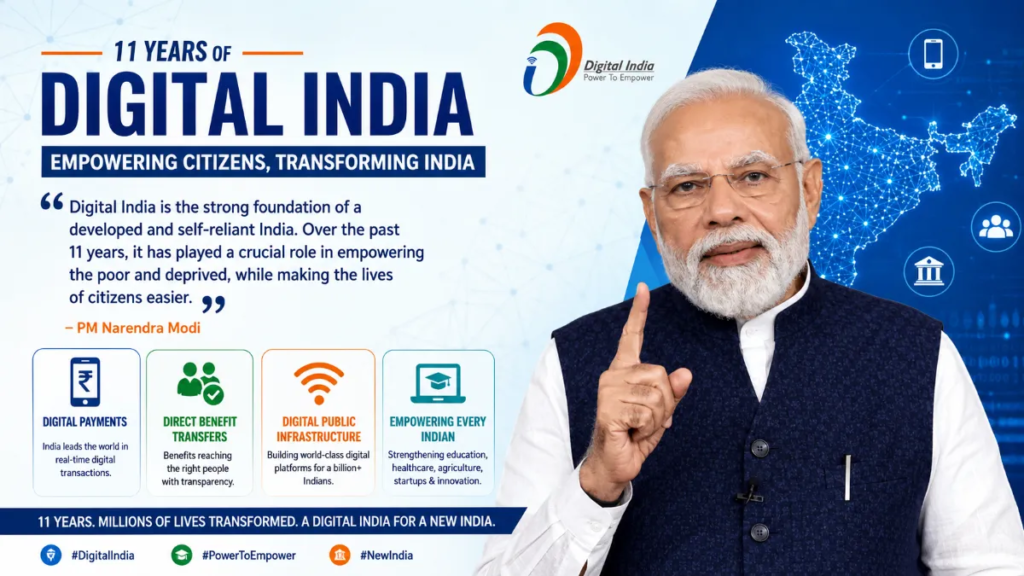
- The Digital India Programme completes 11 years as on 1 July 2026.
Digital India Programme,
- Launched on – 1 July 2015
- Implementation – Ministry of Electronics and Information Technology (MeitY)
- Objective – It is a flagship scheme aimed at transforming the country into a digitally empowered society and knowledge economy.
Flagship Initiatives under Digital India
- JAM Trinity: The Foundation of Digital India has revolutionised financial inclusion and welfare delivery in India. It brought millions into the formal banking system and enabled seamless access to government services.
- DigiLocker: DigiLocker is replacing physical documents with a secure digital wallet, and transforming document storage and verification across India.
- Unified Payments Interface (UPI): Completing ten years in 2026, UPI is transforming digital payments through instant and secure transactions for citizens and businesses.
- eSanjeevani: The telemedicine platform is connecting patients with doctors remotely, especially in rural and underserved regions.
- Tele MANAS provides free tele-counselling and mental health support nationwide.
- Government e-Marketplace (GeM) has transformed public procurement by making it transparent, efficient and paperless.
- Open Network for Digital Commerce (ONDC) is creating an open and interoperable digital commerce ecosystem that connects buyers and sellers across platforms.
- AgriStack – It is a farmer-centric DPI powering services such as e-NAM for online agricultural trading and Kisan e-Mitra, an AI-powered chatbot providing instant farming information and government scheme support.
- DIKSHA (Digital Infrastructure for Knowledge Sharing) is transforming school education through curriculum-linked digital learning resources and teacher training.
- SWAYAM (Study Webs of Active Learning for Young Aspiring Minds) and SWAYAM Prabha are expanding access to quality education beyond classrooms.
- PMGDISHA bridged the rural digital divide by training citizens in smartphone usage, internet access, digital payments and online services.
- FutureSkills Prime is preparing learners for emerging technologies such as AI, cloud computing, cybersecurity and data analytics.
- Skill India Digital Hub (SIDH) is a unified platform for skilling, certification and employment services.
- IndiaAI Mission is strengthening AI education, infrastructure and responsible AI adoption.
Matcha Tea
Economy
Context
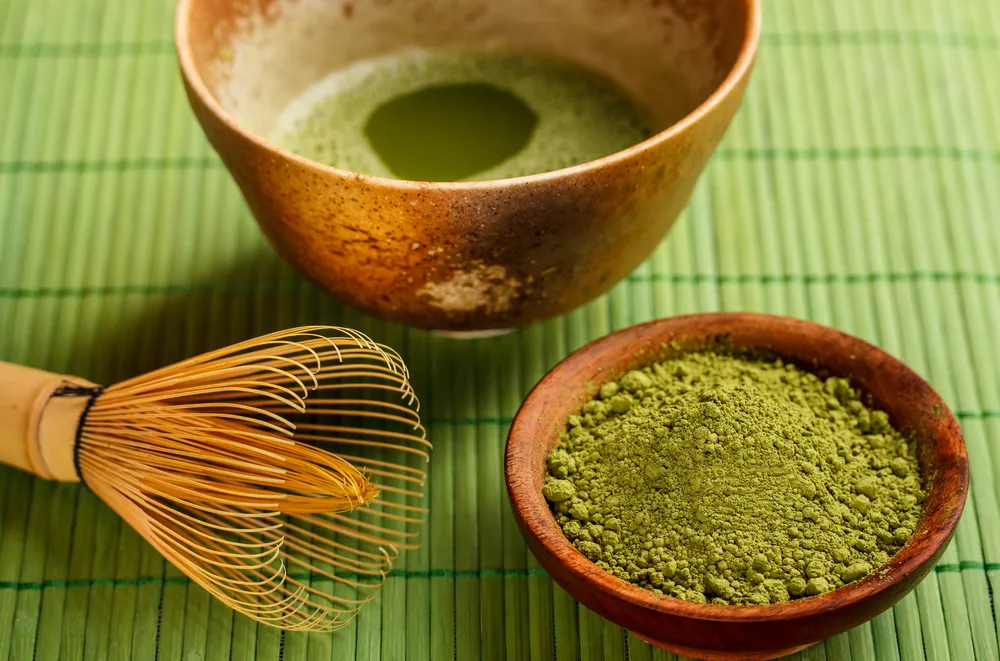
- Assam has become the first state in India to commercially produce Matcha tea, with production commencing at the Chota Tingrai Tea Estate in eastern Assam’s Tinsukia district.
Matcha
-
- Matcha is made after shading Camellia sinensis tea leaves for three to four weeks before harvest.
- Blocking 90% of sunlight from the leaves boosts their chlorophyll and amino acid levels, and gives its characteristic bright green colour and rich umami flavour.
- Matcha originated through cultural exchanges between China and Japan during the premodern period.
- China is the largest producer of matcha tea.
Additional Information – Indian Tea Industry
-
- India is the 2nd largest tea producer and largest black tea producer.
- Export destinations – Iran, Iraq, Syria, Saudi Arabia, Russia etc. India is the 4th largest tea exporter in the World.
- Employment – The Indian tea Industry is employing 1.16 million workers directly.
- Note – Assam grows about 55% of the teas produced in India. India’s tea production has increased by 39% in 2022 from 2008.
- Prominent tea regions: Assam (Assam Valley, Cachar) and West Bengal (Dooars, Terai, Darjeeling).
- Global reputation: Indian teas, especially Assam, Darjeeling, and Nilgiri, are renowned for their quality.
Geographical Condition for Tea production
- The tea plant grows well in tropical and subtropical climates.
- Soil: It requires deep and fertile well-drained soil, rich in humus and organic matter.
- Temperature: The average annual temperature for tea plants to grow well is in the range of 15-23°C.
- Precipitation: The rainfall needed is between 150-200 cm.
- Frequent showers evenly distributed over the year ensure continuous growth of tender leaves.
- Major tea producing states are Assam, hills of Darjeeling and Jalpaiguri districts in West Bengal, Tamil Nadu and Kerala.
- Apart from these, Himachal Pradesh, Uttarakhand, Meghalaya, Andhra Pradesh and Tripura are also tea-producing states in the country.
Asia Tea Alliance
- Member countries – It is a coalition of tea associations from major tea-producing countries in Asia like India, China, Sri Lanka, Japan etc.
- Objective – It aims to promote the collective interests of member nations within the global tea market.
Tea Board of India
- It was set up as a statutory body in 1954 under the Tea Act, 1953.
- It was established for the purposes of regulating the Indian tea industry and protecting the interests of tea producers in India.
- Headquarters-Kolkata.
Mumbai-Ahmedabad High Speed Rail (MAHSR)
Economy
Context
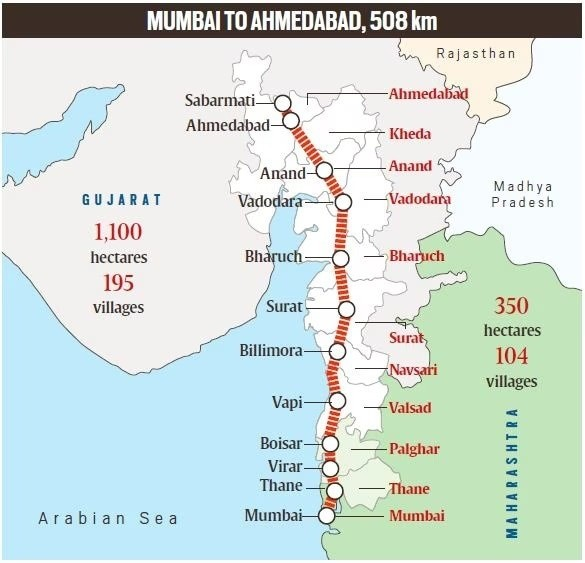
- India is nearing completion of its first bullet train corridor – the Mumbai-Ahmedabad High Speed Rail (MAHSR).
About
- The corridor will connect Mumbai and Ahmedabad in about 1 hour 58 minutes. It covers a total length of approximately 508 kilometres.
- 12 stations have been planned along the route.
- It is expected to commence in August 2027. The first section to open will be from Surat to Vapi.
- The corridor has a design speed of 350 kmph and an operational speed of 320 kmph.
- The MAHSR Project is being developed using Japanese Shinkansen technology and operational practices.
- Track System: J-Slab ballastless track technology is being introduced in India for the first time.
7th National Water Awards
Miscellaneous
Context
- Ministry of Jal Shakti has launched the 7th National Water Awards on the Rashtriya Puraskar portal of Ministry of Home Affairs.
National Water Awards
- The National Water Awards were first launched in 2018.
- Objective – The awards aim to recognize efforts in water management and conservation.
- Significance – The initiative supports the government’s vision of a ‘Jal Samridh Bharat’ (Water Prosperous India).
Simla Agreement
International Relations
Context
- The Simla Agreement completed 54 years on 2 July 2026.
About
- The Simla Agreement was signed in 1972 to establish lasting peace between India and Pakistan post the 1971 war.
- The agreement was signed between Indian Prime Minister Indira Gandhi and Pakistani President Zulfikar Ali Bhutto.
Key Provisions of Simla Agreement
- Peaceful resolution: Both countries agreed to resolve disputes through bilateral negotiations without involving third parties.
- Line of Control (LoC): The ceasefire line in Jammu and Kashmir was redefined as the Line of Control, with both sides committing not to alter it unilaterally.
- Release of prisoners: India agreed to release Pakistani prisoners of war, and Pakistan committed to normalising relations and recognising the sovereignty of Bangladesh.
MANAS Initiative
Government Schemes
Context
- The National Narcotics Helpline MANAS is strengthening India’s fight against drug abuse.
MANAS (Madak Padarth Nishedh Asoochna Kendra)
-
- It was launched in 2024 under the aegis of the Narcotics Control Bureau (NCB), Ministry of Home Affairs, in collaboration with the Digital India Corporation (DIC).
- It enables citizens to report drug-related activities, seek counselling, and access rehabilitation support at any time.
- The platform is accessible through the national helpline number 1933, the official portal, email and the UMANG app.
- MANAS brings together the vision of Digital India and the mission of a Nasha Mukt Bharat.
India’s War Against The Drug Menace
- Constitutional Basis: Article 47 states that the State not to promote consumption of intoxicating drinks and drugs that are injurious to health except for medicinal purposes.
- Global Commitment: India is a party to the 1961 Single Convention on Narcotic Drugs, the 1971 Convention on Psychotropic Substances and the 1988 UN Convention against Illicit Drug Trafficking.
- Legal Frameworks: The Drugs and Cosmetics Act, 1940, NDPS Act, 1985, PITNDPS Act, 1988.
- Key Initiatives: NIDAAN Portal for monitoring drug cases; Nasha Mukt Bharat Abhiyan for awareness, prevention and rehabilitation.
Hasdeo-Arand Forests
Environment
Context
- The Ministry of Environment, Forest and Climate Change (MoEFCC) has granted environmental clearance for mining in the Kente Extension Integrated Coal Block in Chhattisgarh’s Hasdeo-Arand forests.
Hasdeo-Arand forests
- The Hasdeo-Arand forests, spread across Chhattisgarh’s Korba, Surguja, and Surajpur districts, cover about 1.7 lakh hectares and are considered the Green Lungs of Central India.
- They are home to around 640 plant species and nine schedule-1 wildlife species, which are accorded highest legal protection.
- It is also the catchment area of the Hasdeo river, the largest tributary of the Mahanadi.
-
MCQs Compilation on National & International, State Current Affairs and Miscellaneos Current Affairs
MCQs Compilation on National & International, State Current Affairs and Miscellaneos Current Affairs
1. Consider the following statements regarding the International Big Cat Alliance (IBCA):
-
It is an India-led, treaty-based international alliance.
-
Its headquarters is located in India.
-
Bangladesh became its 27th member nation.
Which of the statements given above are correct?
A) 1 and 2 only
B) 2 and 3 only
C) 1 and 3 only
D) 1, 2 and 3Answer: D
2. Green hydrogen is produced by the electrolysis of:
A) Carbon dioxide
B) Methane
C) Water
D) AmmoniaAnswer: C) Water
3. Consider the following statements regarding the Digital India Programme:
-
It was launched on 1 July 2015.
-
It is implemented by the Ministry of Electronics and Information Technology.
-
It aims to transform India into a digitally empowered society and knowledge economy.
Which of the statements given above are correct?
A) 1 and 2 only
B) 2 and 3 only
C) 1 and 3 only
D) 1, 2 and 3Answer: D
4. Which State became the first in India to commercially produce Matcha tea?
A) West Bengal
B) Assam
C) Kerala
D) Tamil NaduAnswer: B
5. Who heads the High-Level Committee constituted to assess demographic changes in India?
A) Justice P.P. Navlekar
B) Justice Ranjan Gogoi
C) Justice N.V. Ramana
D) Justice U.U. LalitAnswer: A) Justice P.P. Navlekar
6. The 29th National Conference on e-Governance (NCeG) 2026 was held in:
A) Bhopal, Madhya Pradesh
B) Gandhinagar, Gujarat
C) Jaipur, Rajasthan
D) Hyderabad, TelanganaAnswer: C) Jaipur, Rajasthan
-