Category: National and International Current Affairs

  • India’s Commitment to Disability Rights | Jiyo Parsi Scheme | Jal Jeevan Mission | Domestic Systemically Important Banks (D-SIBs) | Navy’s new category in Indian Maritime Doctrine 2025

    India’s Commitment to Disability Rights

    Syllabus: GS1/ Society

    Context

    • The International Day of Persons with Disabilities (IDPD) is observed annually on December 3.
    • Aim – to promote the rights and well-being of people with disabilities.
    • Theme 2025: “Fostering disability-inclusive societies for advancing social progress.”

    India’s Commitment to Disability Rights

    • Convention on the Rights of Persons with Disabilities (2006) was adopted to ensure equal opportunity for PwDs.
    • According to Census 2011, there are 2.68 crore persons with disabilities in India which constitute 21 percent of the total population.

    Constitutional Provisions

    • Article 21: Guarantees the right to life and personal liberty, which includes the right to live with dignity.
    • Article 41 (DPSP): Right to work, education, and public assistance in cases of unemployment, old age, sickness, and disability.
    • Seventh Schedule: The subject of “relief of the disabled and unemployable” is listed under the state list, giving state governments jurisdiction over these matters.

    India’s Legal and Policy Framework for Disability Rights

    • The Rights of Persons with Disabilities Act, 2016 was enacted replacing the Persons with Disabilities Act of 1995.
    • India, as a signatory to the UN Convention on the Rights of Persons with Disabilities (UNCRPD), is committed to building an accessible and inclusive society.

    Government Initiatives and Schemes

    • Sugamya Bharat Abhiyan (Accessible India Campaign): Launched in 2015, the Campaign addresses long-standing barriers faced by persons with disabilities.
    • The Divyangjan Card, also known as the E-Ticketing Photo Identity Card (EPICS), is a railway identity card for people with disabilities that allows them to get concessions on train travel.
    • The Unique ID for Persons with Disabilities project is being implemented to create a national database of Persons with Disabilities (PwDs)
    • PM-DAKSH – It is a one-stop hub connecting persons with disabilities, training institutes, employers, and job aggregators under the national skill & employment ecosystem.
    • Promotion of Indian Sign Language (ISL): The Indian Sign Language Research and Training Centre (ISLRTC), set up in 2015 under DEPwD, serves as the nodal institution for advancing ISL across India.
    • In 2024, Government launched PM e-vidya Channel 31 on DTH, exclusively dedicated to ISL training for hearing-impaired students, special educators, and interpreters.

    Jiyo Parsi Scheme

    Syllabus: GS1/ Society, GS2/ Social Justice

    Context

    • The Ministry of Minority Affairs (MoMA), organised a comprehensive Advocacy and Outreach Workshop in Mumbai to promote the Jiyo Parsi Scheme.

    Parsi Community in India

    • According to the 2011 Census of India, the Parsi population in the country was 57,264.
    • This represented a significant decrease of approximately 22% from the 2001 census figure of 69,601.

    Jiyo Parsi Scheme

    • Launched in – 2013-14
    • Objective – to reverse the declining trend of Parsi population by adopting a scientific protocol and structured interventions.

    The scheme has three components:

    • Medical Assistance: Provides financial aid for infertility treatments such as IVF, ICSI, surrogacy, and post-conception care.
    • Advocacy: Provides for counselling of couples with fertility issues
    • Health of the Community: Offers monthly financial support to Parsi couples with children as well as to dependent elderly members.

    Jal Jeevan Mission

    Syllabus:GS2/Governance

    In News

    • Uttar Pradesh reported the highest number of complaints and constituted about 84% of the total complaints received over financial irregularities and poor quality of work under the Jal Jeevan Mission.

    Jal Jeevan Mission (JJM)

    • Launched in – 2019
    • Objective to provide Functional Household Tap Connections
    • Significance – to ensure 55 litres per capita per day of safe drinking water to all rural households by 2024.
    • However, due to implementation challenges, the deadline has now been extended to 2028.
    • Nodal Ministry – Ministry of Jal Shakti.
    • Financing  – Central sponsored scheme

    Domestic Systemically Important Banks (D-SIBs)

    Syllabus: GS3/ Economy

    In News

    • RBI’s 2025 list confirms that State Bank of India, HDFC Bank, and ICICI Bank continue as Domestic Systemically Important Banks (D‑SIBs).

    Domestic Systemically Important Banks (D-SIBs)

    • D-SIBs are banks considered “too big to fail.”
    • Their collapse can trigger system-wide financial instability, so they are placed under special regulation and higher supervision.
    • Concept introduced globally after the 2008 Global Financial Crisis.
    • Based on Basel-III guidelines, RBI released the D-SIB framework in 2014, it identifies banks based on: Size (Total exposures), interconnectedness, substitutability (difficulty of replacing services) & complexity.

    Navy’s new category in Indian Maritime Doctrine 2025

    ಭಾರತೀಯ ಕಡಲ ಸಿದ್ಧಾಂತ 2025

    Syllabus: GS3/Defence

    In News

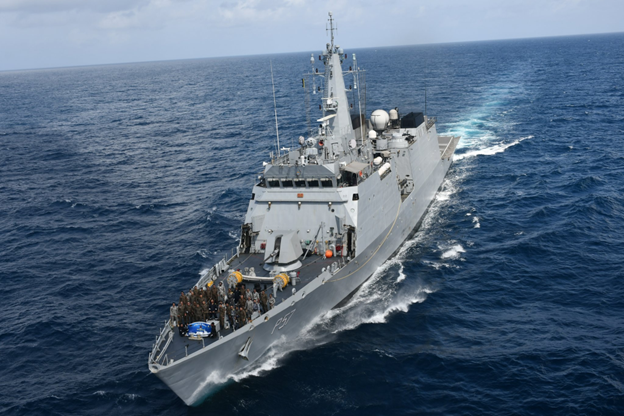
    • The Indian Navy’s Maritime Doctrine 2025, released by Chief of Naval Staff Admiral Dinesh Tripathi.

    Indian Maritime Doctrine

    • It is a foundational document guiding the Indian Navy in protecting India’s sovereignty, securing trade routes.
    • It acts as the “first responder in the maritime domain” in the Indian Ocean Region and beyond..
    • It was First released in 2004, revised in 2009 and amended in 2015.

    Key Highlights of the Indian Maritime Doctrine 2025

    • The 2025 edition reflects major shifts in the geopolitical environment and India’s strategic outlook, focusing on modern security challenges and national development goals.
    • Formal Recognition of “No-War, No-Peace”: For the first time, the doctrine formally recognizes the “no-war, no-peace” category as a distinct operational phase between peace and full-scale war.
    • Emphasis on Jointness and Integration: The doctrine prioritizes interoperability and integration across the Army, Navy, and Air Force,
    • It aligns with national visions such as Viksit Bharat 2047, Sagarmala, PM Gati Shakti, Maritime India Vision 2030, Maritime Amrit Kaal Vision 2047 and MAHASAGAR.

    Additional Information –

    • Viksit Bharat 2047 (Developed India by 2047): India’s vision to become a developed nation by its 100th year of independence, focusing on economic, social, and environmental progress.
    • Sagarmala Programme: A flagship program to modernize ports, develop coastal communities, and create efficient logistics, reducing costs and boosting trade.
    • PM Gati Shakti: A national master plan for integrated, multimodal connectivity (rail, road, ports, waterways, aviation) to create efficient economic corridors.
    • Maritime India Vision 2030 (MIV 2030): A roadmap for the maritime sector to enhance capacity, modernize ports, boost shipbuilding, and promote cruise tourism by 2030.
    • Maritime Amrit Kaal Vision 2047: Extends MIV 2030, aiming for India to be a global maritime hub by 2047, focusing on new mega-ports, shipbuilding clusters, and green port development (Harit Sagar).
    • MAHASAGAR (Mutual and Holistic Advancement for Security and Growth Across Regions): An overarching vision and doctrine promoting comprehensive maritime security, economic growth, and environmental sustainability in the Indian Ocean Region (IOR).
  • National Strategy For Financial Inclusion 2025–30 | Biological Weapons Convention (BWC) | The Central Excise (Amendment) Bill, 2025 | Sanchar Saathi App | Pradhan Mantri Virasat Ka Samvardhan (PM VIKAS) | Heron Mk II UAVs

    National Strategy For Financial Inclusion 2025–30

    Syllabus: GS3/ Economy

    Context

    • The Reserve Bank of India (RBI) has released the National Strategy for Financial Inclusion (NSFI) 2025–30, outlining a five-year plan (Panch-Jyoti) to deepen and widen financial inclusion in India.

    Strategic Pillars of the Panch-Jyoti

    1. Enhancing Financial Services: Provide equitable, responsible, and affordable financial services for households and micro-enterprises.
    2. Gender-Sensitive Inclusion: Implement women-centric strategies and support vulnerable and underserved groups.
    3. Linking Livelihoods and Finance: Integrate skill development and livelihood programmes with formal financial services.
    4. Financial Education: Use financial literacy to promote responsible financial behaviour and discipline.
    5. Consumer Protection: Strengthen customer protection and grievance redressal mechanisms for better reliability and accessibility.

    Government initiatives for financial inclusion

    • Pradhan Mantri Mudra Yojana (PMMY): It was launched in 2015, to support small and micro enterprises with loans up to ₹10 lakh.
    • Financial Inclusion Index (FI-Index) – It was launched by the Reserve Bank of India (RBI) to track the process of ensuring access to financial services.
    • Pradhan Mantri Suraksha Bima Yojana (PMSBY): Launched in 2015, PMSBY is an accident insurance scheme covering death and disability.
    • Pradhan Mantri Jeevan Jyoti Bima Yojana (PMJJBY): Launched in 2015, PMJJBY is a government-backed life insurance scheme.
    • Atal Pension Yojana (APY): It was launched in 2015 and provides social security to unorganised sector workers.
    • Pradhan Mantri Jan Dhan Yojana (PMJDY): Launched in 2014, PMJDY aimed to bring the unbanked into the formal financial system by expanding access to savings accounts, credit, remittance, insurance, and pensions.

    Biological Weapons Convention (BWC)

    Syllabus: GS2/Global Grouping in India’s Interest; GS3/Security

    Context

    • 50 Years of Biological Weapons Convention (BWC)

    Bioterrorism

    • Definition – It refers to the deliberate release of biological agents — such as bacteria, viruses, or toxins — to cause illness or death among humans, animals, or plants.
    • Examples – Bacillus anthracis (anthrax), Variola major (smallpox), and toxins like botulinum.
    • The Biological Weapons Convention (BWC) serves as the key international treaty prohibiting the development, production, and possession of biological weapons.

    Biological Weapons Convention (BWC)

    • It was established and entered into force on March 26, 1975.
    • Uniqueness – It is the first multilateral disarmament treaty to ban an entire category of weapons of mass destruction.
    • Objective – It prohibits the development, production, acquisition, transfer, stockpiling, and use of biological and toxin weapons.
    • Implementation United Nations Office for Disarmament Affairs (UNODA).
    • Membership: 189 countries including India.

    The Central Excise (Amendment) Bill, 2025

    Syllabus: GS2/ Polity and Governance

    Context

    • The Central Excise (Amendment) Bill, 2025 was introduced in Lok Sabha on December 1, 2025.

    The Central Excise (Amendment) Bill, 2025

    • The Bill seeks to amend the Central Excise Act, 1944.
    • The Act provides for the levy and collection of central excise duties on goods manufactured or produced in India.
    • The Bill increases central excise duty on unmanufactured tobacco, manufactured tobacco, tobacco products, and tobacco substitutes.
    • Unmanufactured tobacco (such as sun-cured tobacco leaves) from 64% to 70%.

    Sanchar Saathi App

    Syllabus: GS2/Government Initiatives

    Context

    • Department of Telecommunications (DoT) has directed phone makers to pre-install the Sanchar Saathi app on devices sold from March 2026 onwards.

    Sanchar Saathi

    • Launched by – Department of Telecommunications
    • Objective to help users report and protect against mobile related fraud and theft.

    Key Features

    • Chakshu: Users report suspected fraud via calls, SMS, or WhatsApp, targeting scams like fake KYC updates.​
    • IMEI Tracking and Blocking: Tracks and blocks lost/stolen phones nationwide across all telecom networks.​
    • Verify Mobile Handset Genuineness: Checks if a device is authentic using IMEI or barcode scan.​
    • Report Masked International Calls: Flags calls from abroad disguised as local (+91 followed by 10 digits).​
    • Know Your Internet Service Provider: Searches wireline ISPs by PIN code, address, or name.​

    Pradhan Mantri Virasat Ka Samvardhan (PM VIKAS)

    Syllabus: GS2/Welfare Schemes

    In News

    • PM VIKAS is uplifting minority communities through skill development and  promoting entrepreneurship .

    Pradhan Mantri Virasat Ka Samvardhan (PM VIKAS)

    • Financing – Central Sector Scheme
    • Implementation – Ministry of Minority Affairs
    • It converges five erstwhile schemes vi ‘Seekho Aur Kamao’, ‘Nai Manzil’, ‘Nai Roshni’ and ‘USTTAD’ & ‘Hamari Dharohar’ .
    • Aim – It focuses on upliftment of six notified minority communities through skill development; entrepreneurship and leadership of minority women; and education support for school dropouts.

    Do you know?

    • Six officially recognized minority groups in India —Muslims, Christians, Sikhs, Buddhists, Jains, and Zoroastrians (Parsis)—on socio-economic fronts.

    Heron Mk II UAVs

    Syllabus: GS3/ Defence

    Context

    • India has initiated the procurement of Heron MK-II drones from Israel under emergency provisions invoked after Operation Sindoor.

    Heron Mk II UAVs

    • Developer: Israel Aerospace Industries (IAI)
    • Capability: The Heron Mk II is a medium-altitude, long-endurance (MALE) UAV.
    • It can carry close to 500 kg of payload and sustain more than 24 hours of continuous flight.
  • World AIDS Day | Private Sector Entry in India’s Nuclear Sector | Ellora Caves | Hornbill Festival | India Re-Elected to UNESCO Executive Board | Central Industrial Security Force (CISF) | Hansa-3 NG Trainer Aircraft

    World AIDS Day

    Syllabus: GS2/Health

    Context

    • World AIDS Day is observed on December 1 every year.

    World AIDS Day

    • It is observed every year to raise awareness about the HIV/AIDS epidemic.
    • It was first marked in 1988 by the World Health Organization (WHO).
    • Theme 2025: Overcoming disruption, transforming the AIDS response.

    Acquired immunodeficiency syndrome (AIDS)

    • Pathogen – It is a chronic, potentially life-threatening health condition caused by the human immunodeficiency virus (HIV) which damages the human immune system.
    • Transmission: Through direct contact with certain body fluids (blood, semen, rectal fluid, vaginal fluid or breast milk) from a person infected with HIV.
    • Symptoms:
      • Stage 1: Flu-like illness (Fever, chills, rashes, night sweats)
      • Stage 2: Clinical latency (No particular symptoms)
      • Stage 3: AIDS (Weakening of Immune System)
    • Prevention: Prevention is better than cure, using protective techniques, non-contaminated needles & preventing mother to child transmission.
    • Treatment: There is no cure for HIV infection. It is treated with antiretroviral drugs, which stop the virus from replicating in the body. Untreated HIV can progress to AIDS, often after many years.

    Steps taken by Government of India

    • National AIDS Control Programme (NACP) (Central Sector Scheme)
    • India has achieved the 6th MDG of halting and reversing the HIV epidemic.
    • Prevention from Parent to Child Transmission (PPTCT) programme
    • HIV/AIDS Act 2017 (Prohibits discrimination against HIV-infected people on any grounds)
    • 90:90:90 strategy as adopted by UNAIDS (90% (diagnosed, treatment (by a nti-retroviral treatment (ART)) & suppression)) by 2020. Extended by 10 years with the goal post of 95-95-95.
    • Project ACCELERATE (John Hopkin & NACO initiative): To provide HIV Services through Safe Zindagi online portal.
    • Mission Sampark: Its purpose was to “bring back” people living with HIV (PLHIV) who had stopped antiretroviral therapy (ART).

    Private Sector Entry in India’s Nuclear Sector

    Syllabus: GS3/ Energy

    Context

    • Prime Minister Narendra Modi has said that the government is moving towards opening up the nuclear sector for private players.

    India’s Nuclear Sector

    • Nuclear power plants in India are owned and operated only by Nuclear Power Corporation of India Ltd (NPCIL).
    • Key legislations To allow private sector participation the government has proposed amendments to key legislations.
    • Atomic Energy Act, 1962, a framework for nuclear energy development and regulation.
    • Civil Liability for Nuclear Damage Act, 2010, ensuring compensation mechanisms for nuclear incidents.

    Additional Information – Nuclear Energy

    • Definition – Nuclear energy is the energy released during nuclear reactions, either through fission (splitting of atomic nuclei) or fusion (merging of atomic nuclei).

    Status of Nuclear power capacity in India

    • Nuclear power capacity of India 8,180 MW, spread across 24 nuclear power reactors.
    • Nuclear power capacity target – 100 GW by 2047
    • Capacity Expansion: 10 new reactors (totaling 8 GW) under construction across Gujarat, Rajasthan, Tamil Nadu, Haryana, Karnataka, and Madhya Pradesh.

    Important Nuclear Power Plants in India

    NUCLEAR POWER STATION

    STATE

    TOTAL CAPACITY (MW)

    Tarapur

    Maharashtra

    1,400

    Rawatbhata

    Rajasthan

    1,180

    Kudankulam

    Tamil Nadu

    2,000

    Kaiga

    Karnataka

    880

    Kakrapar

    Gujarat

    1140

    Kalpakkam

    Tamil Nadu

    440

    Narora

    Uttar Pradesh

    440


    POWER STATION

    OPERATOR

    STATE

    TOTAL CAPACITY (MW)

    Jaitapur

    National Power Corporation of India Limited

    Maharashtra

    9,900

    Kovvada

    National Power Corporation of India Limited

    Andhra Pradesh

    6,600

    Mithi Virdi

    National Power Corporation of India Limited

    Gujarat

    6,000

    Haripur

    National Power Corporation of India Limited

    West Bengal

    4,000

    Kudankulam

    National Power Corporation of India Limited

    Tamil Nadu

    2,800

    Gorakhpur

    National Power Corporation of India Limited

    Haryana

    2,800

    Bhimpur

    National Power Corporation of India Limited

    Madhya Pradesh

    2,800

    Mahi Banswara

    National Power Corporation of India Limited

    Rajasthan

    1,400

    Kaiga

    National Power Corporation of India Limited

    Karnataka

    1,400

    Chutka

    National Power Corporation of India Limited

    Madhya Pradesh

    1,200

    Madras

    Bharatiya Nabhikiya Vidyut Nigam Limited

    Tamil Nadu

    300


    Ellora Caves

    Syllabus: GS1/ History and Culture

    Context

    • Scottish historian William Dalrymple has urged the Maharashtra government to bring greater visibility to the lesser-known heritage sites around the Ellora Caves.

    Ellora Caves

    • Located in – Chhatrapati Sambhajinagar, Maharashtra, the Ellora Caves are among India’s first UNESCO World Heritage sites.
    • The cave complex was carved between 600 CE and 1000 CE, spanning the rule of the Chalukyas, Rashtrakutas, and Yadavas.
    • Religious Pluralism: The complex comprises 34 major caves, 12 Buddhist, 17 Hindu, and 5 Jain, demonstrating a unique period of interreligious harmony and artistic exchange.

    Key Architectural Features

    • Kailasa Temple (Cave 16): It is carved from a single monolithic basalt rock, dedicated to the Hindu god Lord Shiva.
    • Buddhist Caves: These include monasteries (viharas) and prayer halls (chaityas).
    • Jain Caves: Built during the later phase of Ellora’s development.

    Hornbill Festival

    Syllabus: GS1/Culture

    In News

    • The 26th edition of Nagaland’s famed Hornbill Festival, known as the “Festival of Festivals,” began at the Naga Heritage Village in Kisama, Kohima, coinciding with the state’s Statehood Day (December 1st).

    Hornbill Festival

    • It is held annually in the first week of December at Kisama near Kohima.
    • It is a vibrant cultural showcase of all Naga tribes.

    Significance –

    • It was conceived in 2000 to promote unity and preserve ethnic heritage.
    • It highlights both traditional and contemporary Naga culture through music, crafts, cuisine, and folklore.
    • Additional Information -Great Hornbill
    • Scientific name – Buceros bicornis.
    • Also known as – It is also known as the concave-casqued hornbill, great Indian hornbill or great pied hornbill.
    • Habitat – It is found in the Indian subcontinent and Southeast Asia.
    • Uniqueness – The most prominent feature of the Great Hornbill is the bright yellow and black casque (hard structure on the head of some birds) on top of its massive bill.
    • Festival – The Hornbill Festival is celebrated in Nagaland.
    • State Bird – Great Hornbill is the state bird of Arunachal Pradesh and Kerala.

    Conservation status 

    • IUCN Status – Vulnerable
    • Indian Wildlife Protection Act,1972 – Schedule I

    India Re-Elected to UNESCO Executive Board

    Syllabus:GS2/IR

    In News

    • India has been re-elected to the UNESCO Executive Board for the 2025-29 term.

    UNESCO Executive Board

    • It is one of the three constitutional organs of the U.N. agency (the others being the General Conference and the Secretariat) and it is elected by the General Conference.
    • It acts under the authority of the General Conference.
    • It examines the programme of work for the organisation and corresponding budget estimates submitted to it by the Director-General.
    • It consists of 58 Member States each with a four-year term of office.

    Central Industrial Security Force (CISF)

    Syllabus: GS3/Internal Security

    Context

    • The Central Industrial Security Force (CISF) has introduced a revised posting policy for personnel assigned to Parliament security duties.

    Central Industrial Security Force

    • It is a paramilitary force established in 1969, under the Central Industrial Security Force Act, 1968.
    • Every year, CISF Raising Day is observed on March 10.
    • Operates under – Ministry of Home Affairs of India.

    Functions –  It provides security to the strategic establishment including

    • Department of Space
    • Department of Atomic Energy,
    • Airports, Delhi Metro and ports.
    • Historical monuments
    • Basic areas of the Indian economy such as petroleum and natural gas, electricity, coal, steel and mining.
    • Additional Information – Paramilitary forces of India

    Hansa-3 NG Trainer Aircraft

    Syllabus: GS3/ Defence

    Context

    • The CSIR-National Aerospace Laboratories (NAL), Bengaluru, launched a “production version” of the indigenous Hansa-3(NG) trainer aircraft.

    Hansa-3

    • It is India’s indigenous two-seat trainer aircraft developed by CSIR-NAL.
    • It is designed for basic flight training catering mainly to flying clubs and pilot training schools.
  • Russia’s S-500 Air Defence System | Operation Sagar Bandhu

    Russia’s S-500 Air Defence System

    Defence

    In News

    • The Prime Minister of India and the President of Russia are expected to discuss India’s interest in the next-generation S-500 air defence system.

    S-500 Air Defence System

      • It is Russia’s most advanced long-range, surface-to-air and anti-space defence system, designed to intercept a wide spectrum of modern and future airborne threats. 
    • It can intercept aircraft, missiles, and hypersonic threats at distances up to 600 km.
    • It is operational at altitudes up to 200 km.  It has a reaction time 3–4 seconds, nearly twice as fast as the S-400.

    Feature

    S-400

    S-500

    Range

    380 km

    600 km

    Target Altitude

    30–40 km

    Up to 200 km (near-space)

    Threats Intercepted

    Aircraft, cruise missiles, limited ballistic missiles

    Ballistic missiles, hypersonic weapons, stealth aircraft, LEO satellites

    Reaction Time

    9–10 sec

    3–4 sec

    Anti-Satellite Capability

    No

    Yes

    Role

    Long-range air defence

    Air + space defence

    Operation Sagar Bandhu

    International

    Context

    • In the aftermath of Cyclone Ditwah, which caused widespread devastation across Sri Lanka, India swiftly launched Operation Sagar Bandhu to support relief and rescue efforts.

    Operation Sagar Bandhu

    • It is a Humanitarian Assistance and Disaster Relief (HADR) operation launched by India to provide emergency aid to Sri Lanka

    Under the operation, India dispatched:

    • Relief material
    • Medical supplies
    • Emergency equipment
    • Significance – The operation reflects India’s commitment to its Neighbourhood First Policy and the broader maritime vision of MAHASAGAR.

    Additional Information – Cyclone Ditwah

    • It is a tropical storm that rapidly formed over the southwest Bay of Bengal.  
    • The name Ditwah was contributed by Yemen.
  • Skyroot’s first orbital rocket, Vikram-I | India Re-elected to International Maritime Organisation Council

    Skyroot’s first orbital rocket, Vikram-I

    Science & Technology

    In News

    • Prime Minister Narendra Modi inaugurated Indian space startup Skyroot’s Infinity Campus and Skyroot’s first orbital rocket, Vikram-I, with the capability to launch satellites to orbit. 

    Skyroot 

    • It is India’s leading private space company, founded by Pawan Chandana and Bharath Dhaka,
    • In November 2022, Skyroot launched its sub-orbital rocket, Vikram-S, becoming the first Indian private company to launch a rocket to space

    Vikram-I 

    • It is built by Skyroot Aerospace  and is named after Vikram Sarabhai, the father of India’s space programme.
    • It is India’s first private orbital-class launch vehicle designed to serve the small satellite market with rapid, cost-effective launches.

    India Re-elected to International Maritime Organisation Council

    Environment

    In News

    • India has been re-elected to the Council of the International Maritime Organisation (IMO) for 2026-27 with the highest vote tally. 

    International Maritime Organization

      • It  is the United Nations specialized agency 
      • Mandate – It is responsible for the safety and security of shipping and the prevention of marine and atmospheric pollution by ships. ​
      • Genesis: IMO was established in 1948 following a UN conference in Geneva and came into existence in 1958.
      • Members: IMO has 175 Member States 
    • Headquarters – London, United Kingdom.
    • India joined the IMO in 1959.
    • Structure: The IMO is administered by a biennially convened Assembly of all member states and a 40-member Council elected for two-year terms.
  • RISE Initiative | Operation Pawan

    RISE Initiative

    Environment

    Context

    • IIT Kharagpur launched Impact RISE (Research, Innovation, Skilling, and Entrepreneurship)

    RISE Initiative 

      • Mandate – It focuses on sustainable tech and management practices for societal transformation.
    • Four pillars – research, innovation, skilling, and entrepreneurship.
    • Significance- It will involve research aligned with sustainable development goals and India’s climate and development priorities.

    Operation Pawan

    Defence

    Context

    • The Chief of the Army Staff (COAS), General Upendra Dwivedi, has paid homage to soldiers who laid down their lives during Operation Pawan (1987 – 1990) in Sri Lanka.

    Operation Pawan

    • It was launched by the Rajiv Gandhi government in 1987 after the signing of the Indo–Sri Lanka Accord.
    • India deployed the Indian Peace Keeping Force (IPKF) to Sri Lanka during the country’s civil war between the minority Tamil population, and the Sinhalese-majority government.

    India was deeply concerned due to:

    • Ethnic and cultural ties with Tamil Nadu
    • Escalating violence
    • Rising refugee inflow into India

    Do you know?

    • The Sri Lankan civil war ended on May 18, 2009 with the defeat of the Liberation Tigers of Tamil Eelam (LTTE).
    • While India had not formally commemorated Operation Pawan for decades, Sri Lanka maintains an IPKF memorial in Colombo.
    • Now, this has changed with the Indian Army officially recognising the sacrifices made by troops during the operation.
  • Nayi Chetna 4.0

    Nayi Chetna 4.0

    Health & Society

    In News

    • Union Minister Shri Shivraj Singh Chouhan launched ‘Nayi Chetna 4.0’ national campaign for gender equality and women’s empowerment.

    Nayi Chetna 4.0

    • It is a month-long campaign, organised by the Deendayal Antyodaya Yojana – National Rural Livelihoods Mission (DAY-NRLM) under the Ministry of Rural Development.
    • Objective – It aims to strengthen community action against gender-based violence and promote women’s safety, dignity and economic empowerment across rural India.
    • Significance – The campaign focuses on enabling safe mobility, recognising women as key economic contributors, and addressing unpaid care work through shared community responsibility.
  • Dr. Verghese Kurien

    Dr. Verghese Kurien

    Economy

    In News

    • 26th November commemorates the birth anniversary of Dr. Verghese Kurien.

    Dr. Verghese Kurien (1921-2012)

    • He was the architect of India’s White Revolution and is celebrated as the “Father of the White Revolution.” 
    • Born in Kozhikode, Kerala, he spearheaded Operation Flood in 1970, which transformed India from a milk-deficient country into the world’s largest milk producer.
    • He was instrumental in establishing the Anand cooperative model, exemplified by Amul, which became a blueprint for dairy development across India.
    • His efforts also led to the creation of institutions such as the National Dairy Development Board (NDDB) and the Institute of Rural Management Anand (IRMA).
    • Dr. Kurien revolutionized the edible oil industry by launching the brand ‘Dhara’ in 1979.
    • Awards received –  Padma Vibhushan, Ramon Magsaysay Award, and the World Food Prize.
  • Constitution Day

    Constitution Day

    Polity & Governance

    In News

    • 26th November is being celebrated as Constitution Day to mark the adoption of the Constitution of India by the Constituent Assembly (CA).

    Constitution Day (Samvidhan Divas, National Law Day)

    • In 2015, the Ministry of Social Justice and Empowerment notified the GOI’s decision to celebrate the 26th November as Constitution Day.
    • The day was celebrated as a tribute to Dr B R Ambedkar as Chairman of the Drafting Committee.

    Historical Background:

    • 1934: Demand for the Constituent Assembly was made by M.N. Roy.
    • 1940: Demand was accepted by the British government.
    • 1946: 9th December, CA conducted the first session on Draft Constitution.
    • 1949: 26th November, CA finally adopted the Constitution of India.
    • 1950: 26th January, the Constitution of India came into force.

    Key Facts about Constituent Assembly

    • Took 2 years, 11 months & 18 days for drafting the Constitution of India.
    • Dr Sachchidananda Sinha was appointed as 1st President of CA.
    • Dr Rajendra Prasad was the chairman of the Constituent Assembly.
    • Jawaharlal Nehru (PM) made the ‘Objectives Resolution’ on 13th December 1946, later adopted as Preamble on 22nd Jan 1947.
    • The constituent assembly acted as the temporary legislature until a new one was to be constituted. 

    Brief About Constitution Of India

    • The longest written constitution of the World (25 Parts & 12 Schedules)
    • The Constitution of India wasn’t typed or printed and is handwritten & stored in a Helium filled case.
    • It was handcrafted by the artists of Shantiniketan under the guidance of Acharya Nandalal Bose.
  • Meerut Bugle | G-Secs | Central Industrial Security Force (CISF) | Article 240

    Meerut Bugle

    Syllabus: GS3/ Economy

    In News

    • Bugle, an instrument common with the drills of armed forces and used in wars, ceremonies, and parades for decades, has earned a GI tag.

    Meerut Bugle

    • Meerut’s association with bugle-making dates back to the late 19th century.
    • The instrument’s journey has been parallel to the evolution of India’s military culture.
    • This was used as command tools during the British era, and as the armed forces evolved, the bugle retained its position of honour

    G-Secs

    Syllabus: GS3/ Economy

    In News

    • Recently, G-Sec yields have inched upward even though the RBI has cut the repo rate.

    Government security(G-Sec)

    • Definition – It is a tradable instrument issued by the Central Government or the State Governments.
    • It acknowledges the Government’s debt obligation.
    • It includes short term (usually called treasury bills, with original maturities of less than one year) or long term (usually called Government bonds or dated securities with original maturity of one year or more).

    Central Industrial Security Force (CISF)

    Syllabus: GS3/Internal Security

    In News

    • Central Industrial Security Force (CISF) has been designated as a Recognised Security Organisation (RSO) for seaports under the International Ship and Port Facility Security (ISPS) code.
    • India has about 250 seaports, of which 65–68 handle active cargo operations.

    Central Industrial Security Force

    • It is a paramilitary force established in 1969, under the Central Industrial Security Force Act, 1968.
    • Every year, CISF Raising Day is observed on March 10.
    • Operates under – Ministry of Home Affairs of India.

    Functions –  It provides security to the strategic establishment including

    • Department of Space
    • Department of Atomic Energy,
    • Airports, Delhi Metro and ports.
    • Historical monuments
    • Basic areas of the Indian economy such as petroleum and natural gas, electricity, coal, steel and mining.

    Article 240

    Syllabus: GS2/Governance

    In News

    • The Union Home Ministry clarified that no Constitutional Amendment Bill in the upcoming winter session would bring Chandigarh under Article 240.

    Constitution (131st Amendment) Bill, 2025

    • It proposes to bring Chandigarh under Article 240, grouping it with Union Territories that lack legislatures, thereby empowering the President to frame regulations for it.
    • It will open the door to an independent administrator in the Union Territory of Chandigarh.
    • The Punjab Governor is currently the Administrator of Chandigarh.
    • The move is aimed to simplify the Central Government’s law-making process for Chandigarh.
    • It aims to ensure uniformity in governance across Union Territories without legislatures.
    • It aims to empower the President to frame regulations for Chandigarh, equivalent to Acts of Parliament.

    Article 240 of the Constitution

    • It grants the power to the President to make regulations for the peace, progress and effective governance of certain Union territories, including the Andaman and Nicobar Islands, Lakshadweep, and Dadra and Nagar Haveli and Daman and Diu.