
Kar Saathi
Economy

Context
- An AI-enabled digital chatbot platform launched by the Income Tax Department to provide 24×7 guidance on direct tax matters under the new Income Tax Act, 2025 framework.
Kar Saathi
- It provides round-the-clock assistance for queries related to ITR filing, tax provisions, forms, notices, deductions, refunds, and compliance.
- It brings all direct tax-related resources such as forms, challans, e-payment, e-verification, and FAQs under one platform.
- Supports taxpayer grievance resolution and compliance queries.
Connect with the basics –
Direct Tax
- A direct tax is paid straight to the government by the person or business that earns the income or profit.
- The burden of this tax cannot be shifted to anyone else; you are solely responsible for paying it.
- Governing Body: Central Board of Direct Taxes (CBDT).
Key Examples:
- Income Tax: Paid by individuals on their annual earnings.
- Corporate Tax: Paid by companies on their yearly profits.
- Capital Gains Tax: Levied on profits from selling assets like property or stocks.
- Securities Transaction Tax (STT): Charged on the sale and purchase of securities on stock exchanges.
Indirect Tax
- An indirect tax is levied on the consumption of goods and services.
- Unlike direct taxes, the burden is transferable; a shopkeeper pays the tax to the government but recovers that cost from you through the selling price.
- Governing Body: Central Board of Indirect Taxes and Customs (CBIC).
Key Examples:
- Goods and Services Tax (GST): The primary indirect tax in India that replaced multiple older taxes like VAT and service tax.
- Customs Duty: Imposed on goods imported into or exported out of India.
- Excise Duty: Still applicable to limited items like petroleum products and alcohol
E20 Petrol
Environment
Context
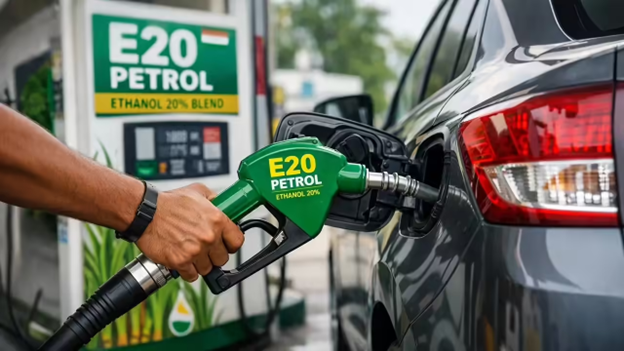
- India has officially mandated the nationwide rollout of E20 petrol at all fuel stations from April 1, 2025.
E20 petrol
- It refers to a fuel blend of 20% ethanol and 80% petrol.
- Objective – It is a critical part of India’s Ethanol Blended Petrol (EBP) Programme, which aims to reduce reliance on crude oil imports and lower vehicular emissions.
- Target Advancement: The initial target for 20% blending was 2030, but it was advanced to 2025–26 under the amended National Policy on Biofuels (2022).
Significance for India
|
Category |
Impact |
|
Energy Security |
Reduces dependence on imported crude oil (~85% of India’s needs are imported). |
|
Economic |
Saves roughly ₹30,000–₹50,000 crore in foreign exchange annually. |
|
Environment |
Lowers carbon monoxide, hydrocarbons, and particulate matter emissions by 30–50%. |
|
Agriculture |
Boosts rural income by creating demand for crops like sugarcane, maize, and damaged food grains. |
India’s Push for Piped Natural Gas
Science and Tech
Context
- India is accelerating the expansion of Piped Natural Gas (PNG) connections to reduce import dependence, improve energy security, and transition towards a cleaner fuel mix.
Types of Gases
Liquefied Petroleum Gas (LPG):
- Composition: Propane and Butane.
- State & Storage: Stored as a liquid under moderate pressure in cylinders.
- Usage: Domestic cooking, water heating, and small-scale industrial applications.
- Key Characteristic: Heavier than air; collects on the ground if leaked.
Piped Natural Gas (PNG):
- Composition: Primarily Methane.
- State & Storage: Delivered as a gas through underground pipelines.
- Usage: Residential kitchens, commercial cooking, and industries.
- Key Characteristic: Continuous supply; no need for cylinder storage.
Compressed Natural Gas (CNG):
- Composition: Primarily Methane.
- State & Storage: Compressed to high pressure (200-250 bar) in tanks.
- Usage: Vehicles (cars, buses, autos) and low-pressure industrial burners.
- Key Characteristic: Cleaner burning than petrol/diesel.
Liquefied Natural Gas (LNG):
- Composition: Primarily Methane.
- State & Storage: Cooled to roughly –160°C to become a liquid for transport.
- Usage: Transporting natural gas over long distances by sea, power generation.
- Key Characteristic: Volume is reduced by 600 times, making it easy to store in bulk.
India’s Shift Towards Piped Natural Gas (PNG)
- Reducing Import Dependence: India imports nearly 60% of its LPG requirement, with a large share coming from West Asia and supply routes like Strait of Hormuz are geopolitically vulnerable.
- Economic Efficiency: PNG eliminates logistics costs associated with cylinder transportation and storage.
- Pricing can be more stable compared to LPG, which is sensitive to global oil prices.
- Environmental Benefits: Natural gas burns cleaner than LPG, producing fewer pollutants and greenhouse gases.
India’s Multi-Hazard Early Warning Decision Support System
Environment
Context
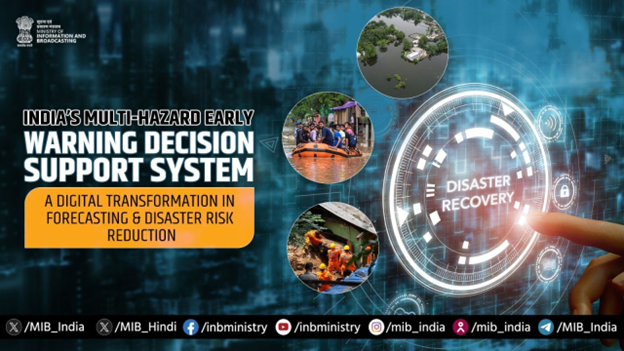
- The India Meteorological Department (IMD) received the National Award for e-Governance 2025 for its indigenously developed Multi-Hazard Early Warning Decision Support System (MHEW-DSS).
Multi-Hazard Early Warning Decision Support System (MHEW-DSS)
- Launched in 2024, it is a digital platform that automates decision-making in critical weather forecasting processes and provides forecast and warning services to the public, government, and non-government agencies, as well as specific stakeholders.
- Developed under Mission Mausam, the system has automated 90% of weather data processing and improved forecast accuracy by 30%, while reducing preparation time from six hours to three.
- It integrates real-time data from satellites, radars, and ground and upper air-based sensors into a centralized GIS-enabled platform, replacing outdated manual workflows.
India Meteorological Department (IMD)
- It was established in 1875 and completed 150 years of service in 2025.
- Functions under – Ministry of Earth Sciences.
- Objective – It is a government agency responsible for meteorological observations, weather forecasting, and seismology in India.
Mission Mausam
- It is an ambitious multi-faceted initiative launched by Ministry of Earth Sciences (MoES)
- Objective – to transform the country into a “weather-ready and climate-smart” nation. It aims to dramatically improve the accuracy and lead time of weather and climate forecasts.
Indonesia
Geography
Context
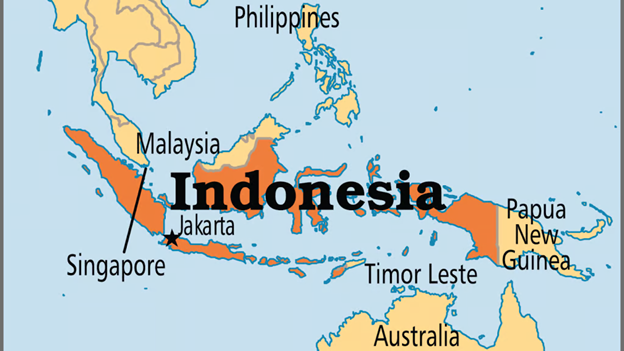
- A magnitude 7.4 earthquake struck the Northern Molucca Sea off Indonesia’s Ternate island.
Indonesia
Basic Geography:
- World’s largest archipelagic state, located between the Indian and Pacific Oceans, off mainland Southeast Asia.
- Major islands: Sumatra, Java, Kalimantan (Borneo), Sulawesi, Papua.
- It shares land borders with East Timor (Timor-Leste), Papua New Guinea, and Malaysia.
- Capital: Jakarta (on the island of Java); new capital being developed — Nusantara in Kalimantan
Tectonic Setting:
- Located on the Pacific Ring of Fire, the seismically active belt where ~90% of the world’s earthquakes occur.
- The Molucca Sea — where the recent earthquake originated — is a highly active tectonic zone in Indonesia’s northern region.
Additional Information – Ring of Fire
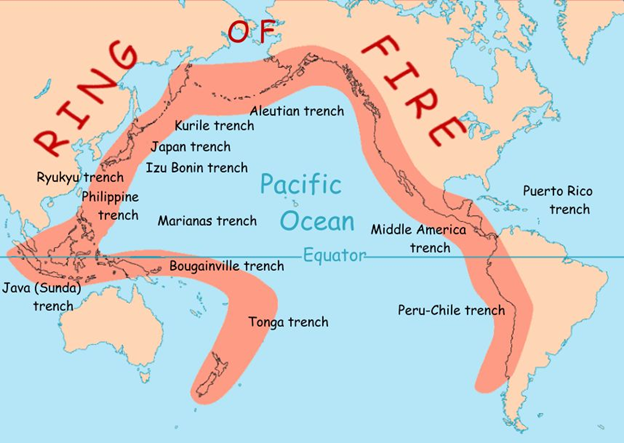
- Known as – The Ring of Fire also referred to as the Circum-Pacific Belt is present along the land borders of the Pacific Ocean.
- Features – It is characterized by active volcanoes and frequent earthquakes.
- Significance – It consists of 75% of Earth’s volcanoes i.e. more than 450 volcanoes are located along the Ring of Fire.
- Reason for the occurrence – The abundance of volcanoes and earthquakes along the Ring of Fire is due to the frequent movement of tectonic plates in this area.
Volcanoes in India
- Barren Island, Andaman Islands (India’s only active volcano)
- Narcondam, Andaman Islands
- Baratang, Andaman Islands
- Deccan Traps, Maharashtra
NCERT Granted Deemed University Tag
Government Initiatives
In News
- The Ministry of Education has declared the National Council of Educational Research and Training (NCERT) an Institution Deemed to be a University.
Impact of the Decision
- NCERT can now start courses and academic programmes and also award degrees.
- It has also been asked to begin research programmes, doctoral programmes, and innovative academic programmes.
- NCERT should also gradually expand into other academic domains in line with UGC norms and regulations, and the National Education Policy (NEP) 2020.
Additional Information – The National Council of Educational Research and Training (NCERT)
- It is an autonomous organisation established in 1961
- Mandate – It assists and advises Central and State governments on policies and programmes aimed at improving the quality of school education.
Key Roles and Functions
- Curriculum Development: NCERT is the nodal agency for developing the National Curriculum Framework (NCF), which sets the standard for school education in India.
- Textbook Publication: It publishes model textbooks for Classes I to XII in English, Hindi, and Urdu.
- Educational Research & Training: It promotes research in school education and provides pre-service and in-service training for teachers.
- Digital Initiatives: Through platforms like ePathshala and DIKSHA, it offers free digital access to textbooks, audio, and video resources.

















Leave a Reply