The Activity Point Tracking System (APTS) mobile app
Why in news :
VTU to launch app to track activity points for students to prevent fraud
About APTS mobile app
Developed by: Visvesvaraya Technological University (VTU).
Purpose: The Activity Point Tracking System (APTS) mobile app aims to curb the unethical practice of students submitting fake documents to claim activity points, ensuring transparency and genuine participation in extracurricular activities.
Target group: All engineering students under VTU who are required to earn at least 75 out of 100 activity points over their four-year course to qualify for their degree (mandated by AICTE from 2018-19).
Mechanism: The system operates through a mandatory mobile application where students must upload geo-tagged photos as proof of their engagement in approved activities.
Objectives: The initiative is designed to foster entrepreneurial capabilities,social commitment, soft skills, leadership qualities, and team spirit among students.
Key Activities: Eligible activities include preparing business proposals for village income enhancement, developing sustainable water management systems, promoting tourism or appropriate technologies, reducing energy consumption, skilling rural populations, and facilitating 100% digitised money transactions.
Indian Army officer from Bengaluru wins UN Secretary-General’s Award 2025
Why in news
An Indian Army officer from Bengaluru, Major Swathi Shantha Kumar, has won the UN Secretary-General’s Award 2025 for her project Equal Partners, Lasting Peace.
Award Details
Recipient: Major Swathi Shantha Kumar, an Indian Army officer from Bengaluru.
Current Role: She is currently serving on the United Nations Mission in South Sudan (UNMISS).
Award: She received the UN Secretary-General’s Award 2025 for her project titled “Equal Partners, Lasting Peace.”
Project Overview
Title:“Equal Partners, Lasting Peace.”
Purpose: The project aimed to significantly enhance gender parity and strengthen grassroots-level engagement within the mission’s area of responsibility.
The President of India, paid tribute to Netaji Subhas Chandra Bose on his birth anniversary, observed as Parakram Diwas.
Netaji Subhas Chandra Bose
Early Life: He was an Indian nationalist leader who played a pivotal role in India’s struggle for independence against British rule.
He was born on January 23, 1897, in Cuttack, Odisha
He studied at the University of Calcutta and later went to England for the Indian Civil Services (ICS) exam.
Political career : He abandoned ICS aspirations to join the Indian National Congress (INC), advocating for complete independence rather than moderate reforms.
He was Elected INC President in 1938 and 1939 but resigned due to differences with Mahatma Gandhi and other leaders over non-violent strategies.
Contributions in Freedom struggle: Bose’s vision for India’s freedom was to leverage the support of Axis powers during World War II.
He escaped from house arrest in India in 1941, travelling through Afghanistan to Germany, where he sought support from Adolf Hitler.
In 1943, he went to Japan, where he took command of the Indian National Army (INA), which had been formed by Indian prisoners of war and expatriates.
The INA’s actions and post-war trials had a strong psychological impact, weakening British authority.
Death: He died in a plane crash in Taiwan in August 1945; circumstances remain mysterious and controversial.
Legacy: He is remembered as a symbol of courage and determination; numerous institutions, monuments, and awards are named after him.
In 2018, The Government of India, renamed three islands of the Andaman and Nicobar archipelago as a tribute to Netaji Subhas Chandra Bose. They are:
Ross Island → Netaji Subhas Chandra Bose Island
Neil Island → Shaheed Dweep
Havelock Island → Swaraj Dweep
This was done to honor Netaji, who hoisted the tricolour flag on Havelock Island in the Andaman and Nicobar archipelago and declared it as India’s first free territory.
Indian Railways Deploys Humanoid Robot ‘ASC ARJUN’
Syllabus: GS2/ Governance
In Context
Indian Railways has deployed a humanoid robot named ‘ASC ARJUN’ at Visakhapatnam Railway Station.
About
ASC ARJUN is a humanoid robot that works with the Railway Protection Force (RPF) for security, surveillance and assistance at the station.
It is fully designed and developed in Visakhapatnam using indigenous, home-grown technology by a dedicated technical team.
Significance
Enhance safety and security of passengers at a busy station.
Optimise manpower by taking over routine patrolling and monitoring tasks so RPF staff can focus on critical work.
Use emerging technologies (AI, IoT, robotics) to improve service delivery and modernise rail operations.
The Karnataka Tourism Department has identified 11 potential Blue Flag beaches in the State, as announced by Secretary K.V. Thrilok Chandra at the Coastal Karnataka Tourism Conclave.
Objective & Strategy
Purpose: To elevate coastal tourism standards by developing 11 beaches as potential “Blue Flag” candidates, addressing the region’s status as “under-developed” despite holding immense potential for hospitality experiences.
Target Area: The initiative focuses on Coastal Karnataka, which currently accounts for 21% to 38% of total tourist visits to the State.
Development Strategy: Involves a multi-faceted approach including educational programmes, installation of information signages, introduction of adventure and water sports, and the organization of beach festivals.
Maintenance & Standards: Operational focus includes rigorous beach cleaning, garbage collection and disposal, regular water quality tests, and the maintenance of public amenities to meet international standards.
Identified Potential Beaches
Dakshina Kannada District:
Someshwara Beach
Ullal Beach
Sasihitlu Beach
Udupi District:
Asare Beach
Kodi Kanyana Beach
Padukere Beach
Kodi Beach (Kundapura)
Shiroor Beach
Uttara Kannada District:
Bailur Beach
Apsarakonda Beach
Rabindranath Tagore Beach
River Cruise Projects
Five national waterways have been identified for developing river cruise tourism:
Kali River: 53 km
Netravathi River: 30 km
Sharavati River: 29 km
Kabini River: 23 km
Gurupura River: 10 km
Tourism Statistics (2023-2024)
The region has seen a significant rise in tourism numbers:
Domestic Footfall: Increased from 28 crores to 30 crores.
Foreign Footfall: Increased from 09 lakh to 4.85 lakh.
Current Blue Flag Status (As of January 2026)
Karnataka currently holds two Blue Flag certified beaches:
Padubidri Beach (Udupi District)
Kasarkod Beach (Uttara Kannada District)
About Blue Flag Certification
Origin: Initiated in France (1985) and expanded globally in 2001.
Awarded By: Denmark-based Foundation for Environmental Education (FEE).
Aim: Promotes sustainable practices in marine and freshwater ecosystems.
Key Criteria:
Water Quality: Maintains high cleanliness and safety standards.
The One District One Product (ODOP) initiative has completed 8 years of transformative impact by promoting traditional industries.
One District One Product (ODOP)
It is a flagship initiative of the Government of India designed to foster balanced regional development by identifying and promoting at least one unique product from each distric
It is inspired by Japan’s “One Village One Product” model.
Objective – it seeks to transform every district into an export hub and boost local economies.
Nationwide Scale: Spearheaded by the Department for Promotion of Industry and Internal Trade (DPIIT), the initiative has identified 1,241 products from 777 districts as of early 2026.
Product Diversity: Covers a wide range of sectors including agriculture (e.g., Alphonso mangoes), handicrafts (e.g., Banarasi silk), textiles, metalware, and food processing.
Financial Support: The PMFME Scheme provides credit-linked subsidies (up to 35% of project cost) for micro food processing units focusing on ODOP products.
Infrastructure: The government is establishing PM Ekta Malls (Unity Malls) in every state to provide dedicated retail space for ODOP and Geographical Indication (GI) products.
Granth Kutir
Syllabus: GS1/Culture
Context
The President of India inaugurated Granth Kutir.
About
Granth Kutir is a library at the Rashtrapati Bhawan which has the collection of around 2,300 books and about 50 manuscripts in 11 Indian classical languages: Tamil, Sanskrit, Kannada, Telugu, Malayalam, Odia, Marathi, Pali, Prakrit, Assamese, and Bengali.
The collection reflects India’s cultural, philosophical, literary, and intellectual heritage.
Subjects include epics, philosophy, linguistics, history, governance, science, devotional literature, and the Constitution of India in classical languages.
Several manuscripts are handwritten on traditional materials such as palm leaf, paper, bark, and cloth.
Granth Kutir supports the vision of the Gyan Bharatam Mission, which aims to preserve, digitise, and disseminate India’s manuscript heritage, blending tradition with modern technology.
India welcomes Spain joining Indo-Pacific Oceans Initiative
Syllabus: GS2/IR
Context
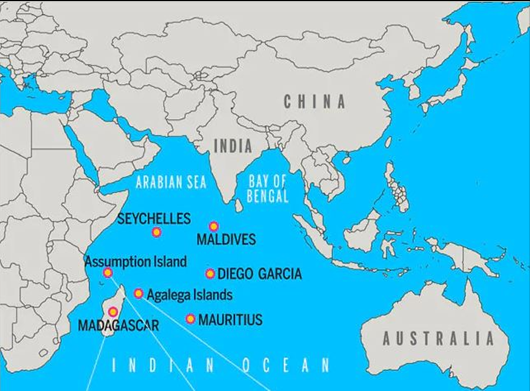
India has welcomed Spain joining the Indo-Pacific Oceans Initiative (IPOI).
Indo-Pacific Oceans Initiative (IPOI)
It was launched by India in November 2019 at the ASEAN-led East Asia Summit (EAS) in Bangkok.
It draws on existing regional cooperation architecture and mechanisms to focus on seven thematic areas, viz. :
Maritime Security;
Maritime Ecology;
Maritime Resources;
Capacity Building and Resource Sharing;
Disaster Risk Reduction and Management
Science, Technology and Academic Cooperation; and
Trade, Connectivity and Maritime Transport.
Objectives : Its objective was to promote cooperation for a free and open Indo-Pacific and the rules-based regional order, which will contribute towards strengthening safety, stability and development in the maritime domain.
Long Range Anti-Ship Hypersonic Missile (LR-AShM)
Syllabus: GS3/Defence
Context
The DRDO will showcase the Long Range Anti-Ship Hypersonic Missile (LR-AShM) along with its launcher during the 77th Republic Day Parade at Kartavya Path.
Long Range Anti-Ship Hypersonic Missile (LR-AShM)
Developed by – DRDO,
It is a Hypersonic Glide Missile designed to meet the coastal defence and strike requirements of the Indian Navy.
It is a first-of-its-kind indigenous system, equipped with indigenous avionics and high-accuracy sensor packages.
It achieves speeds up to Mach 10, with an average hypersonic speed of Mach 5.
Significance – Low-altitude flight, high speed, and manoeuvrability significantly reduce detection by enemy ground- and ship-based radars.
NIT-K Surathkal develops jute-based geocell as alternative to plastic in roadworks
Why in news
Researchers at NIT-K Surathkal have developed an industrially manufactured ‘jute geocell’ to replace conventional petroleum-based plastic geocells for sustainable road construction.
Project Overview
Aim: To replace conventional petroleum-based plastic geocells with an industrially manufactured ‘jute geocell’ for sustainable road construction and slope stabilisation.
Developed by: Researchers at the National Institute of Technology Karnataka (NITK), Surathkal.
Project Support: The project is funded by the National Jute Board under the Union Ministry of Textiles and was executed in collaboration with Birla Jute Mills.
Mechanism & Function
Structure: The geocells function as three-dimensional, honeycomb-like structures.
Application: They are placed beneath roads or on slopes to strengthen weak soil, improve load-bearing capacity, and control erosion.
Sustainability & Impact
Environmental Benefits: Unlike existing high-density polyethylene or polypropylene options that cause microplastic pollution, this solution is cheaper, biodegradable, and eliminates long-term environmental risks.
Target Areas: The innovation is designed for large-scale implementation, particularly in rural and ecologically sensitive regions where environmental preservation is critical.
India’s first commercial Quantum Computer to be deployed at IIIT, Dharwad
Why in news
India’s first commercial Quantum Computer is set to be deployed at the Indian Institute of Information Technology (IIIT) Dharwad.
Key Highlights
Location: The system is being installed at the Indian Institute of Information Technology (IIIT) Dharwad.
Announcement: The initiative was announced by Priyank Kharge, Minister for Rural Development and Panchayat Raj, IT & BT.
Status: This deployment represents the country’s first indigenously built Quantum Computer for commercial use.
Target: The installation is proceeding at a quick momentum to secure Karnataka’s leadership in the quantum space.
Strategic Importance
Purpose: The initiative marks a significant milestone in building a world-class quantum ecosystem and advancing the “Karnataka Quantum Roadmap” to ensure cutting-edge technology translates into real-world impact.
Infrastructure: The State government has also recently announced the establishment of a Centre of Excellence in Quantum AI and Computing at IIIT Dharwad.
Key Collaborations
Tech Partner: The project involves strong collaboration with the Bengaluru-based deeptech company QpiAI for quantum advancements.
Application Focus: Discussions are held with Singapore-based ZWEEC regarding applications, specifically for strengthening rural water security.
Indian Railways commissioned 472.3 route kilometres (RKm) of Kavach Version 4.0.
About
Originally known as the Train Collision Avoidance System (TCAS),
Developed by the RDSO,
Objective – it prevents train collisions by automatically applying brakes if the loco pilot fails to do so (e.g., Signal Passed at Danger – SPAD) and provides real-time speed monitoring.
Note – Kavach 4.0 creates a “digital shield” by integrating several high-tech components:
World Nuclear Outlook Report
Syllabus: GS2/IR/GS3/Science and Tech
In News
According to the new World Nuclear Outlook Report , Five countries — China, France, India, Russia and the United States — could together account for nearly 980 GWe of global capacity in 2050.
World Nuclear Outlook Report
It reviews national targets for nuclear capacity and assesses these against the global goal to triple nuclear capacity by 2050.
Key Findings
Global nuclear capacity could reach 1,446 GWe by 2050, exceeding the tripling target of 1,200 GWe, with growth driven by reactors under construction, planned projects, and proposed or government-driven programs.
China, France, India, Russia, and the USA would account for most capacity, while newcomer nations aim for 157 GWe.
South Asia, led by India, is emerging as a key growth region due to rising electricity demand, urbanization, and industrialization.
Hirakud Wetland
Syllabus: GS3/ Environment
Context
The Hirakud wetland in Sambalpur district of Odisha has recorded the arrival of 4.21 lakh birds during the current migratory season.
Hirakud Wetland
Location: The wetland is part of the Hirakud Reservoir, one of the largest man-made reservoirs in India, built across the Mahanadi River with a total length of almost 26 kilometres.
The reservoir also produces around 350 megawatts of hydropower and irrigates 436,000 hectares of land.
Biodiversity Hotspot: It is a critical stopover for birds along the Central Asian Flyway, hosting 128 species of birds.
Birds Species – Pintail, Shoveler, Teal, Pochard, Bar-headed Goose, and rare Eurasian species like Ruffs.
Ramsar Site: It was designated a Ramsar site of global ecological importance in 2021.
Note – As of February 2026, India has 98 Ramsar Sites, with the total rising following the addition of the Patna Bird Sanctuary (Uttar Pradesh) and Chhari-Dhand (Gujarat).
NITI Aayog launched Sampoornata Abhiyan 2.0 campaign.
Sampoornata Abhiyan 2.0
It is aimed at achieving saturation of critical development indicators in Aspirational Districts and Aspirational Blocks across the country.
The campaign targets 112 Aspirational Districts and 513 Aspirational Blocks to achieve specific Key Performance Indicators (KPIs):
For Aspirational Blocks (6 KPIs):
Nutrition: Regular supplementary nutrition for children (6 months to 6 years) under ICDS.
Monitoring: Monthly measurement efficiency of children at Anganwadi Centres.
Infrastructure: Operational Anganawadi Centres with functional toilets and drinking water.
Education: Adequate girls’ toilet facilities in schools.
Agriculture: Vaccination of bovine animals for Foot and Mouth Disease (FMD).
For Aspirational Districts (5 KPIs):
Focuses on health, nutrition, and education, including increasing the number of babies weighed at birth and improving tuberculosis (TB) case
Additional Information – Aspirational Districts Programme
It was launched in 2018
Objective – to quickly and effectively transform 112 districts across the country.
Focuses on five themes: Health & Nutrition, Education, Agriculture & Water Resources, Financial Inclusion & Skill Development and Infrastructure.
Aspirational Blocks Programme
It was launched in 2023
It aims for the saturation of essential government services in 513 Blocks (329 Districts) across the country.
Focuses on five themes: Health & Nutrition, Education, Agriculture and Allied Services, Basic Infrastructure and Social Development.
Menstrual Health Fundamental Right under Article 21: SC
Syllabus: GS2/Polity and Governance
Context
In Dr. Jaya Thakur v. Union of India, the Supreme Court has ruled that the right to menstrual hygiene is an integral part of the right to life under Article 21 of the Constitution.
Key Highlights of Judicial Intervention
Fundamental Right: Menstrual health is now legally recognized as an essential facet of the Right to Life (Art. 21) and the Right to Education (Art. 21A).
Free Bio-degradable Pads: All government and private schools must provide free bio-degradable sanitary napkins to girl students (Classes 6–12).
Mandatory Infrastructure: Schools must have functional, gender-segregated toilets with water connectivity. Non-compliance can lead to the de-recognition of private schools.
Stigma Reduction: The court mandated NCERT to incorporate gender-responsive curricula to educate both boys and girls, breaking the “hushed whispers” culture.
Article 21 of Constitution
Article 21 is part of the Fundamental Rights, Part III of the Constitution.
It is guaranteed to all persons, citizens and non-citizens
No person shall be deprived of his life or personal liberty except according to procedure established by law.
It places a restriction on the state from arbitrarily interfering with a person’s life and liberty.
Expanded scope through Supreme Court judgments: Over time, courts have interpreted it to also impose positive obligations on the state to ensure a dignified life.
Right to live with human dignity;
Right to privacy (Puttaswamy, 2017);
Right to livelihood (Olga Tellis);
Right to health and medical care;
Right to clean environment;
Right to legal aid and speedy trial;
Right to education (later made explicit via Article 21A);
Protection against custodial torture;
Right to sleep, shelter and food.
Menstrual Health Related Policy of Government of India
Menstrual Hygiene Scheme (MHS): Supported by National Health Mission (NHM). ASHAs distribute packs of 6 napkins (Freedays) at a subsidized rate of ₹6.
PM Bharatiya Janaushadhi Pariyojna: Over 16,000 Kendras provide ‘Suvidha’ (Oxo-biodegradable pads) at ₹1 per pad.
Samagra Shiksha: Funds the installation of vending machines and incinerators. States must now prioritize bio-degradable options following the 2026 SC ruling.
Swachh Bharat Mission (Grameen) Phase 2: Focuses on Menstrual Waste Management (MWM) using small-scale incinerators and deep burial pits to prevent environmental clogging.
Menstrual Hygiene Policy (2024-25): Formulated by the Ministry of Health, it streamlines access to low-cost products, prioritizes “Green” (biodegradable) initiatives, and integrates MHM into the formal school curriculum.
Standardization of Products: The Department of Health Research is studying sustainable alternatives like menstrual cups and recyclable pads to evaluate their safety and feas ibility among rural women.
Kalbelia Community
Syllabus: GS1/Population
In News
The National Human Rights Commission (NHRC) issued a notice to the Rajasthan government over protests by the Kalbelia community in Barmer, who placed a dead body on the road demanding a designated burial ground.
Kalbeliyas
Kalbelia are a snake charming folk community from the region of Rajasthan, India.
Their traditional occupation used to be catching snakes and trading snake venom.
They are known for their vibrant dances and black embroidered attire.
In 2010, their songs and dances were added to UNESCO’s Intangible Cultural Heritage list, recognizing them as a key marker of identity as the community adapts to changing social and economic conditions.
Do you know?
The Kalbelia dance, also called Sapera dance, is a folk dance central to Kalbelia culture, a nomadic tribe traditionally known as snake charmers.
The dance reflects their close association with snakes through movements and costumes.