
Custodial Deaths in India
Governance
Context
- A trial court in Madurai sentenced 9 Tamil Nadu policemen to death for the brutal 2020 custodial killing of a father and son, P. Jayaraj and J. Benicks.
Custodial Death
- Custodial death refers to the death of an individual while in police or judicial custody.
- This may occur before trial, during police interrogation, or after convictio
- The death may be caused by torture, negligence, denial of medical aid, or even under suspicious circumstances.
It violates the Constitutional Rights
- Article 20(1): No person shall be punished beyond what is prescribed in law.
- Article 20(3): Right against Self-Incrimination, stating that “No person accused of any offence shall be compelled to be a witness against himself.
- Article 21: Ensures protection of life and personal liberty, including in police/judicial custody.
- Issue of Custodial Death in India: According to parliamentary data, 11,656 custodial deaths were recorded between 2016-17 and 2021-22, across India.
- Uttar Pradesh topped the list with 2,630 deaths, while Tamil Nadu (490) reported the highest number among the southern States.
International Legal Frameworks for Protection
- United Nations Charter (1945): It sets out the purposes and principles of the UN, including the promotion of human rights.
- Universal Declaration of Human Rights (1948): It prohibits torture and ensures the presumption of innocence.
- International Covenant on Civil and Political Rights (1966): It protects right to life and prohibits torture.
- The Nelson Mandela Rules, officially known as the UN Standard Minimum Rules for the Treatment of Prisoners 2015, establish minimum standards for the humane treatment of all individuals deprived of their liberty.
- European Convention on Human Rights (1950): It recognises individual dignity and access to justice mechanisms.
India Achieves Highest-ever Annual Wind Energy Addition
Environment
Context
- India has achieved the highest-ever annual wind energy capacity addition of 6.05 GW in 2025-26, taking cumulative installed capacity to over 56 GW.
India’s Energy Share
- As of 2025, the country’s total installed electricity capacity has crossed 500 GW, reaching 509.6 GW.
- The total non-fossil power installed capacity has reached 74 GW in 2025 which is 51.5% of the total installed electricity capacity in the country.
- The solar energy installed capacity has reached85 GW in 2025.
- Fossil-fuel-based sources: 80 GW, about 49 % of the total.
- Globally, India stands 3rd in Solar Power installed capacity, 4th in Wind Power capacity and 4th in total Renewable Energy capacity.
India’s Energy Targets
- Emissions Intensity Reduction: India has committed to reducing the emissions intensity (CO₂ per unit of GDP) of its GDP by 47% by 2035 from 2005 levels.
- Expansion of Non-Fossil Fuel Capacity: India has committed to achieving 60% of its installed electric power capacity from non-fossil fuel sources by 2035.
- Creation of Carbon Sink: India has committed to creating a carbon sink of 3.5 to 4 billion tonnes of CO₂ equivalent through forest and tree cover by 2035.
Government Initiatives
- National Solar Mission (NSM): It was launched in 2010, it has set ambitious targets for solar capacity installation, including grid-connected and off-grid solar power projects.
- National Clean Energy Fund (NCEF): It was established to support research and innovation in clean energy technologies and projects that help in reducing greenhouse gas emissions.
- National Wind Energy Mission: Focuses on the development and expansion of wind energy in India. The target for wind energy capacity is set at 140 GW by 2030.
Tar Balls Management Rules
Environment
Context
- The Centre has, for the first time, proposed dedicated rules to manage tar balls that cause on-shore and off-shore marine pollution.
Connect with the basics- Marine Tar balls
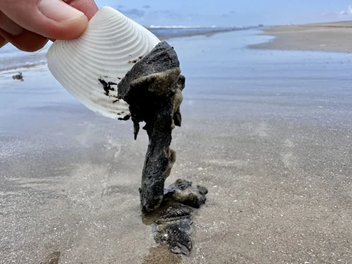
- They are sticky, dark-colored lumps of weathered oil that form after oil spills, leaks, or natural seepage in the marine environment.
Formation
- Weathering Process: They form through weathering, where lighter oil components evaporate, leaving behind heavier hydrocarbons that mix with sand and marine debris.
- Size & Texture: Their size varies from pea-sized globules to basketball-sized lumps.
- Composition: They contain toxic contaminants like heavy metals, persistent organic pollutants (POPs), and Polycyclic Aromatic Hydrocarbons (PAHs).
Impact of Tar Ball Pollution
- Marine Life: Marine animals like sea turtles and seabirds may ingest them, leading to death. They also clog the pores of mangroves and coral reefs.
- Human Health: Direct contact can cause skin irritation, and toxic chemicals can enter the human food chain through contaminated seafood.
- Economy: Significant negative impact on tourism (due to oily beaches and odor) and fisheries (fouling of fishing nets).
Tar-balls Management Rules, 2026
- Framed under the Environment (Protection) Act, 1986, these rules establish India’s first dedicated regulatory framework for tar balls.
|
Feature |
Description |
|
Polluter Pays Principle |
Facility owners are liable to pay compensation for environmental damage caused by leaks or improper handling. |
|
Disaster Classification |
Coastal states are required to declare tar ball pollution as a “State Disaster”. |
|
Institutional Roles |
The Indian Coast Guard (ICG) implements the National Oil Spill Disaster Contingency Plan (NOSDCP); district administrations manage local cleanup. |
|
Circular Economy |
Tar balls with high calorific value (>1,500 kcal) can be repurposed as fuel in the cement industry. |
Sundarbans Losing Ability to Recover
Environment
Context
- A recent study shows that around 10–15 percent of the Sundarbans is undergoing a “critical slowing down” process from environmental stress.
Sundarbans in West Bengal
Geographical location
- It is a vast contiguous mangrove forest ecosystem present in the coastal region of Bay of Bengal
- It spread over India and Bangladesh on the Ganges, Brahmaputra and Meghna delta.
Conservation efforts
- UNESCO World Heritage site – Sundarbans National Park was designated a UNESCO World Heritage site in 1987.
- Biosphere Reserve – Sunderbans was designated as a Biosphere Reserve by UNESCO in 2001.
- Wetland of International Importance – Sundarban Wetland, India was recognised as the ‘Wetland of International Importance’ under the Ramsar Convention in January 2019.
- Flora and Fauna – Sunderban National Park is known for its wide range of fauna, including 260 bird species and is home to the Royal Bengal tiger, Gangetic dolphins and Estuarine crocodile
Supreme Court Hearing on Sabarimala Case
Polity and Governance
Context
- A nine-judge bench of the Supreme Court of India has begun hearings on petitions concerning women’s entry into religious places, including the Sabarimala Temple.
Background
- In 2018, a Constitution Bench (4:1 majority) allowed entry of women of menstruating age into the temple, declaring the restriction unconstitutional.
- Due to widespread protests, in 2019, the matter was referred to a larger bench.
- Significance: The issue reflects tension between Fundamental Rights on equality/non-discrimination (Articles 14, 15, 17) and Religious Freedom (Articles 25, 26).
- It also raises questions on Judicial activism vs restraint and Secularism in India (principled distance model).
Additional Information – Sabarimala Temple
- Location and Deity: The Sabarimala Temple is located in the Pathanamthitta district of Kerala on the banks of the sacred Pamba River (also known as Pampa), within the Periyar Tiger Reserve in the Western Ghats.
- It is dedicated to Lord Ayyappa, also known as Dharmashasta.
- The temple is situated on a hilltop at an elevation of about 1,260 metres.
- Religious Significance: It is one of the largest annual pilgrimage centres in the world. Devotees undertake a rigorous 41-day ‘Vratham’ (penance) before visiting.
- The temple symbolises celibacy (Naishtika Brahmacharya) of Lord Ayyappa.
Credit Guarantee Scheme
Economy
Context
- The government is considering a ₹2.5 lakh crore credit guarantee scheme to support businesses, especially MSMEs impacted by the West Asia crisis.
About
- The scheme will be an expansion of the Emergency Credit Line Guarantee Scheme (ECGLS)
Emergency Credit Line Guarantee Scheme (ECLGS)
- It was launched in 2020 as part of the Aatmanirbhar Bharat Abhiyaan
- Objective – to support eligible MSMEs and other eligible business enterprises due to the disruption caused by the COVID-19 pandemic.
- ECLGS covered almost all the sectors of the economy.
The structure of the scheme permitted
- Easy access to credit
- Interest rate was also capped to lowest.
- Credit and loans were sanctioned without any processing charges.
United Nations Security Council (UNSC)
International
In News
- Russia and China vetoed a UN Security Council resolution aimed at reopening the Strait of Hormuz.
United Nations Security Council (UNSC)
- It is one of the six principal organs of the United Nations
- Objective – to maintain international peace and security.
- It is the only UN body empowered to issue legally binding resolutions that all UN member states are obligated to comply with under international law.
- Structure and Composition: The Council has 15 members divided into two categories:
- Permanent Members (P5) with Veto Power: China, France, Russia, the United Kingdom, and the United States.
- A single veto from any P5 member is sufficient to block any substantive resolution, regardless of how many other members support it.
- Non-Permanent Members (10 seats): Elected by the UN General Assembly for two-year terms, distributed geographically.
- Headquarters: New York, USA
Mission MITRA
Science & Technology
In News
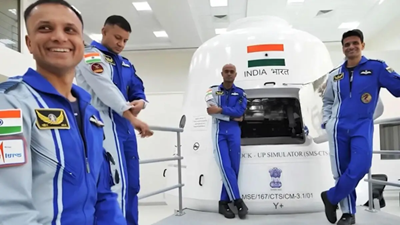
- The Indian Space Research Organisation (ISRO), in collaboration with the IAF-Institute of Aerospace Medicine, has launched Mission MITRA in Leh, Ladakh.
Mission MITRA
- Full Form: Mapping of Interoperable Traits and Response Assessment.
- Agencies Involved: Designed jointly by ISRO and the Indian Air Force’s Institute of Aerospace Medicine (IAM).
- Location: Leh, Ladakh (~3,500 meters altitude).
- Participants: Includes the four designated Gaganyatris (astronauts) for the Gaganyaan mission: Prasanth Nair, Ajit Krishnan, Angad Pratap, and Shubhanshu Shukla.
Objectives and Significance
- The mission is an “analogue mission,” meaning it uses Earth-based environments that mimic the physical and psychological stressors of space.
- Human Factors Engineering: Studies how hypoxia (low oxygen), extreme cold, and isolation affect crew decision-making and teamwork.
- Interoperability: Evaluates coordination between the crew and Ground Control Teams under operational stress and simulated communication delays.
- Gaganyaan Preparation: The data directly informs training protocols for the upcoming crewed Gaganyaan mission (expected in late 2026 or early 2027) and future long-duration stays at the Bharatiya Antariksha Station (BAS).



















Leave a Reply