
FCRA Amendment Bill 2026
Polity & Governance
Context
- Recently, the Union Government has deferred discussion on the FCRA Amendment Bill, 2026 which triggered political controversy, especially ahead of the Kerala Assembly elections.
Foreign Contribution (Regulation) Act (FCRA)
- Mandate– It is a key legislation that regulates the acceptance and utilisation of foreign funds by individuals, NGOs, and associations in India.
- It is administered by the Union Ministry of Home Affairs (MHA).
- Significance – It aims to ensure foreign contributions do not affect national interest, sovereignty, or public order.
Provisions of FCRA Amendment Bill, 2026
New “Designated Authority” to Take Over Assets
- What it does: If an NGO’s registration is cancelled, surrendered, or even if it simply expires and isn’t renewed, this authority can step in and take control of all its foreign funds and assets (like buildings or equipment bought with foreign money).
- Permanent Takeover: If the registration is not restored within a certain timeframe, the government can permanently take these assets, sell them, or transfer them to other government departments.
Personal Liability for “Key Functionaries”
- The Bill expands the definition of “key functionary” to include directors, partners, trustees, and anyone in a management role.
Automatic Ending of Registration
- How it works: Under the new rules, an FCRA registration will automatically lapse if it expires and hasn’t been renewed, or if a renewal request is rejected.
- Strict Timelines: The Bill also sets fixed timelines for how quickly organisations must use the foreign funds they receive.
Changes to Investigations and Penalties
- Centralised Approval: Local police or state agencies now need prior approval from the Central Government before they can even start an investigation into an FCRA-related complaint.
- Reduced Prison Time: The maximum jail term for breaking FCRA rules is being reduced from five years to one year, though fines still apply.
Parliament Passes Insolvency and Bankruptcy Code Bill, 2026
Economy
Context
- The Parliament has passed the Insolvency and Bankruptcy Code (Amendment) Bill, 2026.
Insolvency and Bankruptcy Code (IBC), 2016
- It provides a time-bound process for resolving insolvency in companies and among individuals.
- Insolvency definition – It is a situation where individuals or companies are unable to repay their outstanding debt.
- Bankruptcy definition – It is a situation whereby a court of competent jurisdiction has declared a person or other entity insolvent, having passed appropriate orders to resolve it and protect the rights of the creditors. It is a legal declaration of one’s inability to pay off debts.
- Significance – It aims to remove bottlenecks, streamline the corporate insolvency resolution process and protect the last mile funding in order to boost investment in financially distressed sectors.
Adjudicating authority
- National Company Law Tribunal (NCLT) for companies and LLPs.
- Debt Recovery Tribunal (DRT) for individuals and partnership firms.
Key Features of IBC (Amendment) Bill, 2026
- Timelines for liquidation: The Bill adds that NCLT must pass the order for liquidation within 30 days from the date of the application or intimation.
- It also specifies that liquidation proceedings must be completed in 180 days, extendable by up to 90 days.
- Mandatory Admission: The bill mandates that the National Company Law Tribunal (NCLT) must admit an insolvency application within 14 days if the default is proven and the application is complete, removing judicial discretion on this timeline.
- Cross-Border Insolvency: Introduces a framework to deal with insolvency cases involving foreign assets/creditors.
Qdenga (TAK-003)
Health
Context
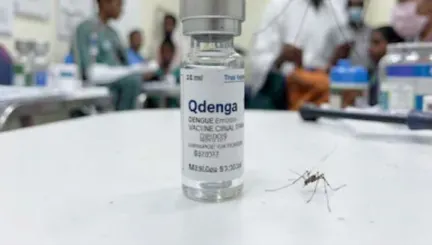
- Qdenga, developed by Takeda Pharmaceutical Company, has received clearance from the Drugs Controller General of India for individuals aged 4–60 years.
Qdenga (TAK-003)
- TAK-003 is a live-attenuated, tetravalent dengue vaccine, containing weakened forms of all four dengue virus serotypes (DENV-1, DENV-2, DENV-3, and DENV-4) to stimulate immunity.
India’s first indigenous dengue vaccine
- DengiAll is an indigenous, tetravalent, single-dose dengue vaccine candidate being developed by Panacea Biotec in collaboration with the Indian Council of Medical Research (ICMR).
- It is designed to fight all four serotypes and is currently in Phase III trials.
Additional Information – Dengue
- Pathogen – Dengue is a viral infection caused by the dengue virus (DENV).
- DENV is an RNA virus of the Flaviviridae family with four serotypes (DENV-1 to 4).
- Symptoms: High fever, severe headache, pain behind the eyes, muscle and joint pains, nausea, vomiting, swollen glands, rash.
- Transmission: The virus is transmitted to humans through the bites of infected female mosquitoes, primarily the Aedes Aegypti mosquito.
- There is a possibility of maternal transmission of Dengue (from a pregnant mother to her baby), transmission via blood products, organ donation and transfusions.
- Prevention: There is no specific antiviral treatment for dengue, so prevention relies on controlling mosquito populations and raising public awareness.
- The mosquitoes that spread dengue are active during the day. The best way of protection is to protect yourself from mosquito bites.
GLP-1 Therapy
Health

Context
- Multiple variants of GLP-1 drugs have been recently introduced in the Indian market, and concerns have emerged regarding their on-demand availability.
- GLP-1 medication was approved by the United States’ Food & Drug Administration in 2005.
GLP-1 drugs
- Glucagon-like peptide-1 receptor agonists are medications developed to treat both type 2 diabetes and obesity by correcting hormonal imbalance.
- They slow down the gastric emptying, increasing the feeling of fullness.
- This decreases patients’ appetites and thereby leads to their weight loss.
- To ensure ethical pharmaceutical practices in the supply chain of GLP-1, the Drug Controller General of India has intensified its regulatory surveillance against the drug’s unauthorised sale and promotion.
- In India, the drug can be prescribed only by endocrinologists, internal medicine specialists and cardiologists.
Additional Information – Central Drugs Standard Control Organization (CDSCO)
- Established under – It is the Central Drug Authority and is responsible for carrying out duties entrusted by the Drugs and Cosmetics Act,1940.
- Responsibilities:
- Adoption of drugs.
- clinical trials, please.
- establishing the criteria for drugs.
- control over the country’s imported drugs’ quality.
- Coordination of state drug control organizations’ effort
Other Drug Regulatory Bodies in India
- Drugs Controller General of India (DCGI): It is in charge of approving licenses for specific kinds of medications. He or she also serves as the head of the CDSCO department of the Indian government.
- Drug Price Control Order (DPCO): To keep certain necessary medications in India accessible for the general people, the DPCO controls their prices.
- Drugs and Cosmetics Act, 1940: This act regulates domestic drug use.
Pradhan Mantri Awaas Yojana – Gramin (PMAY-G) Completed 10 Years
Schemes
In News
- PMAY-G completes 10 years of implementation in 2026, marking a decade of India’s flagship rural housing mission.
Pradhan Mantri Awaas Yojana – Gramin (PMAY-G)
- Aim: Provide “Housing for All” in rural areas — financial assistance to eligible rural households, including houseless families and those living in zero, one, or two-room kutcha houses, to construct pucca homes with basic amenities.
- Beneficiary Selection: Using housing deprivation parameters from the Socio-Economic and Caste Census (SECC), 2011, verified by Gram Sabhas.
- Funding Pattern: 60:40 (Centre:State) in plain areas; 90:10 for North-Eastern and Himalayan states.
- Nodal Ministry: Ministry of Rural Development (MoRD).
Financial Assistance:
- Minimum unit size of 25 sq. m.
- ₹1.20 lakh in plain areas; ₹1.30 lakh in hilly/North-Eastern states.
- Additional ₹12,000 for toilet construction via convergence with Swachh Bharat Mission.
Reforms in the Scheme
- Direct Benefit Transfer (DBT): Financial assistance released directly to beneficiaries’ bank accounts, eliminating middlemen.
- Geo-tagging: Time and date-stamped photographs uploaded at every construction stage for real-time monitoring.
- AI-driven monitoring: AI and Machine Learning tools for anomaly detection; Aadhaar face authentication (including eye-blink detection) to verify beneficiaries and prevent fraud.
- Village-level Functionaries: Each sanctioned house is tagged to a local functionary who follows up with the beneficiary.
- Social Audits: Every Gram Panchayat conducts a formal social audit at least once a year.
Jan Vishwas (Amendment of Provisions) Bill, 2026
Economy
In News
- The Jan Vishwas (Amendment of Provisions) Bill, 2026, was passed by the Parliament of India on April 2, 2026.
- This legislation is a significant expansion of the government’s decriminalisation initiative, following the original Jan Vishwas Act of 2023.
Key Objectives & Impact
- Mandate – The Bill aims to enhance Ease of Doing Business and Ease of Living by transitioning from a punitive to a trust-based governance model.
- Decriminalisation: It decriminalises 717 provisions across 79 Central Acts.
- Scale: In total, the Bill amends 784 provisions administered by 23 different Ministries.
- Offence Rationalisation: More than 1,000 minor offences have been rationalised, shifting from criminal imprisonment to civil penalties, administrative fines, or warnings.
Major Provisions
- Adjudication Mechanism: It provides for the appointment of Adjudicating Officers to handle inquiries and determine penalties, and Appellate Authorities to hear appeals, thereby reducing the burden on the court system.
- Graduated Response: For first-time or minor lapses, the Bill introduces “warning-first” principles.
- Dynamic Penalties: Most fines and penalties will see a 10% increment every three years to maintain their deterrent effect.
- Key Acts Amended: Major laws affected include the Reserve Bank of India Act, 1934, Motor Vehicles Act, 1988, and the Food Safety and Standards Act, 2006.
Ammonium Nitrate
Science and Tech

Context
- Bharat Coal Gasification and Chemicals Ltd. and Mahanadi Coalfields Ltd. recently signed an agreement for a Coal to Ammonium Nitrate Project.
Ammonium Nitrate
- A white, crystalline, water-soluble solid, not found in nature; synthetically produced by reacting ammonia with nitric acid.
- It is hygroscopic in nature and under high heat, it decomposes explosively, releasing nitrogen dioxide (NO₂).
- Example: 2015 Tianjin (China) explosion and 2020 Beirut port explosion.
- One of the world’s most widely used chemicals serving dual roles as a fertiliser and an industrial explosive.
- It is listed as a hazardous chemical under Hazardous Chemicals Rules, 1989.
E-3 Sentry AWACS
Defence

Context
- Iran’s missile and drone strike on Saudi Arabia’s Prince Sultan Air Base has reportedly destroyed a US E-3 Sentry AWACS aircraft.
E-3 Sentry (AWACS)
- The E-3 Sentry is an airborne early warning and control aircraft developed by Boeing for advanced surveillance and battle management.
- The aircraft is commonly known as AWACS, which stands for Airborne Warning and Control System.
- It is equipped with a distinctive rotating radar dome mounted above its fuselage that enables long-range detection and tracking of aerial targets.
Airborne Warning and Control System in India

- The Indian Air Force (IAF) operates three Israeli-origin Phalcon Airborne Warning and Control Systems (AWACS) mounted on Russian Ilyushin Il-76 transport aircraft.
- These systems, known as “eyes in the sky,” provide 360-degree radar coverage, with capabilities to detect aircraft, cruise missiles, and drones at ranges of 370–500 km.
- The NETRA Airborne Early Warning and Control (AEW&C) system is an indigenous, multi-sensor platform developed by DRDO, primarily designed for aerial surveillance, target identification, and command-and-control capabilities.
- It is based on the Brazilian Embraer ERJ 145 aircraft.
Rice’s Whale
Environment

Context
- The US expansion of oil and gas drilling could push the Rice Whale to extinction.
Rice’s Whale (Balaenoptera ricei)
- Belonging to the baleen whale family Balaenopteridae.
- It is one of the rarest whale species, with fewer than 100 individuals remaining.
- Range and Habitat: It is endemic to the northern Gulf of Mexico and lives year‑round within this region without undertaking long migrations.
- Diet: Primarily feeds on small fish and squid.
- Threat: Oil drilling, vessel strikes, and climate change.
- Conservation status: It is listed as Critically Endangered on the IUCN Red List.
Do you know?
- The International Whaling Commission (IWC) was established in 1946 as the global body responsible for management of whaling and conservation of whales.
- Currently, the IWC has more than 80 member countries, including India.















Leave a Reply