
India-Sweden Upgrade Ties to Strategic Partnership
Syllabus: GS2/ International Relations
Context
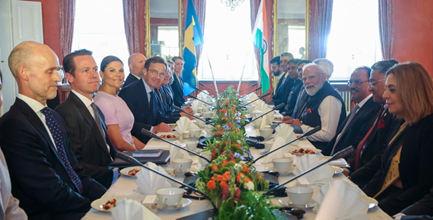
- India and Sweden elevated their bilateral relationship to a Strategic Partnership, during an official visit of PM Modi to Sweden.
Key Highlights of the Visit
- PM Modi received Sweden’s Royal Order of Polar Star and Commander Grand Cross, the highest recognition and honour that can be conferred upon a head of government.
India–Sweden Relations
- Diplomatic Relations: India and Sweden established diplomatic relations in 1948.
- Sweden hosted the first India–Nordic Summit in 2018, strengthening India’s engagement with the Nordic region.
- India and Sweden jointly launched the Leadership Group for Industry Transition (LeadIT) at the UN Climate Action Summit in 2019.
- LeadIT promotes low-carbon industrial transition and sustainable manufacturing practices.
Indus Waters Treaty
Syllabus: GS2/ International Relation
In Context
- India has rejected the latest ruling of the Court of Arbitration (CoA), a five-member arbitral panel set up in 2023 at Pakistan’s request to settle a dispute over the design of India’s Kishenganga and Ratle hydroelectric projects in Jammu & Kashmir.
Indus Waters Treaty
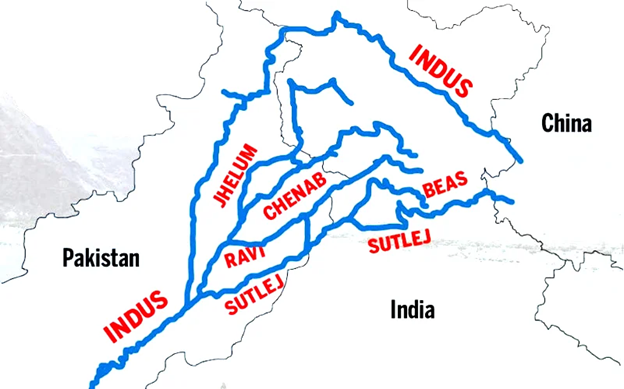
- Background – In 1947, the partition had cut the Indus river system into two between India and Pakistan.
- Mediated by – The World Bank
- Signed in – it was signed in 1960 by former PM Jawaharlal Nehru and then President of Pakistan, Ayub Khan.
- Transboundary river – The Indus River is a transboundary river that flows through Pakistan (47%), India (39%), Tibet (8%), and Afghanistan (6%). It is the longest river in Pakistan.
- Note – In India, the Indus basin spreads over J&K, HP, Punjab, Rajasthan, Haryana, and Chandigarh.
Major tributaries of the Indus River are:
|
River |
Source |
Joins |
|
Jhelum |
Spring at Verinag, Kashmir Valley |
Chenab at Trimmu, Pakistan |
|
Chenab |
Chandra and Bhaga streams near Bara Lacha Pass |
Satluj after receiving Jhelum and Ravi |
|
Ravi |
Kullu hills near Rohtang Pass |
Chenab near Rangpur, Pakistan |
|
Beas |
Near Rohtang Pass |
Satluj at Harike Barrage, India |
|
Satluj |
Manasarovar-Rakas Lakes, Tibet |
Indus a few kilometres above Mithankot, Pakistan |
Provisions of Indus Water Treaty
- It allocated the three western rivers (i.e., Indus, Chenab, and Jhelum) to Pakistan for unrestricted use, barring certain non-consumptive, agricultural and domestic uses by India.
- It allocated the three eastern rivers, (i.e., Ravi, Beas and Sutlej) to India for unrestricted usage.
- This meant that 80% of the share of water went to Pakistan, leaving 20% of water for use by India.
Annexure C and D
- Though Pakistan has rights over waters of Jhelum, Chenab and Indus, but:
- Annexure C of the IWT allows India certain agricultural uses
- Annexure D allows India to build ‘run of the river’ hydropower projects (projects not requiring live storage of water).
Permanent Indus Commission
- The treaty also required that both countries should establish a Permanent Indus Commission constituted by permanent commissioners of both sides.
- It functions as the first stop for resolution of conflicts.
- It should meet at least once a year.
Prime Minister’s Visit to Netherlands
Context
- PM Modi paid an official visit to the Netherlands.
- Elevation to Strategic Partnership: India and the Netherlands upgraded bilateral relations to a “Strategic Partnership”.
India- Netherlands Relations
- Diplomatic relations: India and the Netherlands established diplomatic relations in 1947, with 2026 marking 79 years of bilateral diplomatic ties.
- Economic Cooperation: India and the Netherlands formalized the Joint Trade & Investment Committee (JTIC) in 2025, strengthening bilateral trade, two-way investment cooperation, and collaboration in technology, MSMEs, and emerging sectors.
- Cultural Cooperation: India and the Netherlands signed an MoU in 2025 for cooperation in the development of the National Maritime Heritage Complex (NMHC) at Lothal, Gujarat.
- Additional Information – The National Maritime Heritage Complex (NMHC)

- It is a world-class tourism facility under construction in Lothal, Gujarat to showcase India’s 4,500-year-old maritime history.
- Location: Lothal, Gujarat (Ancient Indus Valley Civilization port city).
- Nodal Ministry: Ministry of Ports, Shipping and Waterways (MoPSW) under the Sagarmala Programme.
- Scale: Spread over 400 acres; set to be the world’s largest maritime museum complex.
- Key Feature: Will host the world’s tallest lighthouse museum.
- Executing Agency: Indian Port Rail Corporation Limited (IPRCL).
Bhojshala
Syllabus: GS1/Art and Culture
In News
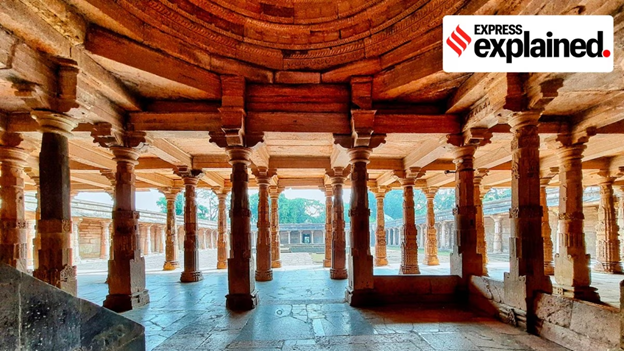
- The Madhya Pradesh High Court declared the Bhojshala complex in Dhar district a Hindu temple.
Bhojshala Complex
- Raja Bhoja, the greatest ruler of the Paramara dynasty, founded the famous Bhojshala at Dhar around 1000–1055 A.D. as a major center of learning dedicated to Goddess Saraswati.
- Later, the structure was converted into the Kamal Maula Mosque during Muslim rule.
- It served as a premier college and centre of Sanskrit learning. The mosque still contains carved pillars, ceilings, and stone inscriptions from the original Bhojshala.
- Important inscriptions include Sanskrit grammar tables, hymns to Vishnu, praises of Paramara kings, and the Sanskrit drama Karpuramanjari written by Madana during the reign of Arjunavarma Deva.
Jaggery Sector in India
Syllabus: GS3/Economy
In News
- Jaggery production in India is a key agro-processing sector that is supporting rural livelihoods, farmer incomes, and value addition through cottage industries.
Jaggery
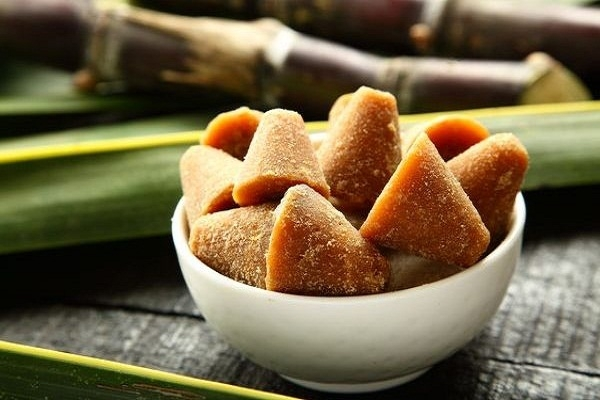
- It is commonly known as gur and is a traditional, unrefined, natural sweetener.
- It is produced by concentrating sugarcane juice without the use of chemicals.
- It is widely consumed across Asia, Africa, Latin America, and the Caribbean under various local names.
Jaggery Production in India
- India produces over 70% of the world’s jaggery, making it the largest global producer.
- Uttar Pradesh contributed 48.5 percent of total production, followed by Maharashtra (24.1 percent) and Karnataka (10.5 percent).
Saranda Forest
Syllabus: GS3/Environment
In News
- The Jharkhand government has filed a review petition in the Supreme Court against its earlier order directing the state to notify the Saranda elephant forests as a wildlife sanctuary within three months.
- Jharkhand argues that declaring the sanctuary could affect tribal habitations, roads, and infrastructure, requiring further studies.
Saranda Forest
- It is located about 122 km from Jamshedpur in Jharkhand.
- It is the largest Sal forest in Asia and is known as the “land of seven hundred hills.”
- It is part of the Chhotanagpur biogeographic zone and connects with forests in Odisha and Chhattisgarh, creating a continuous wildlife habitat.
- Flora and fauna – It includes endangered flying lizards and large elephant populations, and forms an important migratory elephant corridor.
- Major tree species – Sal, Mahua, and Kusum.
- Tribes – Ho, Munda, Uraon, and Santhal peoples,
- Significance – It holds deep cultural significance for local tribes, whose traditions, rituals, and sacred groves (“Sarna”) are closely tied to the forest ecosystem.












Leave a Reply