
Lunar Ring Project
Science and Tech

Context
- The Luna Ring Project, proposed by the Japan-based Shimizu Corporation.
- It is a futuristic, conceptual infrastructure project designed to address Earth’s energy needs by creating a massive solar power ring around the Moon.
Luna Ring Project
- Concept: The project involves constructing 11,000 km (approx. 6,800 miles) long belt of solar panels along the Moon’s equator.
- Mechanism: These solar panels will capture solar energy, which will be converted into microwaves or laser beams and transmitted back to Earth.
- Construction: The project proposes using automated construction robots to process lunar soil (regolith) into concrete, bricks, and glass fibers, enabling In Situ Resource Utilization (ISRU).
- Constant Power: Unlike Earth, the Moon has no atmosphere to block sunlight, allowing for uninterrupted power generation 24 hours a day
Government Notifies Two Institutions as Repositories
Governance
Context
- National Biodiversity Authority (NBA) officially notified two premier scientific institutions as designated repositories under Section 39 of the Biological Diversity Act, 2002
Referral Centres
- ‘Bhavasagara’ (at the Centre for Marine Living Resources and Ecology (CMLRE), Kochi) – A specialized national facility dedicated to deep-sea biodiversity.
- MACS Collection of Microorganisms (at the Agharkar Research Institute (ARI), Pune) – An expert hub for microbial and fungal diversity, which also includes the National Fungal Culture Collection of India.
Key Significance of the Notification
- Expansion of National Network: This addition brings the total number of designated national repositories in India to 20.
- Scientific Support: The notification facilitates innovation by making biological materials accessible for research under transparent and accountable scientific conditions.
Connect with the basics – Biological Diversity Act, 2002
- Enacted – The act was enacted in 2002
- Objective – It aims at the conservation of biological resources, managing its sustainable use and enabling fair and equitable sharing benefits arising out of the use and knowledge of biological resources with the local communities.
The act envisaged a three-tier structure to regulate the access to biological resources:
- The National Biodiversity Authority (NBA)
- The State Biodiversity Boards (SBBs)
- The Biodiversity Management Committees (BMCs) (at local level)
National Biodiversity Authority
- Established in – The National Biodiversity Authority (NBA) was established in 2003 by the Central Government to implement India’s Biological Diversity Act (2002).
- Statutory body – It is a Statutory body that performs facilitative, regulatory and advisory functions for the Government of India on the issue of Conservation and sustainable use of biological resources.
- Headquarter – The NBA has its Headquarters in Chennai, Tamil Nadu, India.
Functions
- Monitoring and prevention of actions prohibited under the Act.
- Providing advice to the government on how best to conserve biodiversity in India.
- Prepare a report on how the government can select biological heritage sites.
- Make concrete steps to prevent the grant of intellectual property rights regarding locally used biological resources or allied traditional knowledge
Elephanta Caves
Syllabus: GS1/ History and Culture
Context
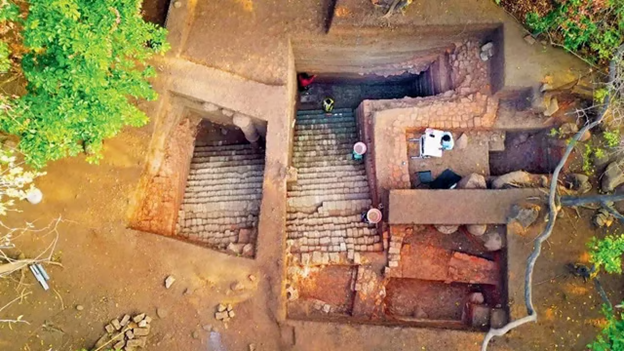
- A major excavation by the Archaeological Survey of India (ASI) on Elephanta Island has revealed a 1,500-year-old stepped reservoir.
- The excavated structure is a T-shaped stepped reservoir, indicating a planned architectural design.
Additional Information – Elephanta Caves
- The Elephanta Caves, located on Elephanta Island (historically known as Gharapuri, meaning “city of caves”), are a UNESCO World Heritage Site situated in Mumbai Harbour.
- The name “Elephanta” was given by the Portuguese in the 16th century after they discovered a large stone elephant near the island, while the original name Gharapuri was used by local inhabitants.
- Historically, the island was associated with multiple dynasties.
- The Kalachuris of Mahishmati are considered the main patrons of the caves during the 6th century CE, as supported by recent coin discoveries of King Krishnaraja. Before them, the Konkan Mauryas ruled the region, followed by the Chalukyas and Rashtrakutas who maintained its importance.
- There are seven caves, of which Cave 1 (Great Cave) is the most prominent. It houses the iconic 20-feet Trimurti sculpture.
- A three-headed figure representing Shiva as Creator, Preserver, and Destroyer.
Soil Sakhis
Syllabus: GS3/Agriculture
Context
- The “Soil Sakhis” initiative in drought-prone districts of western Maharashtra is empowering women while improving soil health and agricultural productivity.
Soil Sakhis
- Launched in 2023 under the Mann Deshi Foundation’s Agriculture and Climate Action Programme.
- Trains rural women as “Soil Sakhis” to promote soil testing and scientific farming practices.
- Implemented in Satara, Sangli, Solapur, Kolhapur, and Pune districts.
Key Features
- Soil Sakhis collect samples and facilitate soil testing through laboratories.
- Farmers receive actionable reports for improved crop and nutrient management.
- Soil Sakhis earn about ₹8,000–₹10,000 per month (excluding petrol allowance).
FSSAI Cannot Regulate Animal Feed
Syllabus: GS2/Health/Governance
Context
- The Delhi High Court struck down a Food Safety and Standards Authority of India (FSSAI) regulation that prohibited the sale of animal feed containing meat or bone meal of bovine or porcine origin for milk-producing animals.
- About
- FSSAI banned the use of meat or bone meal in feed meant for milk- and meat-producing animals, except poultry, pigs and fish.
- The Delhi High Court held that FSSAI is not empowered to prescribe standards for food meant for animal consumption and its mandate is limited to food for humans.
Food Safety and Standards Authority of India (FSSAI)
- It is an autonomous statutory body established under the Ministry of Health and Family Welfare.
- It was created by the Food Safety and Standards Act, 2006.
- Composition: Led by a Chairperson (rank of Secretary to the Government of India) and 22 members, of whom one-third must be women.
- Structure: Headquartered in New Delhi with 6–8 regional offices (Delhi, Mumbai, Kolkata, Chennai, Guwahati, Kochi).
Functions:
- Laying down science-based standards for food.
- Licensing and registration of Food Business Operators (FBOs).
- Monitoring manufacture, storage, distribution, sale, and import of food.
- Accrediting food testing laboratories across India.
Cabinet Clears 12% Hike in P&K Fertiliser Subsidy
Syllabus: GS3/ Agriculture
In News
- The Union Cabinet has approved a 12% increase in Nutrient-Based Subsidy (NBS) rates for Phosphatic and Potassic (P&K) fertilizers for the Kharif Season 2026.
Nutrient-Based Subsidy (NBS) Scheme
- Launch: Introduced in 2010 by the Ministry of Chemicals and Fertilizers.
Objectives
- Encourage balanced fertilizer application across nutrients.
- Rationalise and contain the government’s subsidy burden.
- Promote efficient nutrient management in agriculture.
Key Features:
- Subsidy is nutrient-centric, i.e., calculated based on the content of:
- Nitrogen (N)
- Phosphorus (P)
- Potassium (K)
- Sulphur (S)
- Covers 28 notified grades of P&K fertilisers, including commonly used products such as DAP and SSP (Urea is not under NBS and remains under a separate subsidy regime).
11 Years of Pradhan Mantri MUDRA Yojana (PMMY)
Syllabus: GS3/Economy; GS2/Government Initiatives
Context
- The Pradhan Mantri MUDRA Yojana (PMMY) has completed 11 years.
About
- Launched: In 2015.
- Aim: To support small-scale business ventures.
- Target Group: New entrepreneurs, small shopkeepers, women entrepreneurs, street vendors, artisans, fruit/vegetable vendors, and small manufacturing units.
- These loans are given by Commercial Banks, RRBs, Small Finance Banks, MFIs and NBFCs.
MUDRA has created four products namely:
- Shishu: Covering loans upto Rs. 50,000/-.
- Kishor: Covering loans above Rs. 50,000/- and up to Rs. 5 lakhs.
- Tarun: Covering loans above Rs.5 lakh and upto Rs.10 lakhs.
- TarunPlus: Covering loans above Rs.10lakh and upto Rs.20 lakhs.



















Leave a Reply