
Mission for Cotton Productivity (2026–31)
Syllabus: GS3/Economy
In News
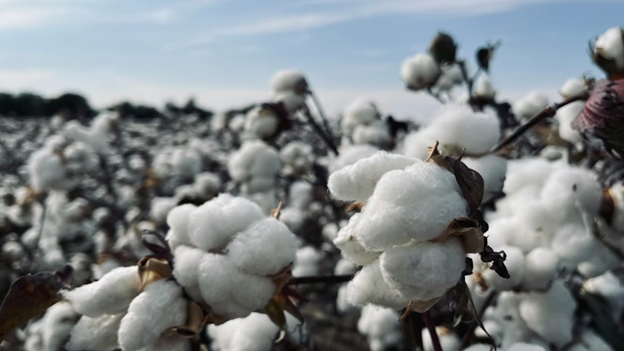
- The Union Cabinet has approved Rs.5659.22 crore for the Mission for Cotton Productivity (2026–27 to 2030–31)
Mission for Cotton Productivity
- It is also referred as Kapas Kranti
- Objective – it aims to address stagnant yields and improve fibre quality to make India a self-reliant and globally competitive textile hub.
- Focuses on high-density planting (HDPS), developing 24 climate-resilient varieties, promoting Extra Long Staple (ELS) cotton, and branding (“Kasturi Cotton Bharat”).
- Modernization: Includes upgrading 2,000 ginning units and integrating digital tools for better market access
Connect with the basics – Cotton Cultivation in India
- It is often referred to as “White Gold,”
- It is a vital commercial crop that serves as the backbone of India’s textile industry and sustains millions of livelihoods.
Geographic & Climatic Requirements-
- It is a subtropical Kharif crop requiring 6–8 months to mature, cotton needs a warm, sunny climate (21°C–30°C) with at least 210 frost-free days.
- Rainfall/Soil: Requires 50–100 cm of water; best grown on moisture-retaining Black Cotton Soil (Regur), though it thrives in alluvial/red soils with proper drainage to avoid waterlogging.
- Production: India is the world’s top producer and holds the largest acreage.
- Major producing states – Gujarat, Maharashtra, and Madhya Pradesh
- Key Challenges: Pink Bollworm (PBW) resistance
India’s e-waste Management
Syllabus: GS3/Environment/Waste Management
Context
- India generated 6.2 million tonnes of e-waste in FY24, projected to more than double to 14 million tonnes by 2030.
Connect with the basics- E-Waste
- E-waste refers to discarded electrical and electronic devices such as computers, circuit boards, mobile phones, and appliances.
- It contains hazardous materials like lead, mercury, cadmium, and brominated flame retardants.
- Improper disposal leads to soil contamination, water pollution, and health hazards.
Impact of Improper E-Waste Management
- Water Pollution: Toxic discharge from cyanide and sulphuric acid affects water bodies.
- Air Pollution: Emissions from lead fumes and plastic burning are severe.
- Soil Contamination: Hazardous substances leach into the soil, damaging agriculture and biodiversity.
- Economic Loss: India is estimated to forfeit over ₹80,000 crore worth of critical metals each year, which could have been recovered and re-used in manufacturing.
Initiatives for E-Waste Management in India
- Extended Producer Responsibility (EPR): Producers, importers, and brand owners are made responsible for managing their product’s end-of-life waste.
- An online EPR E-Waste portal has been developed by Central Pollution Control Board (CPCB) where entities such as producers, manufacturers, recyclers, and refurbishers of the e-waste are required to be registered.
- The Ministry of Environment, Forest and Climate Change has comprehensively revised the E-Waste (Management) Rules, 2016 and notified the E-Waste (Management) Rules, 2022.
- India’s first e-waste clinic was inaugurated in Bhopal, Madhya Pradesh.
- It’s a facility for segregating, processing, and disposing of e-waste from both households and commercial units.
- The Ministry of Mines launched a Pan-India E-Waste Recycling Drive as part of Special Campaign 5.0 (in 2025), aimed at promoting Swachhata in government offices and ensuring scientific disposal and resource recovery from electronic waste.
Basel Convention
- The Basel Convention is a global treaty aimed at controlling the transboundary movement of hazardous wastes and their disposal, ensuring that such wastes are managed in an environmentally sound manner.
- It was adopted in 1989 and entered into force in 1992.
- India is a party to the Basel Convention.
Teesta River
Syllabus: GS1/Geography
In News
- Bangladesh has renewed its request to move forward on the long-pending Teesta water-sharing agreement.
Teesta River
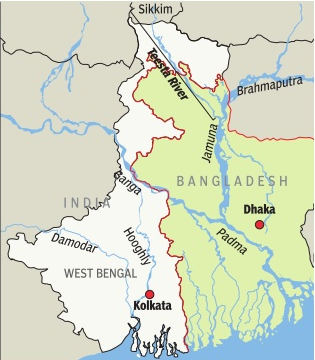
- It is a tributary of the Brahmaputra
- It originates from the Tso Lhamo Lake in north Sikkim.
- It travels for about 150 km in Sikkim and 123 km in West Bengal, before entering Bangladesh.
- It flows another 140 km in Bangladesh and joins the Bay of Bengal.
Agreement
- India and Bangladesh had reached an in-principle agreement in 2011 to share the Teesta river waters, but it was never finalized due to coordination issues between the Centre and the West Bengal government .
- Bangladesh has now expressed hope that the 2011 agreement can be reconsidered in the present political context.




















Leave a Reply