
Miyawaki Forest Plantation
Syllabus: GS3/ Environment
Context
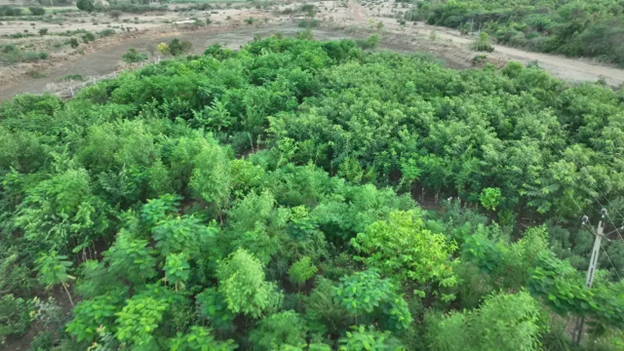
- The Delhi government’s Forest Department has planned a Miyawaki plantation drive at the Asola-Bhatti Wildlife Sanctuary.
Miyawaki Technique
- Origin: The Miyawaki technique, Often referred to as the ‘pot plantation method’, was developed by renowned Japanese botanist Akira Miyawaki in the 1970s.
- It is a revolutionary method for creating dense forests in small urban spaces.
- Principle: It involves planting trees and shrubs close to one another to accelerate their growth. Plants grow 10 times faster with this technique, making it a practical solution for urban areas.
- Significance: In urban areas, the method is known to have successfully converted barren, polluted lands into thriving green ecosystems, simultaneously managing industrial waste and curbing pollution.
Asola-Bhatti Wildlife Sanctuary
- The Asola-Bhatti Wildlife Sanctuary is located in southern Delhi and extends into parts of Faridabad in Haryana.
- The sanctuary lies along the Southern Ridge of the Aravalli Range, which is one of the oldest mountain systems in the world.
- The sanctuary was declared a protected area in 1991 under the Wildlife (Protection) Act, 1972.
- The sanctuary is also known as the “green lungs” of Delhi and acts as a natural ecological barrier against the eastward expansion of the Thar Desert.
Advanced Medium Combat Aircraft (AMCA) project
Syllabus: GS3/Defence

Context
- The Union Minister for Defence laid the foundation stone for the Advanced Medium Combat Aircraft (AMCA) project at Puttaparthi, Andhra Pradesh.
Advanced Medium Combat Aircraft (AMCA) programme facility
- is being developed by the Aeronautical Development Agency under the Defence Research and Development Organisation (DRDO).
- It will serve as the integration, development and flight testing hub for India’s indigenous fifth-generation stealth fighter aircraft programme.
- The AMCA fighter aircraft will feature stealth technology, twin-engine super cruise capability and advanced avionics.
‘Abhay’: AI-powered verification system
Syllabus: GS3/Cyber Security
In News
- The Central Bureau of Investigation (CBI) has launched an AI-based helpbot called “Abhay” for authentication of CBI notices.
‘Abhay’
- It is the AI-powered chatbot-style verification mechanism for the public to verify notices issued by CBI.
- It is designed to protect the citizens from the growing menace of cyber fraud and digital arrest scams.
- It has been designed keeping in mind data confidentiality and the requirement for a public-facing authentication mechanism.
India’s First Satellite-tagged Ganges Soft-shell Turtle
Syllabus: GS3/Environment
In News
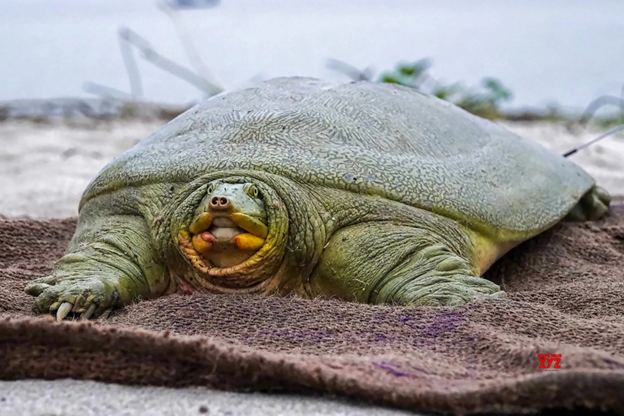
- India’s first satellite-tagged Ganges soft-shell turtle was released in Kaziranga National Park and Tiger Reserve in Assam.
- Assam is one of the world’s top priority areas in freshwater turtle conservation. Of the eight soft-shell turtles reported from India, five are known from the Kaziranga landscape.
Ganges soft-shell turtle (Nilssonia gangetica),
- Characteristics: It can be differentiated from other riverine turtles by its distinct arrowhead-shaped markings on the top of the head.
- It feeds on fish, birds, reptiles, invertebrates, carrion, and aquatic plants.
- Habitat and Distribution: It mainly lives in rivers and large canals with muddy bottoms and flowing, turbid water, though it may also use ponds and lakes.
- It is found across the northern plains of the Indian subcontinent, including the Indus, Ganga, Narmada, Mahanadi, and Brahmaputra river basins in India, Bangladesh, Nepal, Pakistan, and Afghanistan.
- In India, the species inhabits large rivers, lakes, and reservoirs.
- Ecological Role : It is a major river predator and helps clean up the system by feeding on dead and decaying animal matter.
- Threats : It faces severe threats from illegal hunting, international trade, and habitat destruction.
- Protection status : It is a Schedule I animal under the Wildlife Protection Act of 1972.
- It is recorded as endangered on the International Union for Conservation of Nature (IUCN) Red List.
- It is included in CITES Appendix I, prohibiting all forms of international commercial trade.







Leave a Reply