
Buxa Tiger Reserve
Environment
Context
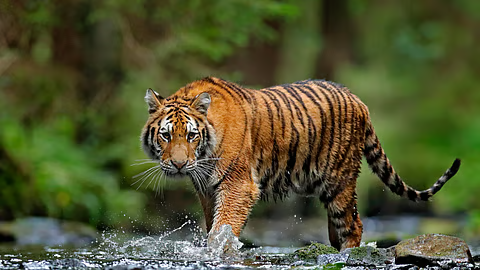
- A three-year-old tigress, T138, has been released into West Bengal’s Buxa Tiger Reserve, marking the beginning of a phased tiger reintroduction programme to establish a self-sustaining tiger population.
Buxa Tiger Reserve
-
- Location: Alipurduar district, northern West Bengal, along the India–Bhutan border.
- Established: Declared a Tiger Reserve in 1983 under Project Tiger.
- Ecological significance:
- Located in the Eastern Himalayan foothills.
- Provides ecological linkages with forests of Assam and Bhutan.
-
- Important fauna: Asian elephant, gaur, sambar, clouded leopard, Indian leopard and Asian golden cat.
- Tiger status: Historically faced a prolonged absence of a stable resident tiger population due to habitat degradation, fragmentation and reduced prey availability.
- Rivers:
- Sankosh River: Forms part of the eastern boundary along the Assam border.
- Jayanti River: Important seasonal river flowing through the Buxa landscape.
Additional Information – Project Tiger
- Launched in 1973 with 9 tiger reserves.
- Legal basis: Tiger Reserves are constituted under the Wildlife (Protection) Act, 1972, particularly after the 2006 amendment.
- NTCA: Established in 2006 as a statutory body for tiger conservation.
- Core area: Legally designated as Critical Tiger Habitat (CTH); receives the highest protection.
- Buffer area: Peripheral area adjoining the core, aimed at promoting coexistence and reducing pressure on the core.
- Tiger Census: Conducted every 4 years under the All India Tiger Estimation (AITE).
- Latest national tiger estimate: 3,682 tigers (2022).
- Highest tiger population: Madhya Pradesh, followed by Karnataka and Uttarakhand (2022 estimate).
- Largest Tiger Reserve by area: Nagarjunsagar-Srisailam (Andhra Pradesh–Telangana landscape).
- Smallest Tiger Reserve: Bor Tiger Reserve, Maharashtra.
- First Tiger Reserve: Jim Corbett Tiger Reserve, Uttarakhand.
- Newest tiger reserves: India has continued adding reserves under Project Tiger; the exact total changes with new notifications.
- Tiger reserves are not necessarily National Parks: A tiger reserve can include National Parks, Wildlife Sanctuaries and other forest areas.
- Global significance: India contains the largest share of the world’s wild tiger population.
G7 Nations to Release 100 Million Barrels of Oil
International
Context
- The Group of Seven (G7) nations have agreed to release 100 million barrels of oil over four months to ease soaring fuel prices, with a substantial release of diesel planned in the first 20 days.
Group of Seven (G7)
- G7: Informal grouping of 7 major advanced economies.
- Members: France, Germany, Italy, Japan, UK, USA and Canada.
- Origin: Emerged from the 1973 oil crisis.
- Initial Group of Five (G5): France, West Germany, USA, UK and Japan.
- Canada joined: 1976 → G7.
- EU: Began participating in 1977; EU is not a G7 member, but participates in meetings.
- G8 phase: Russia joined in 1997, making it G8.
- Back to G7: Russia ceased to be part of the group in 2014 following the annexation of Crimea.
- Nature: Informal grouping, not a treaty-based international organisation.
- Presidency: Rotates annually among member countries.
- Key areas: Global economy, trade, security, climate change, energy, development and geopolitical issues
Additional Information – International Energy Agency (IEA)
- Established: 1974, in response to the 1973–74 oil crisis.
- Headquarters: Paris, France.
- Parent framework: Operates within the framework of the OECD.
- Members: 32 member countries.
- India: Association country, not a full IEA member.
- Other Association countries: China, Indonesia, Singapore, South Africa, Thailand etc.
- Main objective: Ensure energy security and coordinate responses to major disruptions in oil supply.




















Leave a Reply