
PM-UDAY Scheme
Government Schemes

In News
- Recently Delhi CM has sought ₹100 crore as a first phase central government financial assistance to implement the revised Pradhan Mantri Unauthorised Colonies in Delhi Awas Adhikar Yojana (PM-UDAY) in the national capital.
Pradhan Mantri –Unauthorised Colonies in Delhi Awas Adhikar Yojana (PM-UDAY)
- Financing – It is a central sector initiative
- Launched in- October 2019
- Objective – to grant legal ownership, transfer, and mortgage rights to residents living in Delhi’s unauthorised colonies.
- Administered by – Delhi Development Authority (DDA) under the Ministry of Housing and Urban Affairs (MoHUA)
Parrot Bornavirus 4
Science & technology
Context
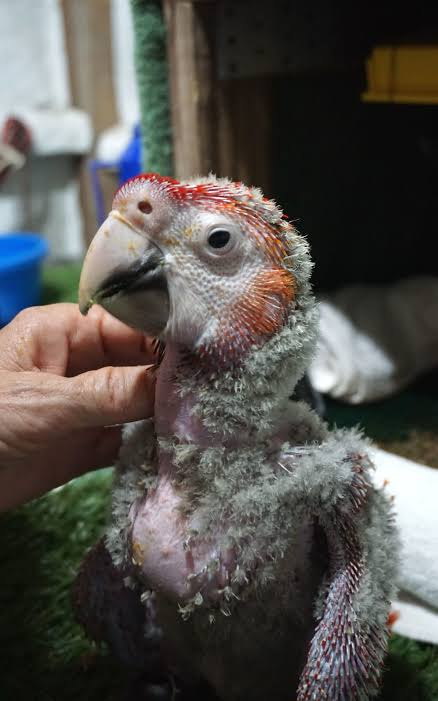
- Deadly bird virus PaBV-4 has been identified for the first time in India.
Parrot Bornavirus 4 (PaBV-4)
-
- It is an avian virus recently detected for the first time in India (Assam, Karnataka, West Bengal) among captive parrot species.
- The Virus: Enveloped, negative-sense, single-stranded RNA virus (Bornaviridae family).
- Zoonotic Status: Not zoonotic (does not infect humans).
- Target: Psittacine birds (macaws, cockatoos, parakeets, budgerigars).
Associated Disease
- It causes Proventricular Dilatation Disease (PDD), also called “Macaw Wasting Disease.”
- Gastrointestinal: Destroys nerves in the digestive tract, causing an enlarged stomach, weight loss, and undigested seeds in droppings.
- Neurological: Causes tremors, loss of coordination, seizures, and paralysis.
Transmission & Management
- Spread: Contact with infected feces, saliva, feather dust, or vertically from parent to egg.
- Challenge: Infected birds can stay asymptomatic while actively shedding the virus.
- Control: No vaccine or cure exists. Diagnosis is via RT-PCR; management relies on isolation and supportive care.
Direct Seeded Rice (DSR)
Economy
In News
- Recently, the Chhattisgarh government issued an advisory to focus on prioritising Direct Seeded Rice (DSR) over the traditional transplanting method against the backdrop of the uncertainty of rainfall due to El Niño.
Direct Seeding of Rice
- It is a resource-efficient cultivation technique where paddy seeds are sown directly into the main field, completely bypassing the traditional, water-intensive stages of nursery raising, manual transplanting, and field puddling.
- Also locally called the ‘tar-wattar’ technique (sowing in moist soil).
- It has gained immense policy traction across states like Punjab and Haryana to counter severe groundwater depletion and El Niño-induced monsoon deficits.
Additional Information – DSR vs. Traditional Puddled Transplanted Rice (PTR)
|
Feature |
Traditional Method (PTR) |
Direct Seeding of Rice (DSR) |
|
Nursery Phase |
Seeds grown in nurseries for 25–35 days. |
Skipped entirely; seeds sown directly. |
|
Field Preparation |
Puddling (ploughing flooded fields to create mud). |
Laser land levelling and dry/moist sowing. |
|
Water Usage |
Flooded conditions; requires ~3,600–4,125 litres per kg. |
Saves 15% to 35% water; no continuous submergence. |
|
Labour Need |
Highly intensive (manual uprooting & planting). |
Mechanised; slashes labour costs by over 30%. |
|
Methane Profile |
High (anaerobic decomposition in flooded fields). |
Low (soil remains moist, not flooded). |
Long March 10B Rocket
Science & Technology
In News
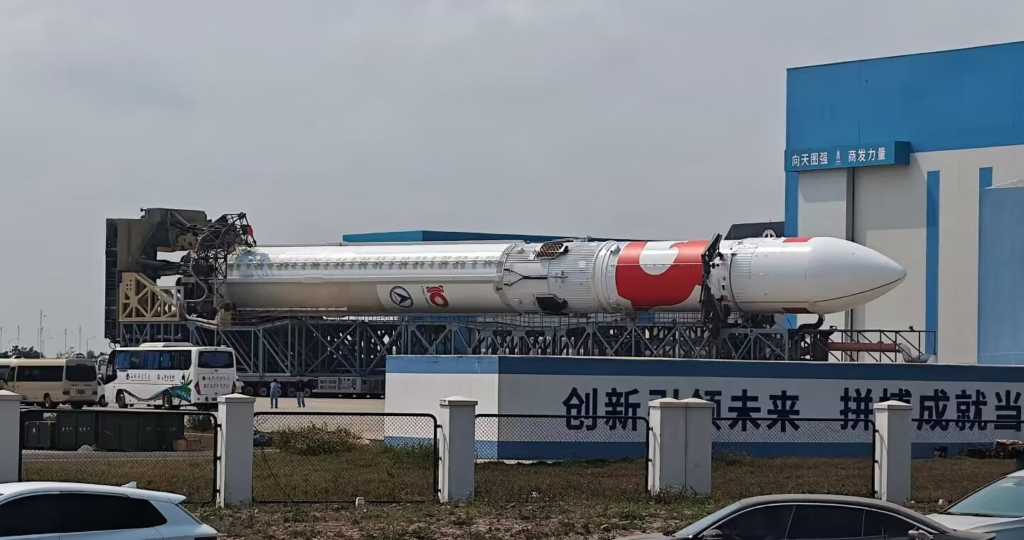
- China successfully achieved its first reusable rocket landing at the Wenchang Commercial Space Launch Site, making a precise sea-based recovery after separation.
Long March 10B
- It is also called Changzheng 10B.
- It is designed to support next-generation space exploration.
- Developer: China Academy of Launch Vehicle Technology (CALT).
- Primary Mission: Launching the Mengzhou (crewed spacecraft) and Lanyue (lunar lander) for China’s manned lunar missions.
- Timeline: The first test flight is projected around 2027, aiming for a crewed moon landing by 2030.
India-New Zealand ‘Strategic Partnership’
International
News –
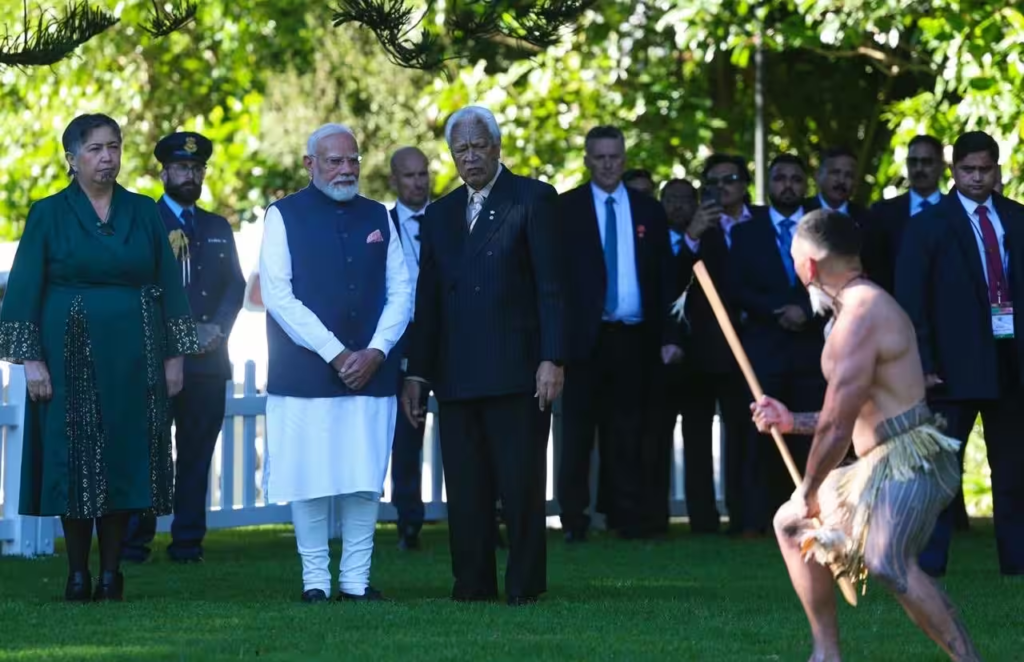
- The Prime Minister’s visit to Auckland was the first visit by an Indian Prime Minister to New Zealand in four decades.
- PM Modi was honoured with a Māori Pōwhiri, a formal welcome ceremony of the Māori (the indigenous Polynesian people of New Zealand), featuring the ‘Haka’ dance.
Outcomes of the Visit
- Roadmap to 2030: Elevated bilateral relations to a ‘Strategic Partnership’.
- Indo-Pacific Oceans Initiative: New Zealand adopted Maritime Security as its priority pillar within the seven-pillar IPOI framework.
- Climate and Energy Platforms: New Zealand joined the Global Biofuels Alliance and reaffirmed its cooperation under the Coalition for Disaster Resilient Infrastructure (CDRI).
- Civilisational Ties: Established cultural and traditional medicine cooperation alongside a framework between the New Zealand Maritime Museum and India’s National Maritime Heritage Complex at Lothal.
New Zealand
- Island Nation: New Zealand is a remote island country in the South Pacific Ocean, consisting of two main islands (North and South) and several smaller islands.
- No Land Borders, and Australia is its nearest neighbour, located over 1,600 km to the northwest.
- Geopolitical Position: It lies in Australasia with Australia and marks the southwestern boundary of Polynesia, bordered by the Tasman Sea and the Pacific Ocean.
India’s Textile Sector
Economy
Context –
- The Ministry of Textiles released a report on India’s Textile Future, emphasising the need to adopt circular economy principles across the textile value chain.
Significance of the Textile Sector
- It is also called the “spinning wheel” of India’s industrial growth,
- The textile and apparel sector contributes ~2% to GDP and ~11% of manufacturing GVA.
- It is India’s 2nd largest employer after agriculture, providing livelihoods to over 45 million people.
- India is the 6th largest textile and apparel exporter, with a 4% global market share.
Government Initiatives
- PM MITRA Parks: Massive textile parks with sustainable infrastructure, featuring Common Effluent Treatment Plants (CETPs) to optimize water reuse.
- Indian Carbon Market (ICM) Integration: The government has added the carbon-heavy textile sector to the requirements for disclosing Scope 1 and 2 GHG emissions.
- RAMP Programme: Introduced MSE-SPICE with a 25% capital subsidy for circular methods and MSE-GIFT with a 2% interest subsidy for green technology upgrades to finance small businesses.
- National Technical Textiles Mission (NTTM): Funds scientific research to chemically and mechanically convert tough textile waste into industrial advanced materials.
- Eco Mark Scheme: Establishes national eco-labelling standards for textile products, easing the transition into markets with strict environmental standards.
- Mission LiFE: Promotes clothing reuse, swapping, circular economies, and less fast-fashion consumption through lifestyle change.
- Industrial Innovation: The SURE Initiative, led by CMAI and the UN in India, is India’s largest voluntary fashion-sector sustainability commitment.
Pinaka Long Range Guided Rocket
Science & technology

News –
- DRDO conducted a successful flight test of the Pinaka Long Range Guided Rocket (LRGR) at the Integrated Test Range (ITR), Chandipur.
Pinaka Long Range Guided Rocket (LRGR)
- It is an indigenously developed, precision-guided rocket for the Pinaka multi-barrel rocket launcher (MBRL) system.
- It is designed to replace Russian-origin BM-21 Grad systems.
- Range: Up to 120 km
- Guidance System: It combines an Inertial Navigation System (INS) with India’s NavIC (IRNSS) satellite network for precision navigation.
Oxytocin
Science & technology
Context –
- WHO has sought information from India regarding reports linking suspected spurious oxytocin to maternal deaths.
Oxytocin
- It is a neuropeptide hormone synthesised in the hypothalamus and released into the bloodstream by the posterior pituitary gland.
- Often called the “love hormone.
- Function – It acts as a chemical messenger in the central nervous system, aiding childbirth, lactation, and social bonding.
- Regulation – Administering oxytocin to cattle is a cognizable offence under Section 12 of Prevention of Cruelty to Animals Act; unauthorised manufacture or sale is prohibited under Section 18(a) of Drugs and Cosmetics Act, 1940.








Leave a Reply