
Yuva Sangam
Government Initiatives
Context
- Registrations for institution-led exposure tours under Yuva Sangam Phase-VI were held, covering 22 States and Union Territories.
Yuva Sangam
- It is an initiative by the Government of India to strengthen people-to-people connect between youth belonging to different States/UTs of India.
- It was conceptualised by the Ministry of Education and was launched under the banner of Ek Bharat Shreshtha Bharat (EBSB).
Ek Bharat Shreshtha Bharat (EBSB)
- It is a landmark initiative to celebrate the country’s unity in diversity.
- It was announced by Prime Minister Narendra Modi on 31st October 2015, coinciding with the 140th birth anniversary of Sardar Vallabhbhai Patel.
Key Initiatives Under Ek Bharat Shreshtha Bharat
- Yuva Sangam: A youth exchange program that allows students and off-campus youth to travel to paired states, focusing on five pillars: Paryatan (Tourism), Parampara (Tradition), Pragati (Progress), Paraspar Sampark (People-to-people connect), and Devshakti (Spiritual connection).
- Bhasha Sangam: An initiative to encourage people to learn basic sentences in different Indian languages, promoting linguistic harmony.
- Educational Integration: Schools and universities across the country conduct EBSB clubs, student exchange trips, and cultural festivals like Kala Utsav.
- Special Events: Celebration of Statehood Days and integration of cultural themes in national events like Bharat Parv.
- Implementation – The Ministry of Education serves as the nodal ministry for coordinating the program
Purchasing Manager’s Index (PMI)
Economy
Context
- The West Asia crisis has led to India’s Manufacturing PMI falling from 56.9 in February 2026 compared to 53.9 in March 2026.
Comparison: PMI vs. IIP
|
Feature |
Purchasing Managers’ Index (PMI) |
Index of Industrial Production (IIP) |
|
Source |
Private (S&P Global) |
Government (NSO, MoSPI) |
|
Basis |
Perception-based survey |
Actual physical output data |
|
Coverage |
Manufacturing & Services |
Broad Industrial Sector (Mining, Mfg, Elec) |
|
Timing |
Monthly, at the start of the month |
Monthly, with a 6-week lag |
Coal Gasification Incentive Scheme
Economy
In Context
- The Union Minister has unveiled India’s roadmap to address this through domestic coal utilisation, with the Coal Gasification Incentive Scheme as a central instrument.
Coal Gasification
- Coal gasification is the process of converting coal into syngas (synthesis gas) — a mixture primarily of hydrogen (H₂) and carbon monoxide (CO) — through a reaction with steam and oxygen at high temperatures.
Syngas serves as a feedstock for producing:
- Ammonia → used in fertiliser manufacturing
- Methanol → used as fuel and chemical feedstock
- Hydrogen → clean energy carrier
- Synthetic natural gas → substitute for imported LNG.
Aditya-L1 Mission
Science and Tech
News
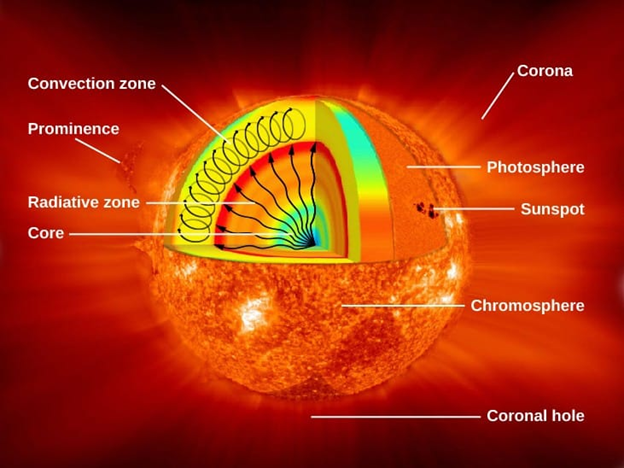
- ISRO invites proposals from the Indian solar physics community to analyse data from the Aditya-L1 mission.
Aditya-L1 mission
- Uniqueness – Aditya-L1 is the first space-based Indian observatory to study the Sun. It will be launched by the PSLV-C57.
- Note – The solar mission will not see the spacecraft actually go to the sun, it will instead create a space observatory at a point from which the sun can be observed even during an eclipse.
- The spacecraft is planned to be placed in a halo orbit around the Lagrange point 1 (L1), around 1.5 million km from the Earth, of the Sun-Earth system.
Major objectives of the mission
- The mission will focus on study of the Solar upper atmospheric (chromosphere and corona) dynamics.
- It will also identify what drives space weather, along with the origin, composition and dynamics of the solar wind.
Additional Information – International Solar Missions
|
Mission |
Space Agency |
Key Feature |
|
Parker Solar Probe (2018) |
Closest mission to the Sun; first spacecraft to “touch” the corona. |
|
|
Solar Orbiter (2020) |
ESA & NASA |
Focuses on high-resolution images of the Sun’s poles. |
|
SOHO (1995) |
ESA & NASA |
An older observatory at L1 that has provided over two decades of solar data. |
|
PUNCH (2025) |
NASA |
A constellation of four small satellites studying how the corona becomes solar wind. |
|
ASO-S (Kuafu-1) (2022) |
CNSA (China) |
Studies the relationship between the solar magnetic field, solar flares, and CMEs. |
INS Taragiri
Defence
Context
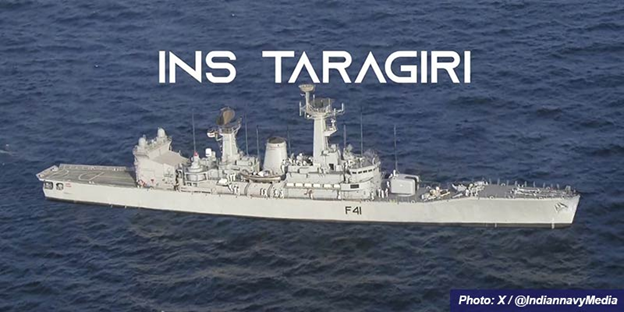
- INS Taragiri, a Nilgiri-class stealth guided missile frigate, has been commissioned into the Indian Navy.
INS Taragiri
- It is the 4th of the 7 Project 17A multi-mission stealth guided missile frigates.
- It was built by Mazagon Dock Shipbuilders Limited (MDL).
- It is named after the Taragiri hill ranges of Uttarakhand.
- About 75% of the ship is indigenously built.
Key Features
- It is designed for multi-role operations across air, surface and sub-surface warfare.
- It is equipped with MF-STAR radar, MRSAM, Barak air defence missiles, and BrahMos missiles.
Additional Information – Project 17A (P-17A)
- Objective: To build seven advanced stealth guided-missile frigates for the Indian Navy.
- Key Manufacturers: The project is split between Mazagon Dock Shipbuilders Limited (MDL) in Mumbai (4 ships) and Garden Reach Shipbuilders & Engineers (GRSE) in Kolkata (3 ships).
- Design: Designed in-house by the Warship Design Bureau (WDB).
- Indigenization: Approximately 75% of the content is indigenous, involving over 200 MSMEs, aligning with the Aatmanirbhar Bharat (Self-reliant India) initiative.
List of Seven Frigates
- INS Nilgiri – Commissioned Jan 2025
- INS Himgiri – Commissioned Aug 2025
- INS Udaygiri – Commissioned Aug 2025
- INS Taragiri – Commissioned April 2026
- INS Dunagiri – Delivered March/April 2026
- INS Vindhyagiri – Under sea trials/outfitting
- INS Mahendragiri – Under construction/outfitting
INS Aridhaman
Defence
In News
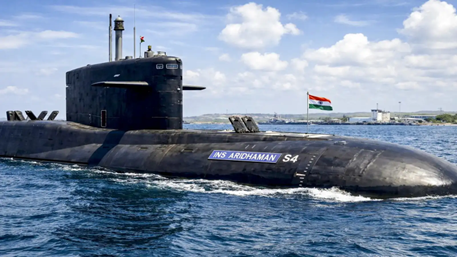
- INS Aridaman, part of India’s Arihant-class ballistic missile submarine (SSBN) fleet, has been commissioned as a more advanced platform than its predecessors — INS Arihant (commissioned 2016) and INS Arighaat (commissioned 2024).
Key Features
- It is larger than INS Arihant and INS Arighaat, with a displacement of about 7,000 tonnes.
- It can carry up to 24 K-15 Sagarika missiles, or 8 K-4 / K-5 missiles.
- The K-4 missile has a range of about 3,500 km.
- These are nuclear-capable submarine-launched ballistic missiles (SLBMs).
- India’s Nuclear Submarine Programme – It was developed through collaboration between DRDO, the Department of Atomic Energy (DAE), the Navy, and private defence firms, with technical assistance from Russia in the early phases.









Leave a Reply