National and International Issues MCQ’s
- Consider the following statements:
- Sanand in Gujarat is emerging as a semiconductor manufacturing hub and the facility is established by Kaynes Semicon.
- It is a part of the India Semiconductor Mission (ISM) launched in December 2021.
- It is implemented by the Ministry of Electronics and Information Technology (MeitY).
- It also includes development of the display manufacturing ecosystem.
How many of the statements given above is/are NOT correct?
- Two only
- Three only
- All Four
- All are correct
Answer: D
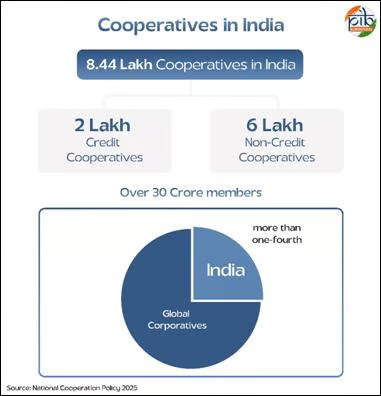
- Consider the following statements regarding the 97th Constitutional Amendment Act, 2011:
- It made the right to form cooperative societies a Fundamental Right under Article 19.
- It inserted Article 43B as a Directive Principle of State Policy.
- It added Part IX-B dealing with cooperative societies applicable to both Union and States.
- It mandated reservation of seats for SCs/STs and women in all cooperative societies.
How many of the above statements is/are correct?
- One only
- Two only
- Three only
- All Four
Answer: C
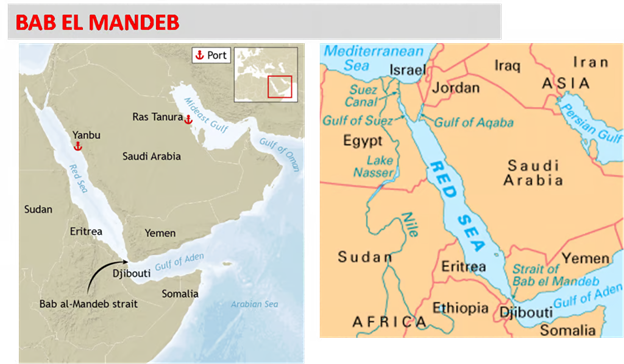
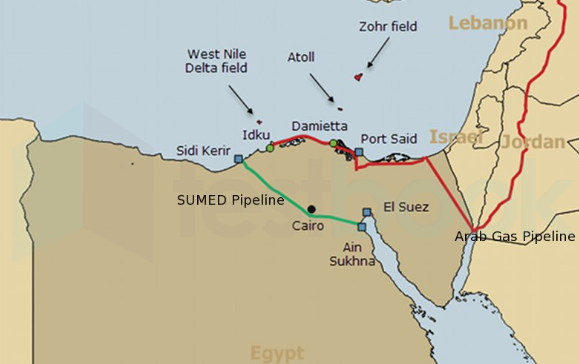
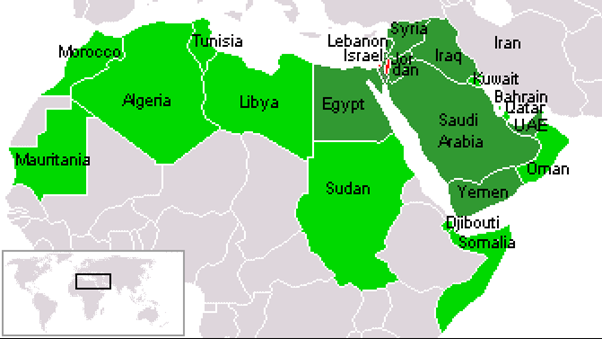
- Consider the following statements regarding the Bab el-Mandab Strait:
- It connects the Red Sea with the Arabian Sea directly.
- It separates the Arabian Peninsula from the Horn of Africa.
- It lies between Yemen and Djibouti/Eritrea.
- It forms a critical link in the route connecting the Mediterranean Sea with the Indian Ocean.
Which of the above statements are correct?
- 2, 3 and 4 only
- 1 and 2 only
- 1, 3 and 4 only
- 2 and 3 only
Answer: A
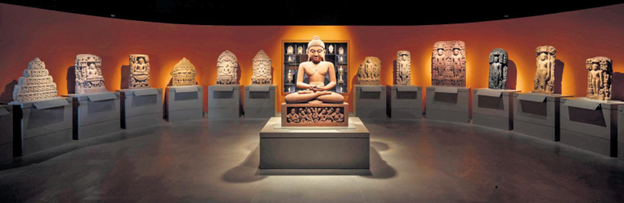
4). Consider the following statements regarding Samrat Samprati:
- He was a direct successor of Emperor Ashoka in the Mauryan empire.
- He is regarded as a patron of Jainism and is often called the “Jain Ashoka.”
- His life is described in Jain texts such as Parishistaparva.
- He is believed to have actively promoted the principle of ahimsa.
Which of the above statements are correct?
- 1 and 2 only
- 2, 3 and 4 only
- 1, 3 and 4 only
- 1, 2, 3 and 4
Answer: B
- Consider the following statements regarding IN-SPACe:
- It is an autonomous agency functioning under the Department of Space and it acts as a single-window clearance agency for space-related activities.
- It was established to regulate and promote private sector participation in the space sector.
- It is working under the chairmanship of Pawan Kumar Goenka and located in Bhopal, Madhya Pradesh.
- It has initiatives like the Technology Adoption Fund (TAF) and the Satellite Bus as a Service (SBaaS).
Which of the above statements are correct?
- 1, 2 and 4 only
- 1 and 3 only
- 2, 3 and 4 only
- 1, 2, 3 and 4
Answer: A
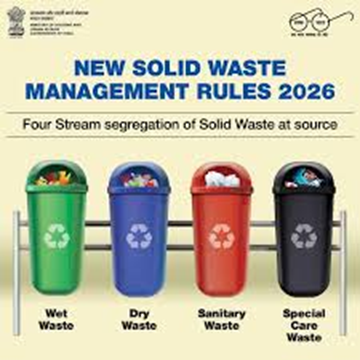
- Consider the following statements regarding the Solid Waste Management (SWM) Rules, 2026:
- These rules replace the SWM Rules, 2016 and aims to promote a circular economy and zero-waste model.
- They mandate segregation of waste into four distinct categories such as wet, dry, sanitary and hazardous.
- Bulk waste generators producing 100 kg/day must process wet waste locally and adopt Extended Producer Responsibility (EPR).
- Industries and cement plants are required to increase Refuse Derived Fuel (RDF) usage over time.
How many of the above statements is/are NOT correct?
- Two only
- Three only
- All Four
- None
Answer: D
- Consider the following statements regarding the Insolvency and Bankruptcy Code (IBC), 2016:
- It provides a time-bound process for resolving insolvency of companies and individuals.
- Insolvency and bankruptcy are interchangeable terms under the Code and the Bankruptcy involves a legal declaration by a competent authority.
- The Code aims to improve ease of doing business by resolving stressed assets efficiently.
- The National Company Law Tribunal deals with insolvency cases of companies and LLPs, while
The Debt Recovery Tribunal handles insolvency of individuals and partnership firms.
Which of the above statements are correct?
- 1, 3 and 4 only
- 1 and 2 only
- 2 and 3 only
- 1, 2, 3 and 4
Answer: A
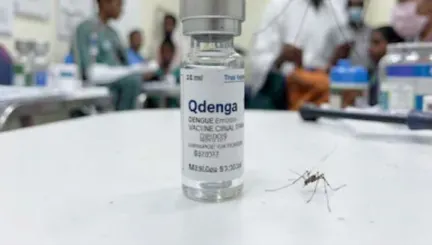
- Consider the following statements regarding Qdenga (TAK-003):
- It is a dengue vaccine developed by Takeda Pharmaceutical Company.
- It is a live-attenuated tetravalent vaccine targeting all four dengue virus serotypes.
- It has been approved by DCGI in India for individuals of all age groups to stimulate immunity by using weakened forms of the dengue virus.
- DengiAll, India’s first indigenous dengue vaccine developed by Panacea Biotec in collaboration with the ICMR.
Which of the above statements are correct?
- 2, 3 and 4 only
- 1 and 3 only
- 1, 2 and 4 only
- 1, 2, 3 and 4
Answer: C
9). Consider the following statements regarding PMAY-G:
- It aims to provide pucca houses with basic amenities by providing financial assistance to rural households.
- Beneficiaries are identified based on Socio-Economic and Caste Census (SECC), 2011 data and are verified by Gram Sabha.
- The funding ratio between Centre and State is 60:40 in plain areas and for North-Eastern and Himalayan states, the ratio is 90:10.
- Financial assistance is higher in hilly and North-Eastern states compared to plain areas and it is implemented by the Ministry of Housing and Urban Affairs.
Which of the above statements are correct?
- 1 and 3 only
- 1, 2 and 4 only
- 2 and 3 only
- 1, 2, 3 and 4
Answer: B
10). Consider the following statements regarding applications of Ammonium Nitrate:
- It is widely used as a nitrogenous fertilizer in agriculture.
- It is a key component in ANFO explosives used in mining.
- It is used as a reducing agent in pyrotechnics.
- It is used in manufacturing nitrous oxide.
Which of the above statements are correct?
- 1, 2 and 4 only
- 1 and 3 only
- 2 and 3 only
- 1, 2, 3 and 4
Answer: A
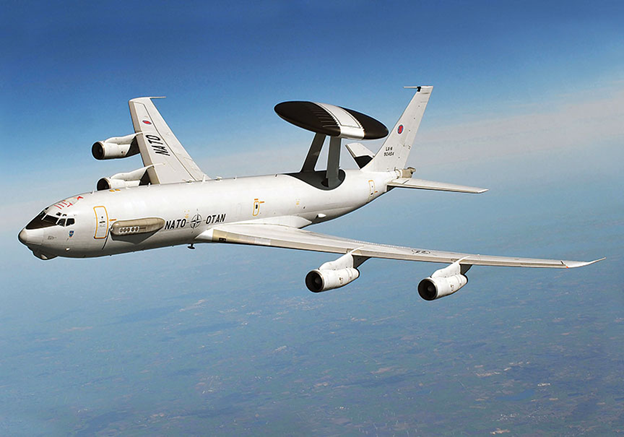
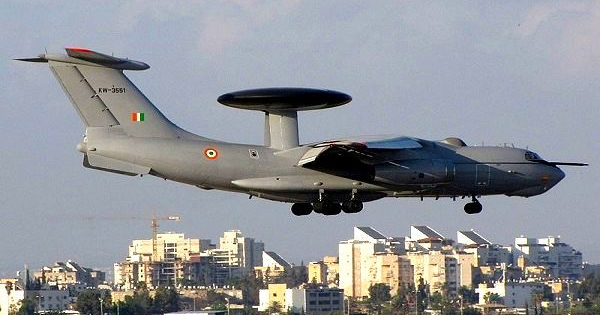
11). Consider the following statements regarding the NETRA AEW&C system:
- It is developed by the DRDO.
- It is primarily used for aerial surveillance and early warning.
- It is mounted on a satellite platform for space-based monitoring.
- It provides command-and-control capabilities during operations.
Which of the above statements are correct?
- 2 and 3 only
- 1 and 3 only
- 1, 2 and 4 only
- 1, 2, 3 and 4
Answer: C
- Consider the following passage:
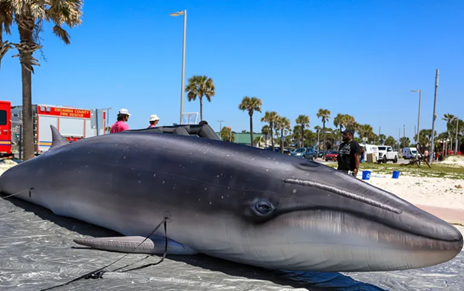
A marine mammal belonging to the baleen whale group is among the rarest whale species in the world, with fewer than 100 individuals remaining. It is endemic to a specific region in the northern Gulf of Mexico and does not undertake long-distance migrations. It primarily feeds on small fish and squid and faces threats from oil drilling, vessel strikes, and climate change. It is listed as Critically Endangered on the IUCN Red List.
Which of the following species is best described in the above passage?
- Blue Whale
- Rice’s Whale (Balaenoptera ricei)
- Humpback Whale
- Sperm Whale
Answer: B
- With reference to Kar Saathi, consider the following statements:
- It is an AI-enabled chatbot platform launched by the Income Tax Department of India.
- It provides assistance only during official working hours.
- It integrates services such as e-payment, e-verification, and tax-related FAQs on a single platform.
- It deals exclusively with indirect taxes under GST.
How many of the statements given above is/are correct?
- One only
- Two only
- Three only
- All Four
Answer: B
- Which of the following fuel gases are primarily methane-based fuels?
- Piped Natural Gas (PNG)
- Compressed Natural Gas (CNG)
- Liquefied Natural Gas (LNG)
- Liquefied Petroleum Gas (LPG)
Select the correct answer using the code below:
- 1, 2 and 3 only
- 1, 2 and 4 only
- 1, 3 and 4 only
- 1, 2, 3 and 4
Answer: A
- With reference to the Multi-Hazard Early Warning Decision Support System (MHEW-DSS), consider the following statements:
- It is an indigenously developed AI-enabled digital platform by the India Meteorological Department that automates critical weather forecasting processes.
- It integrates real-time data from satellites, radars, and ground as well as upper-air sensors into a centralized GIS-enabled platform.
- It is developed under Mission Mausam, and has achieved complete automation of weather data processing and entirely eliminated manual workflows.
- It has improved forecast accuracy by about 30% and reduced forecast preparation time from 6 hours to 3 hours significantly.
Which of the statements given above are correct?
- 1 and 3 only
- 2 and 3 only
- 1, 2 and 4 only
- 1, 2, 3 and 4
Answer: C
- With reference to the Molucca Sea, consider the following statements:
- It is located in the western Pacific Ocean between the islands of Sulawesi and Halmahera.
- It lies along a tectonically active region associated with subduction zones and frequent earthquakes.
- It connects the Indian Ocean directly with the South China Sea, forming a major international shipping route.
- It is part of the Coral Triangle, known for exceptionally high marine biodiversity.
Which of the statements given above are correct?
- 1, 2 and 4 only
- 1 and 3 only
- 2, 3 and 4 only
- 1, 2, 3 and 4
Answer: A
- With reference to Yuva Sangam, consider the following statements:
- It is an initiative of the Government of India aimed at strengthening people-to-people connect among youth from different States and Union Territories.
- It was conceptualised by the Ministry of Education and implemented under the Ek Bharat Shreshtha Bharat programme.
- The Ek Bharat Shreshtha Bharat initiative was announced by Narendra Modi on 31st October 2015, marking the birth anniversary of Sardar Vallabhbhai Patel.
- Yuva Sangam primarily focuses on financial assistance to youth entrepreneurs across States.
Which of the statements given above are correct?
- 2, 3 and 4only
- 1 and 4 only
- 1, 2 and 3 only
- 1, 2, 3 and 4
Answer: C
- With reference to Syngas (Synthesis Gas), consider the following statements:
- Syngas is used as a feedstock for the production of ammonia, which is widely used in fertilizer manufacturing.
- Methanol produced from syngas can serve both as a fuel and as a chemical feedstock.
- Hydrogen derived from syngas is considered a clean energy carrier.
- Synthetic Natural Gas (SNG) produced from syngas can act as a substitute for imported Liquefied Natural Gas (LNG).
How many of the statements given above is/are NOT correct?
- Two only
- Three only
- All Four
- All are correct
Answer: D
- With reference to the Aditya-L1 mission, consider the following statements:
- It is India’s first space-based observatory dedicated to studying the Sun.
- The mission is planned to be launched using the PSLV-C57.
- The spacecraft will be placed in a halo orbit around the Lagrange Point L2 of the Sun–Earth system.
- It aims to study the dynamics of the Sun’s upper atmosphere, including the chromosphere and corona.
Which of the statements given above are correct?
- 1, 2 and 4 only
- 1 and 3 only
- 2, 3 and 4 only
- 1, 2, 3 and 4
Answer: A
- Consider the following statements:
Statement 1: INS Taragiri is an Arihant-class nuclear-powered ballistic missile submarine (SSBN).
Statement 2: INS Taragiri was built by Mazagon Dock Shipbuilders Limited.
Statement 3: INS Aridaman is a Nilgiri-class stealth guided missile frigate.
Statement 4: INS Aridaman was built at the Ship Building Centre (SBC) in Visakhapatnam.
Which one of the following is correct in respect of the above statements?
- Statement 1 is correct, Statement 2 is incorrect, Statement 3 is correct, Statement 4 is incorrect.
- Statement 1 is incorrect, Statement 2 is correct,
Statement 3 is incorrect, Statement 4 is correct.
- Both Statement 1 and Statement 2 are correct, but both Statement 3 and Statement 4 are incorrect.
- Both Statement 1 and Statement 2 are incorrect, but both Statement 3 and Statement 4 are correct.
Answer: B
- Consider the following pairs:
- Deendayal Port – Gujarat
- Paradip Port – Odisha
- Syama Prasad Mookerjee Port – Andhra Pradesh
- Kamarajar Port – Kerala
- Jawaharlal Nehru Port – Maharashtra
How many of the pairs given above is/are correctly matched?
- Two only
- Three only
- Four only
- All Five
Answer: B
- Consider the following statements regarding Stagflation:
- It refers to a situation of high inflation accompanied by stagnant or negative economic growth.
- It is usually associated with economic growth but rising unemployment levels.
- It supports the traditional Phillips Curve relationship between inflation and unemployment.
- It was first popularized by British politician Iain Macleod in the 1960s.
Which of the statements given above are correct?
- 2, 3 and 4 only
- 1 and 3 only
- 1, 2 and 4 only
- 1, 2, 3 and 4
Answer: C
- Consider the following statements regarding Project Chetak:
- It is one of the largest projects of the Border Roads Organisation in terms of geographical coverage.
- It was raised in 1980 and operates primarily in the northeastern region of India.
- It plays a strategic role in maintaining feeder roads towards India’s International Borders.
- It contributes to both defence logistics and regional connectivity in parts of Rajasthan, Punjab and northern Gujarat.
Which of the statements given above are correct?
- 1, 3 and 4 only
- 1 and 2 only
- 2, 3 and 4 only
- 1, 2, 3 and 4
Answer: A
- Consider the following tribes:
- Naikda / Nayaka / Bedar
- Gond
- Jenu Kuruba
- Soliga
- Hakkipikki
- Koraga
- Yerava
How many of the above tribes do NOT belong to Karnataka?
- Only three
- Only four
- None
- All seven
Answer: C
- Consider the following statements regarding the Namo Drone Didi Scheme:
- It was launched in 2023 with the objective of promoting drone technology in Indian agriculture.
- It aims to provide 15,000 drones to Women Self-Help Groups (SHGs) between 2024 and 2026.
- It is a Centrally Sponsored Scheme implemented jointly by the Union and State Governments.
- It is implemented by the Ministry of Agriculture & Farmers Welfare to empower rural women as agri-tech entrepreneurs.
Which of the statements given above are correct?
- 1 and 3 only
- 1, 2 and 4 only
- 2, 3 and 4 only
- 1, 2, 3 and 4
Answer: B
- Consider the following statements:
- He participated in both the Civil Disobedience Movement and the Quit India Movement.
- He founded organizations such as the Akhil Bharatiya Ravidas Mahasabha and the All India Depressed Classes League.
- He was instrumental in the enactment of the Protection of Civil Rights Act, 1955 aimed at eliminating untouchability.
- As Food & Agriculture Minister, he is credited with the Green Revolution and as Defence Minister, he played a key role during the Indo-Pak War of 1971 which led to the creation of Bangladesh.
Which of the following personalities is best described by the above statements?
- B. R. Ambedkar
- Jagjivan Ram
- Ram Manohar Lohiya
- Lal Bahadur Shastri
Answer: B
- Consider the following statements regarding custodial deaths:
- It includes the death of an individual occurring in both police or judicial custody.
- The custodial deaths may occur before trial, during police interrogation or after conviction.
- It may result from torture, negligence, denial of medical care, or suspicious circumstances.
- Uttar Pradesh recorded the highest number of custodial deaths and Tamil Nadu recorded the highest number of custodial deaths among the southern states.
Which of the statements given above are correct?
- 2 and 3 only
- 1, 2 and 3 only
- 2, 3 and 4 only
- 1, 2, 3 and 4
Answer: D
- Consider the following statements regarding marine tar balls:
- They are formed due to weathering of crude oil after oil spills, leaks, or natural seepage in marine environments.
- They are typically light-colored and dissolve easily in seawater.
- They may contain toxic substances such as heavy metals and polycyclic aromatic hydrocarbons (PAHs).
- They are entirely harmless to marine ecosystems once formed.
Which of the statements given above are correct?
- 1 and 3 only
- 1, 2 and 3 only
- 2 and 4 only
- 1, 2, 3 and 4
Answer: A
- The Sabarimala Temple is located within which protected area?
- Bandipur National Park
- Periyar Tiger Reserve
- Nagarhole National Park
- Silent Valley National Park
Answer: B
- Consider the following statements:
- The proposed Credit Guarantee Scheme is an expansion of the Emergency Credit Line Guarantee Scheme (ECGLS) framework.
- ECLGS was introduced to mitigate the economic impact of the COVID-19 pandemic.
- Only large corporate firms were eligible under ECLGS.
- The scheme provided guaranteed credit support to eligible borrowers.
Which of the statements given above are correct?
- 1, 2 and 4 only
- 1 and 3 only
- 2, 3 and 4 only
- 1, 2, 3 and 4
Answer: A
- Consider the following statements regarding United Nations Security Council:
- China, France, Russia, the United Kingdom, and the United States are permanent members of the UNSC.
- Non-permanent members are directly appointed by the UN Secretary-General.
- The UNSC can pass binding resolutions under international law.
- A resolution can pass even if one permanent member votes against it.
How many of the statements given above is/are correct?
- Three only
- One only
- Two only
- All Four
Answer: C
- Consider the following statements regarding Mission MITRA:
- It stands for Mapping of Interoperable Traits and Response Assessment.
- It is jointly designed by ISRO and the Indian Air Force’s Institute of Aerospace Medicine.
- It is an actual space mission involving human spaceflight in orbit.
- It uses Earth-based environments to simulate space-like conditions.
Which of the statements given above are correct?
- 1, 2 and 4 only
- 1 and 3 only
- 2, 3 and 4 only
- 1, 2, 3 and 4
Answer: A
- Consider the following statements regarding the “Lunar Ring” project:
- It has been proposed by Japan’s Shimizu Corporation.
- It envisages a belt of solar power plants along the Moon’s equator.
- The project aims to transmit solar energy from the Moon to the Earth.
- It is an operational project currently generating electricity for Earth.
Which of the statements given above are correct?
- 1, 2 and 4 only
- 1, 2 and 3 only
- 2, 3 and 4 only
- 1, 2, 3 and 4
Answer: B
- With reference to the United Nations Framework Convention on Climate Change, consider the following statements:
- It was adopted at the Earth Summit 1992 and is one of the three Rio Conventions along with the Convention on Biological Diversity and the United Nations Convention to Combat Desertification.
- It imposes legally binding emission reduction targets on all member countries to stabilize greenhouse gas concentrations.
III. It serves as the parent treaty for the Kyoto Protocol and the Paris Agreement.
- It manages and coordinates financial mechanisms such as the Green Climate Fund, Global Environment Facility, and Adaptation Fund to support developing countries.
Which of the statements given above are correct?
- I, II and III only
- I, III and IV only
- II, III and IV only
- I, II, III and IV
Answer: B
- With reference to the Andaman and Nicobar Islands, consider the following statements:
- Great Nicobar Island is the southernmost island, and the Indira point is the southernmost point of India.
- Saddle Peak is the highest point of the islands, while Mount Thullier is the highest peak in Great Nicobar.
- Pandanus is a rare fruit endemic to these islands.
- Barren Island hosts the only confirmed active volcano in India and the entire South Asia region.
How many of the statements given above is/are NOT correct?
- Two only
- Three only
- All Four
- All are correct
Answer: D
- Consider the following statements:
- The title “Mahatma” was conferred on him by Vithalrao Krishnaji Vandekar.
- He established the first school for girls in India at Bhide Wada in 1848.
- He founded Satyashodhak Samaj in 1873 to eradicate caste-based socio-economic inequalities.
- He established the Balhatya Pratibandhak Griha in 1863 to prevent infanticide and support vulnerable women.
- He authored works such as Gulamgiri and Shetkarayacha Asud.
Which one of the following personalities is best described by the above statements?
- Raja Ram Mohan Roy
- Ishwar Chandra Vidyasagar
- Jyotirao Phule
- B. R. Ambedkar
Answer: C
- With reference to the Sindhi language, consider the following statements:
- Sindhi is a Dravidian language predominantly spoken only within India.
- It was included in the Eighth Schedule of the Constitution by the 21st Constitutional Amendment Act 1967.
- Sindhi has a rich literary tradition influenced by both Vedantic and Sufi philosophies.
- Recently the Constitution of India has been released in Sindhi in both Devanagari and Persian scripts.
Which of the statements given above are correct?
- 1, 3 and 4 only
- 1 and 2 only
- 2, 3 and 4 only
- 1, 2, 3 and 4
Answer: C
- Consider the following species:
- Emperor Penguin
- Amphibians
- Canary
- Honeybee
- Polar Bear
The above species are best categorized under which one of the following?
- Sentinel Species
- Endemic Species
- Keystone Species
- Invasive Species
Answer: A
- Arrange the following events/organizations associated with Dr. BR. Ambedkar in the correct chronological order:
- Bahishkrit Hitkarini Sabha
- Mahad Satyagraha
- Poona Pact
- Independent Labour Party
- Scheduled Castes Federation
Select the correct answer using the code given below:
- 2 – 3 – 1 – 5 – 4
- 2 – 1 – 3 – 4 – 5
- 1 – 3 – 2 – 4 – 5
- 1 – 2 – 3 – 4 – 5
Answer: D
- With reference to the Indian Ocean Conference, consider the following statements:
- It was launched in 2016 by the India Foundation as an annual consultative forum.
- Its objective includes promoting regional cooperation, maritime security, and economic development in the Indian Ocean Region.
- It connects over 40 countries, including ministers and experts focused on the SAGAR (Security and Growth for All in the Region) vision.
- The 9th edition of the conference was held in Mauritius in April 2026, while the 8th edition was held in Oman.
How many of the statements given above is/are correct?
- Two only
- Three only
- All Four
- None
Answer: C
- With reference to Project Him Sarovar, consider the following statements:
- It is a scientific water conservation initiative launched on April 10, 2026.
- It aims to create large multipurpose dams to store river water for hydroelectric power generation.
- The project proposes to construct around 50 small water bodies to capture snowmelt and rainwater.
- It seeks to ensure year-round water availability in high-altitude cold desert regions.
- It aligns with India’s broader goal of restoring 2.6 crore hectares of degraded land by 2030.
Which of the statements given above are correct?
- 1, 3, 4 and 5 only
- 1, 2, 3 and 5 only
- 2, 3, 4 and 5 only
- 1, 2, 3, 4 and 5
Answer: A
- With reference to National Agriculture Market (e-NAM), consider the following statements:
- It is a pan-India electronic trading portal launched on April 14, 2016.
- It operates as a centrally sponsored scheme with cost-sharing between the Centre and States.
- It is fully funded by the Central Government as a Central Sector Scheme through the Agri-Tech Infrastructure Fund.
- It aims to create a unified national market by integrating existing Agricultural Produce Market Committee mandis.
Which of the statements given above are correct?
- 1, 2 and 4 only
- 1, 3 and 4 only
- 2, 3 and 4 only
- 1, 2, 3 and 4
Answer: B
- With reference to India’s new deportation policy for illegal migrants, consider the following statements:
- It mandates a 30-day deadline for States/UTs to verify the credentials of suspected illegal migrants, failing which deportation may be initiated.
- District-level Special Task Forces (STFs) have been created exclusively under the Ministry of External Affairs to manage deportation proceedings.
- The policy provides for dedicated district-level units to identify and detain undocumented migrants in designated centres.
- It mandates biometric data digitization through the Foreigners Identification Portal with data-sharing involving the Unique Identification Authority of India and the Election Commission of India.
Which of the statements given above are correct?
- 2, 3 and 4 only
- 1, 2 and 4 only
- 1, 3 and 4 only
- 1, 2, 3 and 4
Answer: C
- Consider the following:
- New Development Bank (NDB)
- Contingent Reserve Arrangement (CRA)
- BRICS Payment System
- Customs Agreements
- Constellation of Remote Sensing Satellites
How many of the above are the Initiatives of BRICS?
- Only two
- Only three
- Only four
- All five
Answer: D
- The Konyak Tribe is primarily found in which of the following states?
- Assam
- Nagaland
- Manipur
- Mizoram
Answer: B
- “Glufosinate-ammonium” is best described as which of the following?
- Insecticide used to kill insects
- Fungicide used to control fungal diseases
- Herbicide used to control a broad range of weeds
- Fertilizer used to enhance soil nutrients
Answer: C
- With reference to the Ghaggar River, consider the following statements:
- It is a perennial river fed mainly by glacial sources in the Himalayas.
- It originates near Dagshai in the Shivalik Hills.
- It flows through Punjab, Haryana, and Rajasthan.
- Markanda River and Sarsuti River are among its tributaries.
Which of the statements given above are correct?
- 1 and 2 only
- 2, 3 and 4 only
- 1, 3 and 4 only
- 2 and 4 only
Answer: B
- With reference to the Andaman Sea, consider the following statements:
- It is a marginal sea of the northeastern part of the Indian Ocean.
- It is bordered by Myanmar to the north and east, and Thailand and Malaysia to the east.
- It is directly connected to the South China Sea through the Strait of Malacca.
- It is bordered by Andaman and Nicobar Islands to the west and Indonesia to the south.
Which of the statements given above are correct?
- 1, 2 and 3 only
- 1, 2 and 4 only
- 1, 3 and 4 only
- 1, 2, 3 and 4
Answer: D
- With reference to the Asia Zero Emission Community, consider the following statements:
- It is a Japan-led initiative launched in 2023 to promote decarbonisation and clean energy transition in Asia.
- It primarily focuses only on nuclear energy cooperation among Asian countries.
- AZEC Plus includes additional Asian countries and global institutions such as the Asian Development Bank and the International Energy Agency.
- One of its objectives is to enhance energy security in the Asian region.
Which of the statements given above are correct?
- 1, 3 and 4 only
- 1 and 2 only
- 2, 3 and 4 only
- 1, 2, 3 and 4
Answer: A
- The Carbon Border Adjustment Mechanism (CBAM) of the European Union is designed to:
- Provide subsidies to exporters of carbon-intensive goods.
- Impose a fair carbon price on imports based on emissions during production.
- Eliminate all trade barriers for developing countries.
- Promote fossil fuel consumption in Europe.
Answer: B
- With reference to the Elephanta Caves, consider the following statements:
- They are historically known as Gharapuri, meaning “city of caves”.
- They were primarily patronized by the Kalachuris of Mahishmati during the 6th century CE.
- Cave No. 1, also known as the Great Cave, contains the famous Trimurti sculpture depicting Shiva as Creator, Preserver, and Destroyer.
- The Elephanta Caves are recognized as a UNESCO World Heritage Site.
How many of the statements given above is/are correct?
- Two only
- Three only
- All Four
- None
Answer: C
- With reference to the Soil Sakhis initiative, consider the following statements:
- It was launched in 2023 under the Mann Deshi Foundation’s Agriculture and Climate Action Programme.
- It aims to train rural women to promote soil testing and scientific farming practices.
- It is implemented across all states of India as a centrally sponsored scheme.
- Soil Sakhis collect soil samples and facilitate laboratory testing for farmers.
- Farmers receive reports to improve crop and nutrient management based on soil analysis.
Which of the statements given above are correct?
- 1, 2, 4 and 5 only
- 1, 3, 4 and 5 only
- 2, 3, and 4 only
- 1, 2, 3, 4 and 5
Answer: A
- With reference to the Nutrient-Based Subsidy Scheme (NBS), consider the following statements:
- It was introduced in 2010 by the Ministry of Chemicals and Fertilizers and it covers notified grades of Phosphatic and Potassic (P&K) fertilisers.
- Subsidy under the scheme is calculated based on the nutrient content of Nitrogen, Phosphorus, Potassium, and Sulphur.
- Urea is covered under the NBS scheme along with other fertilisers like DAP and SSP.
- The Union Cabinet approved a 12% increase in NBS rates for P&K fertilisers for the Kharif Season 2026.
Which of the statements given above are correct?
- 1, 2 and 3 only
- 1, 2 and 4 only
- 2, 3 and 4 only
- 1, 2, 3 and 4
Answer: B
- With reference to the Pradhan Mantri MUDRA Yojana, consider the following pairs:
|
Category
|
Loan Limit
|
|
1. Shishu
|
Up to ₹50,000
|
|
2. Kishor
|
₹50,000 to ₹5 lakh
|
|
3. Tarun
|
₹10 lakh to ₹20 lakh
|
|
4. Tarun Plus
|
₹10 lakh to ₹20 lakh
|
Which of the pairs given above are correctly matched?
- 1, 2 and 4 only
- 1 and 3 only
- 2, 3 and 4 only
- 1, 2, 3 and 4
Answer: A
- With reference to the Skill Outcomes Fund, consider the following statements:
- It aims to create better career opportunities for youth from economically disadvantaged backgrounds.
- It is implemented by the National Skill Development Corporation.
- It follows a blended finance model involving government, CSR funds, philanthropic organizations, and development agencies.
- It focuses only on traditional sectors like agriculture and handicrafts.
- It aims to support over 2 lakh youth, with a significant focus on low-income women.
Which of the statements given above are correct?
- 1, 2, 4 and 5 only
- 1, 3 and 4 only
- 1, 2, 3 and 5 only
- 1, 2, 3, 4 and 5
Answer: C
- Match List I with List II with reference to monetary policy tools of the Reserve Bank of India:
|
List I (Monetary Tools)
|
List II (Description)
|
|
a. Statutory Liquidity Ratio (SLR)
|
1. Buying and selling of government securities.
|
|
b. Open Market Operations (OMO)
|
2. Emergency borrowing at a penal rate
|
|
c. Marginal Standing Facility (MSF)
|
3. Portion of deposits kept in liquid assets
|
|
d. Liquidity Adjustment Facility (LAF)
|
4. Repo and reverse repo framework
|
|
e. Market Stabilisation Scheme (MSS)
|
5. Bonds issued to absorb excess liquidity
|
Select the correct answer using the code below:
- a-3, b-1, c-2, d-4, e-5
- a-1, b-3, c-2, d-5, e-4
- a-3, b-2, c-1, d-4, e-5
- a-1, b-2, c-3, d-4, e-5
Answer: A
- Consider the following statements:
- The Montreal Protocol primarily aims to reduce substances responsible for ozone layer depletion.
- It mandates complete elimination of hydrofluorocarbons (HFCs) by the late 2040s.
- The Kigali Amendment focuses on curbing both production and consumption of HFCs.
- The Kigali Amendment seeks to achieve more than 80% reduction in HFC consumption by 2047.
Which of the statements given above are correct?
- 1, 2 and 4 only
- 1, 3 and 4 only
- 2, 3 and 4 only
- 1, 2, 3 and 4
Answer: B
- Consider the following statements:
- The Central Armed Police Forces function under the Ministry of Home Affairs and are tasked with both border and internal security duties.
- Their mandate explicitly includes counter-insurgency operations and infrastructure protection.
- They are intended to act as a substitute for state police forces in maintaining public order.
- All CAPF forces are uniformly responsible for both border guarding and internal security.
Which of the statements given above are correct?
- 1 and 2 only
- 1, 2 and 4 only
- 2 and 3 only
- 1, 2, 3 and 4
Answer: A
59). Consider the following statements regarding the Carbon Border Adjustment Mechanism:
- It is a carbon tariff imposed by the European Union on imports of carbon-intensive products such as cement and electricity.
- It applies only to goods produced within the European Union and not to imports.
- It acts as a price on carbon, thereby discouraging greenhouse gas emissions.
- It has implications for international trade by affecting production patterns and exports.
Which of the above statements are correct?
- 2, 3 and 4 only
- 1 and 2 only
- 1, 3 and 4 only
- 1, 2, 3 and 4
Answer: C
- Consider the following statements regarding Marine Heatwaves:
- Marine heatwaves are primarily driven by oceans absorbing a large share of excess atmospheric heat due to climate change.
- Ocean currents can contribute to marine heatwaves by transporting warm water into relatively cooler regions.
- High-pressure atmospheric systems, such as the North Pacific High, help dissipate surface heat and reduce the intensity of marine heatwaves.
- El Niño events can elevate sea surface temperatures and trigger large marine heatwaves.
Which of the above statements are correct?
- 1, 3 and 4 only
- 1, 2 and 3 only
- 2, 3 and 4 only
- 1, 2 and 4 only
Answer: D
- Which of the following best describes Memflation?
- A temporary rise in food prices due to seasonal demand.
- A structural and persistent rise in semiconductor memory prices.
- Inflation caused by increased government spending.
- A decline in prices of electronic goods over time.
Answer: B
- Consider the following statements:
- The Amazon Rainforest extends across nine countries of South America, with the largest share located in Brazil.
- The forest is bounded by the Andes Mountains to the east and the Atlantic Ocean to the west.
- The climate of the Amazon is characterized by uniformly high temperatures and heavy rainfall throughout the year without distinct seasons.
- Indigenous tribes such as Yanomamo and Kayapo inhabit the Amazon region.
Which of the above statements are correct regarding the Amazon Rainforest?
- 1, 3 and 4 only
- 1 and 2 only
- 2, 3 and 4 only
- 1, 2, 3 and 4
Answer: A
- Consider the following species:
- Lantana camara
- Water Hyacinth
- African Catfish
- Nile Tilapia
The above species are best categorized under which one of the following?
- Sentinel Species
- Endemic Species
- Keystone Species
- Invasive Species
Answer: D
- Consider the following Paragraph:
A high-altitude mammal found in the cold arid grasslands of the Tibetan Plateau produces an extremely fine wool that is obtained only after killing the animal. Due to heavy poaching for this wool, its trade has been strictly banned in India and internationally. The species is listed under Schedule I of the Wildlife (Protection) Act, 1972, and under Appendix I of CITES, with an IUCN status of Near Threatened.
Which of the following species is being referred to?
- Snow Leopard
- Tibetan Antelope
- Himalayan Tahr
- Kiang
Answer: B
- Consider the following statements regarding India’s space activities in 2025:
- Indian Space Situational Awareness Report 2025 was released by ISRO during the SMOPS-2026 conference held in Bengaluru.
- The year 2025 recorded over 300 successful global launches, deploying more than 4,000 satellites.
- India conducted more than 10 launches in 2025, including a milestone 100th mission.
- India’s space achievements included missions such as NISAR, SpaDeX docking experiment, and continued operation of Aditya-L1, along with efforts toward a debris-free space mission by 2030.
Which of the above statements are correct?
- 1, 2 and 4 only
- 1 and 3 only
- 2, 3 and 4 only
- 1, 2, 3 and 4
Answer: A
- Consider the following statements:
- The report titled State of India’s Bats 2024–25 was released by the Nature Conservation Foundation in collaboration with multiple conservation organizations.
- India hosts more than 200 species of bats, with the highest diversity found in West Bengal.
- Bats belong to the order Chiroptera and are the only mammals capable of sustained powered flight.
- Bats play an important ecological role as pollinators, seed dispersers, and controllers of insect populations.
Which of the above statements are correct?
- 1, 2 and 4 only
- 2, 3 and 4 only
- 1, 3 and 4 only
- 1, 2, 3 and 4
Answer: C
- Consider the following statements regarding the River Basin Management Scheme:
- It is a Centrally Sponsored Scheme implemented jointly by the Centre and States.
- The scheme adopts a basin-level approach by integrating surface water, tributaries, and groundwater as a single hydrological unit.
III. The 16th Finance Commission period allocation for the scheme has been reduced compared to the previous cycle.
- The scheme prioritizes the North Eastern Region and the Indus Basin for strategic and transboundary considerations.
Which of the statements given above is/are correct?
- II and IV only
- I, II and III only
- II, III and IV only
- I and IV only
Answer: A
- Consider the following statements:
- He is regarded as the founder of a “Lingayata” movement that emphasized equality and rejected caste-based discrimination.
- He served as a “finance minister” under Bijjala II of the Kalachuri dynasty.
III. His teachings are preserved in poetic compositions known as “Vachanas”.
- He introduced the concept of “Ishtalinga”, promoting a direct and personal connection with the divine.
- He established the Anubhava Mantapa, considered the first Parliament of the world, encouraging open discussions on spiritual and social issues.
Which one of the following medieval Indian personality is best described by the above statements?
- Allamaprabhu
- Lord Basaveshwara
- Devara Daasimayya
- Shankaracharya
Answer: B
- Consider the following statements regarding the “Yellow Line”:
- It is a military demarcation line created by Israel to distinguish areas of operational control in conflict zones.
- It represents a permanent international boundary recognized under international law between conflicting parties.
- It serves as a temporary operational limit marking the extent of troop deployment.
- Crossing this line is treated as a potential security threat, triggering military response protocols.
- It has been used in both Gaza and southern Lebanon contexts to delineate zones of control involving Hamas.
Which of the statements given above are correct?
- 1, 3, 4 and 5 only
- 1, 2 and 5 only
- 2, 3, 4 and 5 only
- 1, 2, 3 and 4 only
Answer: A
- Consider the following statements regarding the Indo–Lanka Accord:
- It was signed between Rajiv Gandhi and J. R. Jayewardene to address the ethnic conflict in Sri Lanka.
- It provided for the devolution of powers to the provinces through the 13th Amendment to the Sri Lankan Constitution.
- It led to the immediate disbandment of the Liberation Tigers of Tamil Eelam and complete cessation of hostilities.
- It resulted in the deployment of the Indian Peace Keeping Force (IPKF) in Sri Lanka to enforce the agreement.
- It recognized Tamil as the sole official language of Sri Lanka, replacing Sinhala.
How many of the statements given above is/are correct?
- Two only
- Four only
- Three only
- All Five
Answer: C
- Consider the following statements:
- It is a statutory body established under the National Medical Commission Act, 2019, and became operational in 2020.
- It replaced the Medical Council of India with the aim of improving transparency and quality in medical education.
- It functions through four autonomous boards, including the Medical Assessment and Rating Board and the Post-Graduate Medical Education Board.
- The Commission consists exclusively of elected members representing State Medical Councils.
Which of the statements regarding the National Medical Commission is/are correct?
- 1, 2 and 4 only
- 1, 2 and 3 only
- 2, 3 and 4 only
- 1, 2, 3 and 4
Answer: B
- Consider the following statements:
- Odisha has become the first state in India to initiate a Marine Spatial Plan covering its entire coastline.
- The plan has been developed in collaboration with the National Centre for Coastal Research under the Union Ministry of Earth Sciences.
III. The initiative aims to exclusively promote industrial and commercial use of coastal resources, without considering ecological conservation.
- The plan aligns with Sustainable Development Goal 14 focusing on conservation and sustainable use of oceans and marine resources.
Which of the statements regarding Marine Spatial Planning in India is/are correct?
- I, II and IV only
- I and III only
- II, III and IV only
- I, II, III and IV
Answer: A
Key Answers
01). D 26). B 51). C
02). C 27). D 52). A
03). A 28). A 53). B
04). B 29). B 54). A
05). A 30). A 55). C
06). D 31). C 56). A
07). A 32). A 57). B
08). C 33). B 58). A
09). B 34). B 59). C
10). A 35). D 60). D
11). C 36). C 61). B
12). B 37). C 62). A
13). B 38). A 63). D
14). A 39). D 64). B
15). C 40). C 65). A
16). A 41). A 66). C
17). C 42). B 67). A
18). D 43). C 68). B
19). A 44). D 69). A
20). B 45). B 70). C
21). B 46). C 71). B
22). C 47). B 72). A
23). A 48). D
24). C 49). A
25). B 50). B