World Mental Health Day 2026
Health

Context
- World Mental Health Day is observed annually on October 10.
- The 2026 theme is “Lived experiences heard: real voices, real change”.
- Initiated by : 1992 by the World Federation for Mental Health (WFMH).
- Mental Health: State of well-being that enables individuals to cope with stress, work productively and contribute to society.
Indian Initiatives
- Tele-MANAS: 24×7 tele-mental health helpline providing counselling and support.
- National Mental Health Programme (NMHP): Launched in 1982.
- District Mental Health Programme (DMHP): Launched in 1996, based on Karnataka’s Bellary Model.
- Ayushman Arogya Mandirs: Integrate mental health services into comprehensive primary healthcare.
- Mental Healthcare Act, 2017: Protects the rights and dignity of persons with mental illness.
Global Initiatives
- WHO Comprehensive Mental Health Action Plan (2013–2030): Strengthens mental health services, leadership and prevention.
- WHO mhGAP: Supports evidence-based mental healthcare through non-specialist health workers.
- SDG 3.4: Promotes mental health and well-being alongside reducing premature mortality from non-communicable diseases.
World Cotton Day
Economy
Context
- India and Mali jointly organised a UN event on “Cotton for Sustainability: Livelihoods, Value Addition and Partnership.
World Cotton Day
- Observed: 7 October, proclaimed by the UN General Assembly.
- First observed: 7 October 2019, in Geneva.
- Origin: Proposed by the Cotton Four (C-4) countries — Burkina Faso, Benin, Chad and Mali.
- Objective: Promote cotton, its by-products, markets and livelihoods.
Cotton Production in India
- White Gold: Cotton is economically important for India’s agricultural and textile sectors.
- Global significance: Cotton accounts for around 23% of global fibre production.
- Cotton species: India is the only country cultivating all four recognised cotton species.
- Asian cotton: Gossypium arboreum and Gossypium herbaceum.
Major Cotton-Growing Zones
- Northern Zone: Punjab, Haryana and Rajasthan.
- Central Zone: Gujarat, Maharashtra and Madhya Pradesh.
- Southern Zone: Telangana, Andhra Pradesh and Karnataka.
- Other states: Odisha and Tamil Nadu.
Bt Cotton
- Bt: Bacillus thuringiensis, a naturally occurring soil bacterium.
- Introduction: Commercially introduced in India in 2002.
- Purpose: Provides resistance against bollworms, reducing crop losses and insecticide use.
Government Initiatives
- MSP for Cotton (2026–27)
- Mission for Cotton Productivity (2025–26) – Five-year mission to develop high-yielding, pest-resistant and climate-resilient varieties.
- Kapas Kisan App – Facilitates farmer self-registration and booking of procurement slots under the MSP system.
- Kasturi Cotton Bharat – Promotes Indian cotton through traceability, certification, branding and improved global market positioning.
Khadi and Village Industries (KVI)
Economy
Context
- Khadi and Village Industries (KVI) have continued to play a significant role in promoting rural livelihoods, generating employment and strengthening the vision of an Atmanirbhar Bharat.
Khadi and Village Industries Commission (KVIC)
- Establishment: Statutory body established in 1957 under the Khadi and Village Industries Commission Act, 1956.
- Ministry: Ministry of Micro, Small and Medium Enterprises (MSME).
- Objectives: Promote khadi and village industries, generate rural employment, encourage self-employment and strengthen local production.
- Functions: Financial assistance, artisan training, marketing support and development of village-based enterprises.
Major Initiatives
- Khadi Vikas Yojana (KVY) – Promotes the khadi sector through:
- Modified Market Development Assistance (MMDA).
- Interest Subsidy Eligibility Certificate (ISEC).
- Workshed Scheme for Khadi Artisans.
- Strengthening of existing weak Khadi Institutions.
- Assistance for Marketing Infrastructure.
- Khadi Science and Technology initiatives.
- Gramodyog Vikas Yojana (GVY) – Promotes village industries through common facilities, technology upgradation, training and toolkit distribution.
- Centre of Excellence for Khadi (CoEK) – Established by KVIC in collaboration with the National Institute of Fashion Technology (NIFT), New Delhi.
-
- Objective: Design intervention, product development and market support for khadi products.
- Significance
- Creates rural employment and supports traditional artisans.
- Promotes self-reliance and local entrepreneurship.
- Preserves traditional skills while improving product quality and market access.
Central Asian Flyway (CAF)
Environment
Context
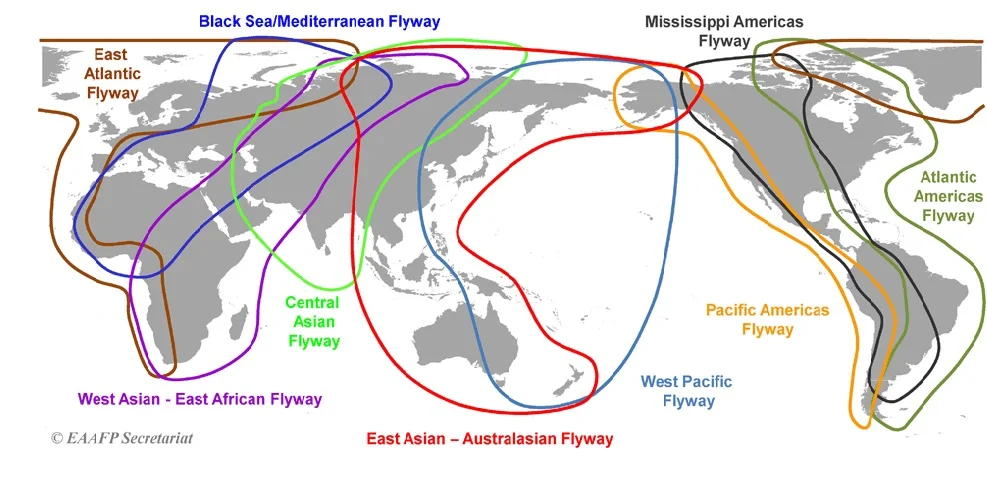
- The Central Asian Conservation Network (CACN) has launched a new Central Asian Flyway Digital Hub.
Central Asian Flyway Digital Hub
- Launched by: Central Asian Conservation Network (CACN).
- Objective: Strengthen knowledge-sharing and cooperation for the conservation of migratory birds.
- Key Features:
- Information on migratory bird species, important flyway sites and conservation projects.
- Opportunities for public participation.
- Dedicated portals to report bird collisions and sightings of marked birds.
- Importance: The Digital Hub can improve cross-border data sharing, monitoring of bird collisions and coordinated conservation efforts.
Central Asian Flyway (CAF)
- Geographical extent: Covers 30 countries across North, Central and South Asia and the Trans-Caucasus, connecting the Arctic and Indian Oceans.
- Bird diversity: More than 600 bird species use this flyway.
- Species covered: Migratory waterbirds, landbirds and raptors.
- Significance: Supports international cooperation for conserving migratory birds, many of which face population declines.
- International framework: Associated with conservation efforts under the Convention on the Conservation of Migratory Species of Wild Animals (CMS).
Connect with the basics – CONSERVATION OF MIGRATORY SPECIES OR BONN CONVENTION
- Known as – The Convention on the Conservation of Migratory Species of Wild Animals is more commonly known as Conservation of Migratory Species (CMS) or the Bonn Convention;
- Objective – It aims to conserve terrestrial, marine and avian migratory species throughout their range.
- Launched under – It is an intergovernmental treaty, concluded under the aegis of the United Nations Environment Programme (UNEP), concerned with the conservation of wildlife and habitats on a global scale.
- Coverage – The Appendices of CMS include many mammals, including land mammals, marine mammals and bats; birds; fish; reptiles and one insect.
|
CMS COP 13
|
Concept of Flyways
- Developed by – Bird Life International
- Definition – According to Bird Life International, flyways are geographical areas covered by a migratory bird over the course of its annual cycle, encompassing breeding and non-breeding grounds and the connecting migration route.
CAQM Panel Proposes 100% Electric Cars in Delhi by 2030
Environment
Context
- A 15-member expert committee appointed by the Commission for Air Quality Management (CAQM) has recommended a phased phase-out of older vehicles in Delhi-NCR.
Commission for Air Quality Management (CAQM)
- Established: Under the Commission for Air Quality Management in National Capital Region and Adjoining Areas Act, 2021.
- Objective: Coordinate, monitor and address air pollution in the National Capital Region (NCR) and adjoining areas.
Powers and Functions
- Restricts activities affecting air quality and issues pollution-control guidelines.
- Issues binding directions to concerned authorities and persons.
- May impose environmental compensation for stubble burning, as prescribed by the Central Government.
- Issues orders under the Graded Response Action Plan (GRAP) to combat air pollution in the NCR.
- In case of conflict, its directions prevail over those of state governments, CPCB, State Pollution Control Boards and other state-level statutory bodies.
Significance
- Enables coordinated action against air pollution across state boundaries.
- Strengthens pollution-control enforcement and accountability.
- Promotes a regional approach to improving air quality.
India-Middle East-Europe Economic Corridor (IMEC)
International
News –
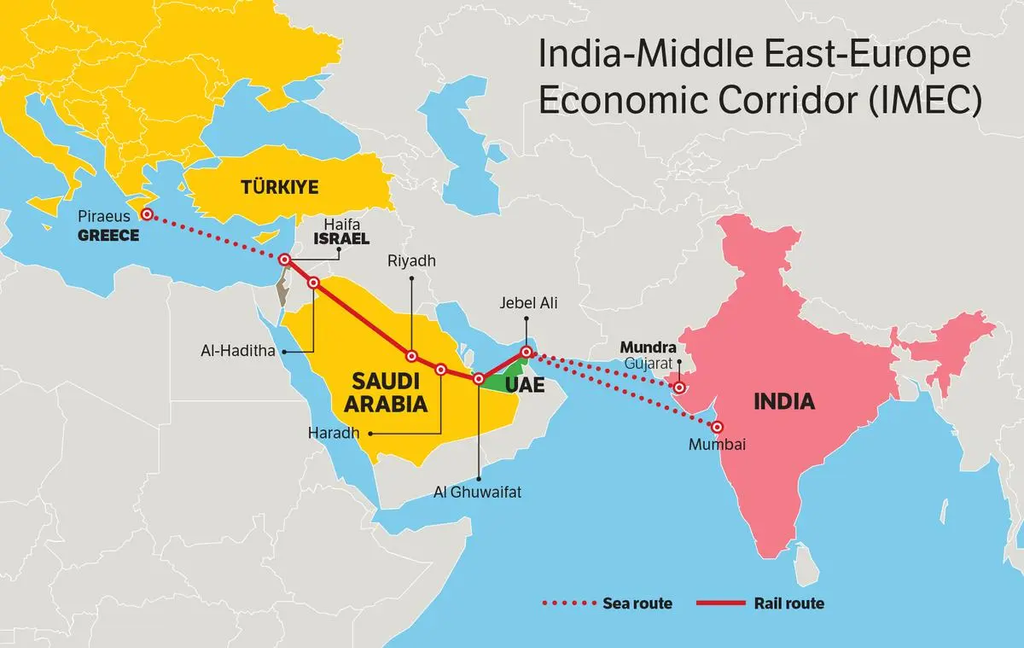
- France’s Special Envoy for IMEC called for adding alternative routes to IMEC amid shipping risks in the Strait of Hormuz.
India–Middle East–Europe Economic Corridor (IMEC)
- Announced: G20 New Delhi Summit, 2023.
- Objective: Develop a multimodal trade corridor linking India with Europe through the Gulf.
Corridors
- Eastern Corridor: India to the Gulf by sea.
- Northern Corridor: Gulf to Haifa (Israel) by rail through Saudi Arabia and Jordan, then to Europe by sea.
- Signatories: India, Saudi Arabia, UAE, France, Germany, Italy, EU and the US. Jordan and Israel are non-signatories to the MoU.
- Funding: G7’s Partnership for Global Infrastructure and Investment (PGII), launched in 2022, aims to mobilise $600 billion by 2027.
Significance
- Faster trade: Projected to reduce transit time by around 40%.
- Strategic connectivity: Could reduce dependence on the Bab-el-Mandeb Strait and Suez Canal.
- Mediterranean gateway: Adani Ports acquired a 70% stake in Haifa Port Company in 2023.
- Geopolitical significance: Offers an alternative connectivity framework to China’s Belt and Road Initiative (BRI).
- Energy and digital links: Proposes electricity cables, digital cables and clean hydrogen pipelines.