
GOBARdhan Scheme
Environment
News
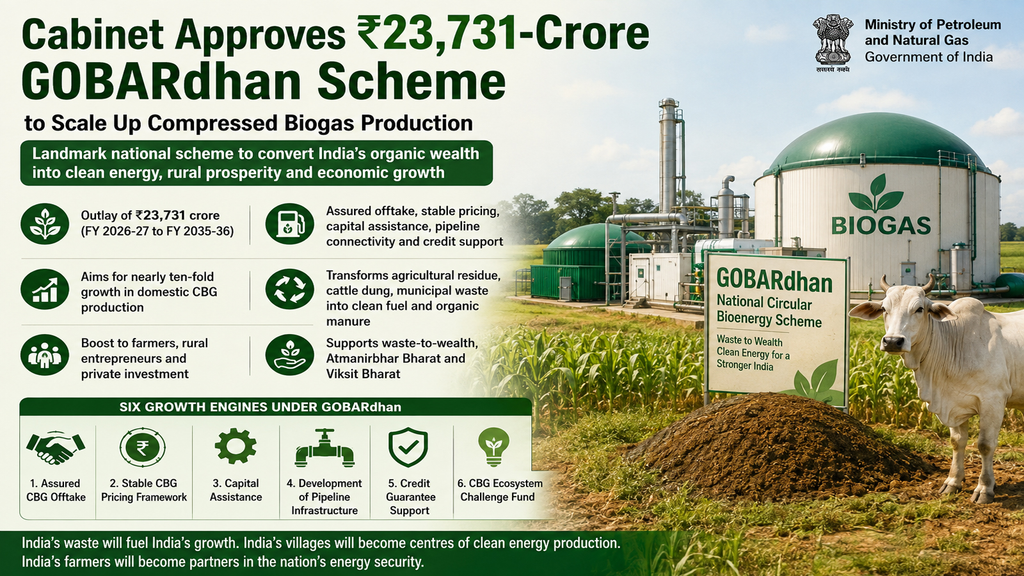
- The Union Minister of Petroleum and Natural Gas launched the GOBARdhan Scheme for development of the Compressed Biogas (CBG) sector.
The GOBARdhan (National Circular Bioenergy Scheme)
- It is a 10-year initiative (FY 2026–27 to 2035–36)
- Implementation – Ministry of Petroleum and Natural Gas
Key Objectives & Components
- Target: Boost Compressed Biogas (CBG) production tenfold to 5 MMSCMD.
- Unified Framework: Consolidates previous initiatives like SATAT, Market Development Assistance (MDA), and Biomass Aggregation Machinery (BAM).
Additional Information – Biofuels
-
- Definition – Biofuels are alternative fuels made from plant and plant-derived resources.
- Example: Bioethanol, Biodiesel, Green diesel, Biogas etc.
National Policy on Biofuels, 2018
- The National Policy on Biofuels 2018 (amended in 2022) provides a framework for increasing the use of biofuels in India to enhance energy security.
Government Efforts for Biofuel Expansion
- Pradhan Mantri JI-VAN Yojana (Jaiv Indhan – Vatavaran Anukool fasal awashesh Nivaran Yojana): It promotes 2G ethanol production from agricultural waste and residues.
- SATAT Scheme (Sustainable Alternative Towards Affordable Transportation): It promotes Compressed Bio-Gas (CBG) production as a fuel alternative.
Great Indian Bustards
Environment
News
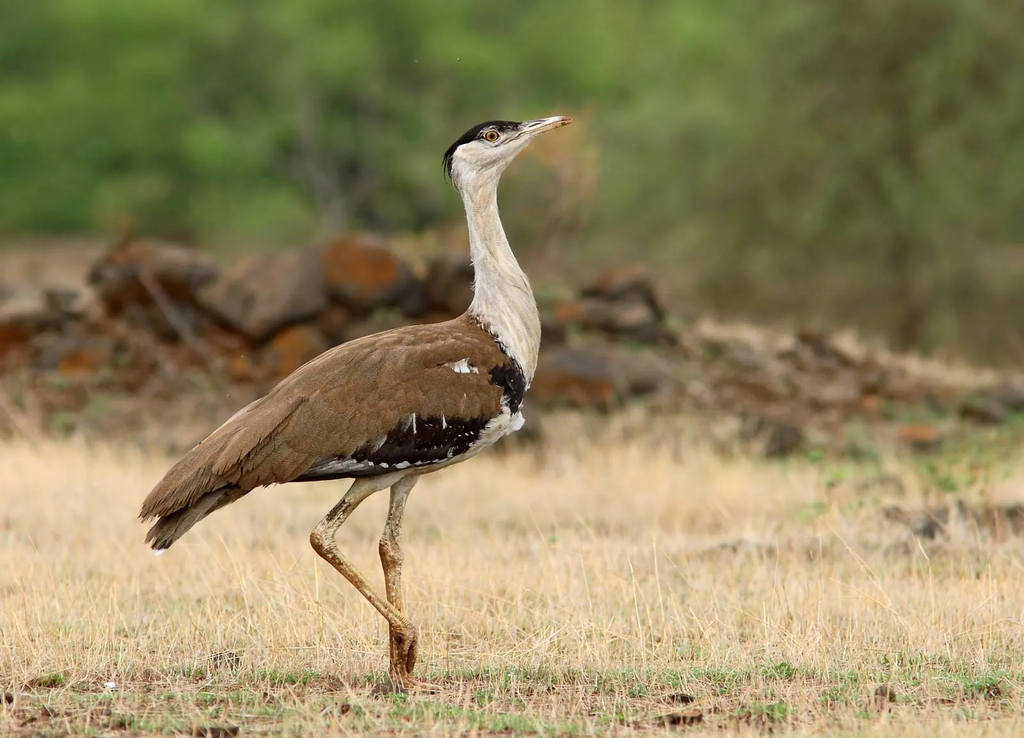
- Ten captive-bred Great Indian Bustards (GIBs) are set to be released into their natural habitat in Rajasthan’s Jaisalmer as part of an effort to rebuild the species’ wild population.
Great Indian Bustard (GIB)
- Scientific name: Ardeotis nigriceps
- Size: Large ground bird; about 1 m tall and 15–18 kg.
- Ecological significance: Keystone species of arid and semi-arid open ecosystems.
- Population: Critically low; latest estimates indicate about 130 ± 20 in Rajasthan, with only 5–6 individuals across Gujarat, Maharashtra and Karnataka.
- State bird: Rajasthan.
Conservation Status
-
IUCN: Critically Endangered
-
Wildlife (Protection) Act, 1972: Schedule I
-
CITES: Appendix I
-
CMS: Listed under the Convention on Migratory Species.
Major Threats
-
Habitat loss and fragmentation
-
Poaching
-
Predation of birds and eggs
-
Collision with overhead power transmission lines, particularly those associated with renewable-energy projects.
Power Lines & Supreme Court
-
Power-line collisions have emerged as a major conservation challenge in GIB habitats.
-
The Supreme Court has directed that renewable-energy project power lines in specified GIB areas outside the Desert National Park (DNP) be shifted underground, with implementation targeted by December 2027
.
India-specific tool to predict Sickle Cell Anaemia severity
Science and Tech
News
- Scientists at the CSIR-Centre for Cellular and Molecular Biology (CCMB) have developed an India-specific disease severity score for sickle cell anaemia (SCA).
Sickle cell anaemia
-
- Disease – It is an inherited group of blood disorders that is genetic in nature.
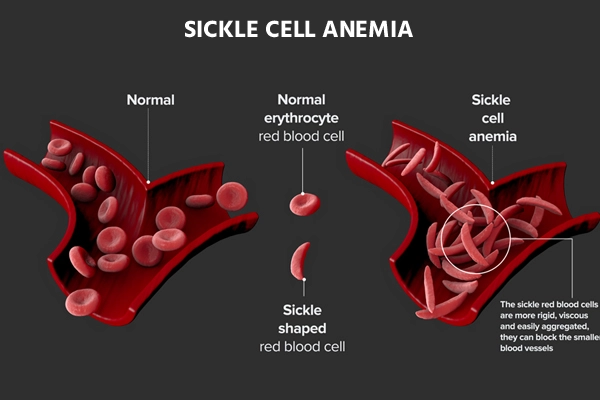
- Cause – It is caused by a mutation in the hemoglobin-β gene found on chromosome 11. This mutation results in defective haemoglobin (Hb).
- Characteristics – After giving up oxygen, these defective Hb molecules cluster together resulting in formation of rod like structures.
- The red blood cells become stiff and assume sickle shape. (Haemoglobin (Hb) is a protein found in the red blood cells that carries oxygen in your body and gives blood its red colour)
- Transmission – It is usually transferred from the parents to the child during birth i.e. both parents can be carriers of SCDs.
- Symptoms – Babies who are born with sickle cell anaemia might not show symptoms for many months.
- Extreme tiredness, fussiness and painfully swollen hands and feet and jaundice.
- Effects – The misshapen cells lack plasticity and can block small blood vessels, impairing blood flow.
- The sickle cells die prematurely, resulting in a chronic lack of red blood cells (anaemia), often called sickle-cell anaemia.
- Treatment – Medication, blood transfusions and rarely a bone-marrow transplant are done.








Leave a Reply