
India-Australia Relations
International
News –
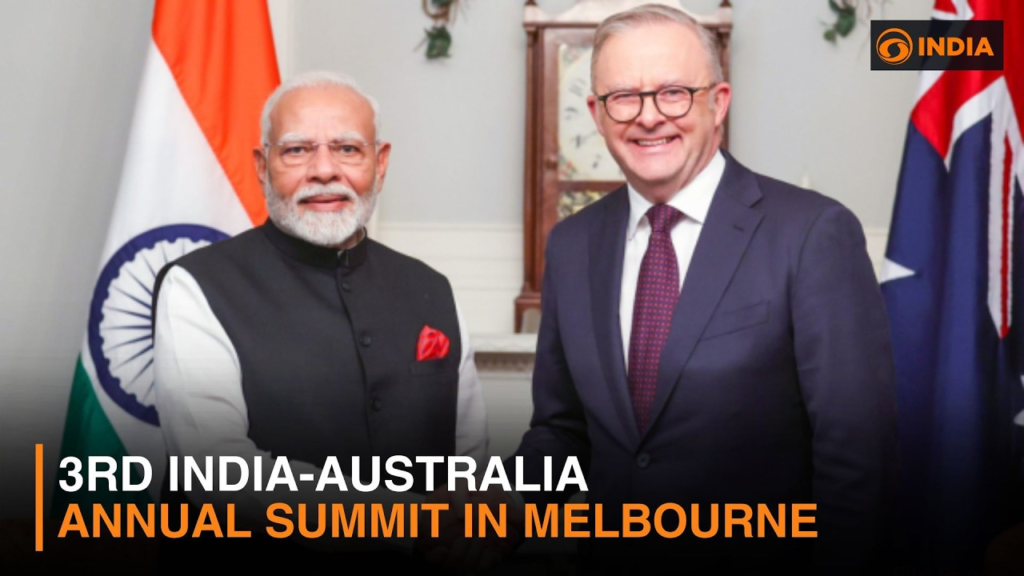
- The Indian Prime Minister participated in the 3rd India-Australia Annual Summit in Melbourne.
Outcomes
- India-Australia Civil Nuclear Agreement: Operationalises Civil Nuclear Agreement signed in 2014, enabling supply of uranium from Australia for peaceful purposes under IAEA safeguards.
- Australia-India Partnership for Cyber, Critical Technologies, Supply Chains (PACTS): Builds on 2020 Framework Arrangement on Cyber and Cyber Enabled Critical Technology Cooperation.
India-Australia Relations
-
- Strategic: Upgraded bilateral relationship from ‘Strategic Partnership’ in 2009 to Comprehensive Strategic Partnership (CSP) in 2020.
- Civil Nuclear Cooperation: Australian Parliament passed Civil Nuclear Transfer to India Bill 2016 allowing Uranium mining companies to supply Australian uranium to India for civil use.
- Economic Cooperation: India–Australia Economic Cooperation and Trade Agreement (Ind-Aus ECTA) was signed in 2022, Negotiations are underway for Comprehensive Economic Cooperation Agreement (CECA).
- Bilateral Trade: Stood at USD 24.1 billion in 2024-25.
- Exports From India: India is Australia’s fifth largest trading partner; 4th largest source of refined petroleum.
- Multilateral Cooperation: Quad partnership; cooperation under Indo-Pacific Oceans Initiative (IPOI), etc.
- Military Exercises: AUSINDEX, AUSTRAHIND, MALABAR exercises, etc.
Additional Information – International Atomic Energy Agency (IAEA)
-
- It was established in 1957 as the world’s “Atoms for Peace” organisation within the UN.
- It serves as the UN’s nuclear watchdog, promoting peaceful atomic energy use while verifying safeguards against proliferation.
- Headquartered in Vienna, the body got the 2005 Nobel Peace Prize for non-proliferation efforts.
- The IAEA has 178 member states, India being one of the founding members of it.
Super Typhoon Bavi
Geography
News-
- Super Typhoon Bavi affected the U.S. territories of Guam and the Northern Mariana Islands, as well as Ryukyu Islands of Japan and China, in the western North Pacific Ocean.
Typhoon Bavi
- It was the 3rd tropical cyclone in 2026
- Origin: Western North Pacific Ocean.
- Typhoon Bavi is named by Vietnam.
- Intensity: Peak sustained winds of 290 km/h (Category 5)
- Impact Areas: Guam, Rota, Philippines, Japan, Taiwan, and Southeastern China Climate Driver: Fueled by a strong El Niño phase causing warmer ocean waters.
Tropical Cyclones (Connect with the basics – Cyclone)
-
- They are violent storms that originate over oceans in tropical areas and move over to the coastal areas bringing about large-scale destruction caused by violent winds, very heavy rainfall and storm surges.
- Wind Direction – The winds blow counterclockwise in the Northern Hemisphere and clockwise in the Southern Hemisphere.
- Different Names – Tropical Cyclones are known by different names in different regions
- Cyclones in the Indian Ocean
- Hurricanes in Atlantic
- Typhoons in the Western Pacific & South China Sea
- Willy-Willies in Western Australia.
- Conditions – The conditions favorable for the formation and intensification of tropical cyclones are:
- Large sea surface with a temperature higher than 27°C.
- Presence of Coriolis force.
- Small variations in the vertical wind speed.
- A pre-existing weak-low-pressure area or low-level-cyclonic circulation.
- Upper divergence above the sea level system.
Global Passport Index 2026
Report
News-
- The sixth annual Global Passport Index released by Global Citizen Solutions (GCS).
Objective-
- It assesses passports of 197 countries across three weighted pillars – Enhanced Mobility (50%), Investment (25%), and Quality of Living (25%), using 14 different indicators.
Key Findings
- Nine of the world’s top 10 strongest passports belong to European countries. Sweden ranks first, followed by Switzerland and Finland.
- India ranks 125th, slipping one place from 124th in the previous edition.
- Indian passport holders currently enjoy visa-free or visa-on-arrival access to 26 destinations.
Astra Mk 1 Missiles
Science & Technology
News-
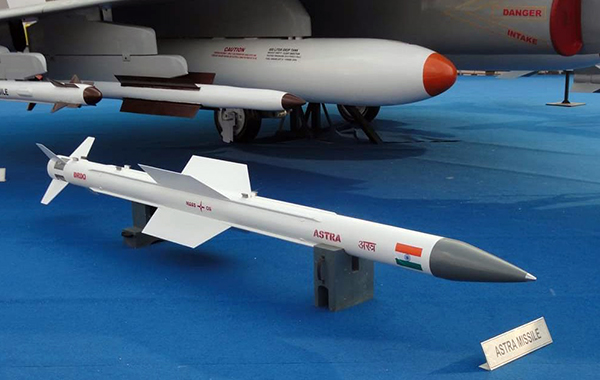
- India and Indonesia signed a deal for the export of Astra Mk 1, marking India’s first-ever export of the Astra missile family.
Astra Mk 1
- Developed by – Defence Research and Development Organisation (DRDO)
- Type – It is a family of indigenous Beyond Visual Range Air-to-Air Missiles (BVRAAMs) that will be integrated with the Air Force and the Navy.
- Range – 20 nautical miles, or 37 km.
Astra Variants:
- Astra Mk 1: It has a range of 80 to 110 km, an altitude capability of up to 20 km, and a speed of Mach 4.5. It is integrated with the Su-30 MKI and planned for the Tejas Mk 1A and Rafale jets.
- Astra Mk 2: Advanced variant with enhanced range of 200 km.
- Astra Mk 3 (Gandiva): India’s most advanced BVRAAM, potential range exceeding 350 km.
Uttarakhand Declared “Fully Literate” State
Government Schemes
News –
- Uttarakhand became India’s sixth fully literate state under the ULLAS initiative, crossing a literacy rate of 98%.
About –
- Ladakh (2024) was the first UT to achieve full functional literacy.
- Mizoram (2025) was the first fully literate state, followed by Goa, Tripura, Himachal Pradesh, and Sikkim.
- A state or UT is declared fully literate on reaching at least 95% literacy among those aged 15 and above.
ULLAS
- Full form – Understanding Lifelong Learning for All in Society
- Financing – It is a centrally sponsored scheme
- Launched by – Ministry of Education (2022–2027)
- Objective – to educate adults aged 15+ who missed formal schooling.
- It aligns with NEP 2020 and is based on the spirit of Kartavya Bodh (sense of duty) and Jan Jan Saakshar Bharat (Every Citizen Literate).
- Key pillars: Foundational literacy, life skills, education, vocational skills, and continuing learning.
Global Status Report on Cancer 2026
Report
News-
- WHO and the International Agency for Research on Cancer (IARC) jointly released the Global Status Report on Cancer 2026, alongside the first-ever global survey of people affected by cancer.
Key Findings of the Report
- Cancer ranks as the second-leading cause of death globally after cardiovascular disease, claiming over 26,000 lives daily, with 20.6 million new cases and ~10 million deaths recorded in 2024.
- Lung cancer remains the most commonly diagnosed and deadliest global malignancy, followed by breast and colorectal cancers.
















Leave a Reply