
Indian Statistical Institute (ISI) Bill, 2026
Polity

News
- The Indian Statistical Institute (ISI) Bill, 2026 has been introduced in Parliament.
About –
- It was introduced in the Lok Sabha on August 3, 2026.
- It aims to replace the ISI Act, 1959,
- It transitioned the 1931-founded Institute of National Importance from a registered society into a statutory body to streamline governance.
Key Provisions
- President as Visitor: Designates the President of India as the Visitor, granting powers to order performance inquiries and issue directives.
- Board of Governors (BoG): Replaces the 33-member Governing Council with an 11-member BoG to oversee administration, budgets, and degree approvals.
- Director Appointment: The Director will be selected by a search committee and appointed by the BoG with prior approval from the Visitor.
- Regulatory Autonomy: Prior Central Government approval is required only for the first set of regulations drafted by the BoG, relaxing the strict 1959 rules.
- Removal of Take-Over Clause: Deletes the 1959 provision allowing the government to seize administrative control of ISI for two years during defaults.
Additional Information – Indian Statistical Institute (ISI)
-
- It is a premier, globally acclaimed public research university and an Institution of National Importance,
- Headquartered in Kolkata, West Bengal.
- Founded on December 17, 1931,
-
- Founded by – by the legendary statistician Prasanta Chandra Mahalanobis,
- ISI serves as India’s gold standard for academic excellence and research in statistics, mathematics, computer science, quantitative economics, and allied sciences.
- Functions under – Ministry of Statistics and Programme Implementation (MoSPI).
Fugitive Economic Offenders Act, 2018
Economy
Context
- As per the Ministry of Home Affairs, India has brought back 274 fugitive criminals from 36 countries between 2019 and 2026.
Fugitive Economic Offender (FEO)
- A Fugitive Economic Offender (FEO) is an individual against whom an Indian court has issued an arrest warrant for a specified economic offence involving ₹100 crore or more, and who has either left India to evade criminal prosecution or refuses to return from abroad to face the law.
- This legal status was established under the Fugitive Economic Offenders Act, 2018 (FEOA) to deter economic offenders from evading justice by staying outside the jurisdiction of Indian courts
Fugitive Economic Offenders Act, 2018
- Confiscation of Property: The Act empowers authorities to attach and confiscate properties of the offender located both in India and abroad.
- The law also covers benami properties and assets indirectly controlled by the offender.
- Bar on Civil Claims: The Act disallows declared FEOs from initiating or defending any civil claims in Indian courts.
- Special Court Mechanism: The Act provides for adjudication of cases through special courts established under the Prevention of Money Laundering Act, 2002.
Enforcement Directorate
-
- Established in – On 1st May 1956, an ‘Enforcement Unit’ was formed. In the year 1957, this Unit was renamed as ‘Enforcement Directorate’.
- Established under – It is a specialized financial investigation agency under the Department of Revenue, Ministry of Finance.
- Functions – ED enforces the following laws
- Foreign Exchange Management Act, 1999 (FEMA)
- Prevention of Money Laundering Act, 2002 (PMLA)
- The Fugitive Economic Offenders Act, 2018 (FEOA).
The World Development Report 2026
Economy
Context
- The World Bank has released The World Development Report 2026.
About
- It has been published annually since 1978
- It provides in-depth analysis and policy recommendations on a specific and important aspect of development
Major Findings
- Automation Risks: Jobs in high-income countries are more than three times as likely to face automation risk from generative AI as those in low- and middle-income countries.
- Boost in Productivity: AI could boost productivity in more than 16% of existing jobs in developing economies, compared with more than 18% in advanced economies.
- AI in Agriculture: Separate research on agriculture found that AI could improve productivity and resilience, but only with supportive policies, infrastructure and equitable access.
Additional Information – World Bank Group (WBG)
-
- Origins: Established at the 1944 Bretton Woods Conference.
- Headquarters: Washington, D.C
- Mandate: Eradicate extreme poverty and promote shared global prosperity.
The Five Institutions
- IBRD: Loans to middle-income and creditworthy low-income nations.
- IDA: “Soft Loan Window” providing interest-free credits/grants to poorest nations.
- IFC: Private sector arm investing directly in developing markets.
- MIGA: Offers political risk insurance to foreign investors.
- ICSID: Arbitrates international investment disputes.
India & WBG
- Founding Member: Of IBRD, IDA, and IFC.
- Exclusion: India is NOT a member of ICSID (cites bias toward developed states).
- Borrowing Status: “Blend Status” (transitioning from soft IDA credits to commercial IBRD loans).
Key Global Publications
-
- World Development Report
- Global Economic Prospects
- Human Capital Index
- Note: The Ease of Doing Business Report has been permanently discontinued.
Governance & Structural Rules
- Prerequisite: Nations must join the IMF before joining the IBRD.
- Voting Power: Tied to financial shareholding, not population; USA holds de facto veto power.
Uzbekistan
Geography
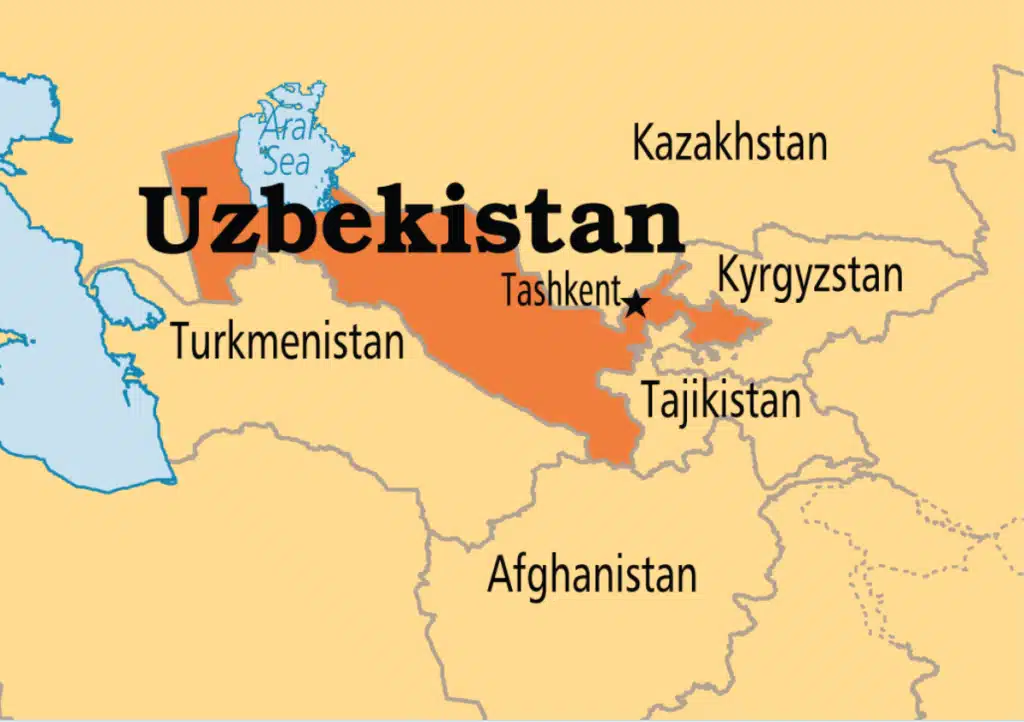
Context
- India and Uzbekistan have agreed to expand their strategic partnership.
Uzbekistan
-
- Uzbekistan is Central Asia’s most populous country, with a population of 30.8 million people.
- It shares borders with Kazakhstan, Turkmenistan, Kyrgyzstan, Tajikistan, and Afghanistan.
- Its economy is largely dependent on commodity exports, making it vulnerable to fluctuations in global commodity prices.
- Tashkent is the capital and largest city.
- Major rivers: Amu Darya and Syr Darya.
Zero Defect, Zero Effect Certification Scheme
Economy
News
- The Ministry of Micro, Small and Medium Enterprises (MSME) is promoting MSME Sustainable (Zero Defect, Zero Effect – ZED) Certification Scheme.
Zero Defect, Zero Effect Certification Scheme
- Implementation – Ministry of Micro, Small and Medium Enterprises (MSME).
- Launched in – 2016
- Objective – to motivate Indian MSMEs to adapt manufacturing processes that ensure high-quality products with zero customer rejection (Zero Defect) and minimal adverse environmental footprints (Zero Effect).
Clouded Leopard Conservation Action Plan (CAP)
Environment

In News
- Recently, the Clouded Leopard Conservation Action Plan (CAP) was launched on the occasion of International Clouded Leopard Day (4th August).
Clouded Leopard (Neofelis Nebulosa)
- Characteristics: It is a medium-sized, highly arboreal wild cat.
- It is known for its large cloud-shaped markings, long canine teeth, and exceptionally long tail.
- It is a nocturnal hunter that feeds on a variety of arboreal and terrestrial prey, including deer, primates, porcupines, pangolins and squirrels.
- Habitat and Distribution: It is found mainly in primary tropical forests but also in secondary forests, dry forests, mangroves and above 3,500 m in the Himalayas.
- It occurs from the Himalayan foothills of Nepal across Mainland Southeast Asia to China.
- It is extinct in Taiwan, and in Vietnam, China, and Bangladesh its populations are critically low and close to local extinction (extirpation).
- Threats: Habitat loss and fragmentation caused by rapid deforestation and infrastructure development, but the biggest drivers of population decline remain illegal hunting and snaring for the wildlife trade.
Conservation status –
- It is included on CITES Appendix I
- The IUCN Red List of Threatened Species lists Clouded Leopard as Vulnerable.
Clouded Leopard Conservation Action Plan (CAP)
- It is prepared under the Government of India–GEF–UNDP initiative.
- It provides a comprehensive framework for securing habitats, restoring forest connectivity, strengthening scientific monitoring, and empowering local communities for conservation of the species.




















Leave a Reply