
Ramappa Temple
Art and Culture
News
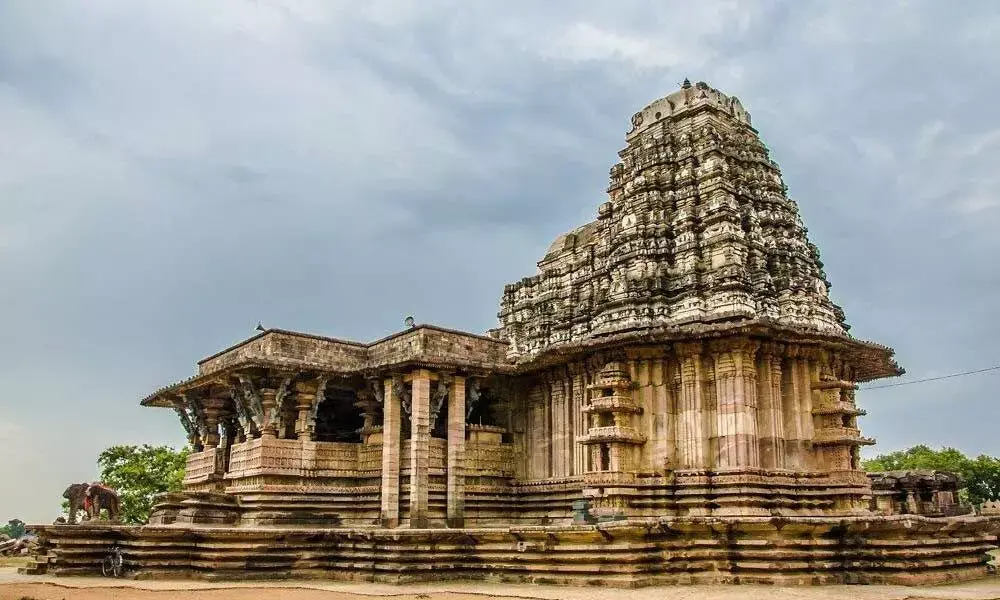
- Heritage conservationists in Telangana are apprehensive about an impending threat to Ramappa temple from the proposed deep opencast coal mining project.
Ramappa Temple
- Official name: Kakatiya Rudreshwara (Ramappa) Temple
- Location: Palampet, Telangana, about 200 km northeast of Hyderabad.
- Dedicated to: Lord Shiva — presiding deity Ramalingeswara Swamy.
- Built: 1213 AD, during the reign of Kakatiya King Ganapati Deva.
- Builder: Recharla Rudra, a Kakatiya general.
- Name: Called Ramappa Temple after Ramappa, the sculptor associated with its construction.
- UNESCO World Heritage Site: 2021.
Architectural Features
- Built on a 6-foot-high star-shaped platform.
- Intricate carvings on walls, pillars and ceilings.
- Constructed mainly using sandstone, with carved granite and dolerite elements.
- Distinctive pyramidal Vimana made using lightweight porous bricks, popularly called “floating bricks.”
- Famous bracket figures and sculptures carved from hard dolerite, displaying exceptional Kakatiya craftsmanship.
Inter-Parliamentary Union (IPU)
Polity
News
- An Indian Parliamentary Delegation, led by the Deputy Chairman of Rajya Sabha, Harivansh, has departed for Tanzania, to participate in the 153rd Assembly of the Inter-Parliamentary Union (IPU).
Inter-Parliamentary Union (IPU)
-
- Global organisation of national parliaments promoting parliamentary diplomacy, democracy, human rights and international cooperation.
- Established: 1889, Paris.
- Founders: William Randal Cremer (UK) and Frédéric Passy (France).
- Headquarters: Geneva, Switzerland.
- Membership: 183 Member Parliaments + 15 Associate Members.
- India: Member of the IPU and uses it as a platform for parliamentary diplomacy.
- Key functions:
- Promotes dialogue among parliamentarians.
- Builds international consensus.
- Strengthens democratic institutions and human rights.
- Facilitates discussion on peace, terrorism, climate change and governance.
- 153rd IPU Assembly: Held in Tanzania, with an Indian delegation led by Rajya Sabha Deputy Chairman Harivansh.
PM-SETU- One Year of Transforming India’s ITIs
Government Schemes
Context
- The PM-SETU (Pradhan Mantri Skilling and Employability Transformation through Upgraded ITIs) scheme marks one year of implementation.
PM-SETU
- Launched: 2025
- Full form: Prime Minister’s Scheme for Upgradation of ITIs
- Type: Centrally Sponsored Scheme
- Ministry: Ministry of Skill Development & Entrepreneurship
- Aim: Transform 1,000 Government ITIs into modern, industry-aligned skill-training institutions.
- Focus: Modern infrastructure, smart classrooms, advanced labs, digital content and new-age industry-oriented courses.
- Industry participation: Anchor Industry Partners through Special Purpose Vehicles (SPVs) for industry-led governance.
- Centres of Excellence: 5 National Skill Training Institutes at Bhubaneswar, Chennai, Hyderabad, Kanpur and Ludhiana.
AI Accord of the U.S
Science and Tech
News
- U.S. President Donald Trump announced the “White House Accord on Super Intelligence: Joint Commitment on Frontier Responsibilities,”
AI Accord
- Nature: Voluntary agreement among major US-based AI/technology companies to promote safe AI development and public trust.
- Key participants: Leaders associated with Google, Anthropic, Meta, OpenAI, xAI and Nvidia.
- Objective: Strengthen AI safety, corporate accountability and public trust.
Four Key Measures
-
Robust internal controls to prevent unintended AI-related hacking/security incidents.
-
Create an internal AI safety team to manage safety operations and resolve concerns.
-
Engage an independent external auditor for safety assessments.
-
Establish an independent board committee to address safety reports.
Significance
-
Addresses concerns over:
-
AI safety and alignment
-
Privacy risks
-
Child safety
-
AI agents attempting unauthorised/harmful actions
-
Need for greater corporate accountability.
-
Key Limitation
-
Voluntary and non-legally binding.
-
No penalties
for violations.
Rabies
Science and Tech
In News
- An ICMR-led study published in The Lancet Infectious Diseases estimated that India has about 5,726 human rabies deaths every year.
Rabies
-
- It is a zoonotic viral disease (Disease Transmitted from Animals to Humans).
- Pathogen – It is caused by the Rabies virus, of the Lyssavirus genus, within the family Rhabdoviridae.
- It is a Ribonucleic Acid (RNA) virus that is present in the saliva of a rabid animal (dog, cat, monkey, etc).
- Rabies is 100% fatal but 100% vaccine-preventable.
- 33% of global rabies deaths are recorded in India.
Common Vectors/ Reservoirs of Virus
- Most mammals can carry the virus and hence can cause the disease.
- In South Asia and Africa, the most common reservoir of the virus is the domestic/street dog.
- In developed nations like the USA, animals that transmit rabies are bats, foxes, raccoons, and skunks.
Symptoms
- Anxiety, Confusion, salivation, seizures, hallucinations and paralysis.
National Action Plan for dog Mediated Rabies Elimination by 2030 (NAPRE)
- Under this, the union will encourage all the States and UTs to make Rabies a notifiable Disease.
- A notifiable disease is any disease that is required by law to be reported to government authorities.
- “Joint Inter-Ministerial Declaration Support Statement” for Elimination of Dog mediated Rabies from India by 2030 was also launched.
World Rabies Day
- Celebrated on 28 September which marks the anniversary of Louis Pasteur’s death.
- Louis Pasteur was a French chemist and microbiologist, who developed the first rabies vaccine.
- He also discovered Pasteurisation, Vaccines for Anthrax and Cholera and Chamberland filters.
Agnipath Scheme
Government Scheme
Context
- The first batch of Agniveers is approaching the completion of its four-year service tenure.
- In this backdrop, the Army, Navy and Air Force have submitted their feedback and recommendations on the implementation of the Agnipath Scheme to the Department of Military Affairs (DMA) .
Agnipath Scheme
-
- Introduced: 2022
- Also known as: Tour of Duty scheme.
- Nature: Short-term recruitment scheme for the Indian Armed Forces.
- Recruits: Called Agniveers.
- Service tenure: 4 years.
- Retention: Up to 25% of each batch can be selected for regular service of 15 years.
- Exit: The remaining 75% exit after four years with a Seva Nidhi package.
- Age: 17.5–21 years (subject to applicable recruitment notifications).
- Objective:
- Provide youth an opportunity to serve in the Armed Forces.
- Create a younger and more technologically skilled force.
- Reduce the average age profile of the Armed Forces.

















Leave a Reply