
Tuvalu
Miscellaneous / Place in News
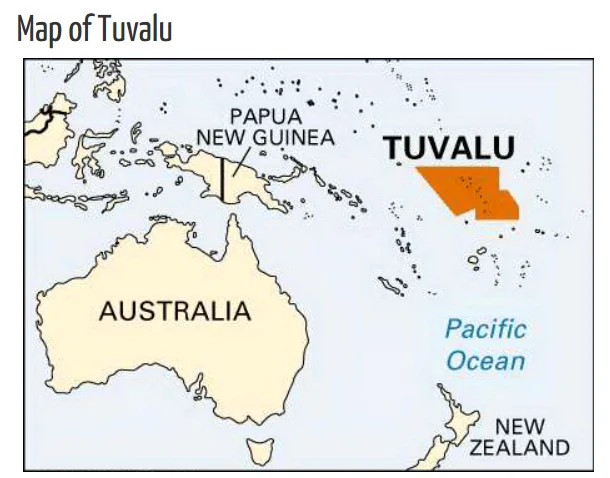
Context
- Tuvalu is facing a combination of sea-level rise, marine heatwaves and declining fisheries, highlighting the disproportionate climate vulnerability of small island developing states (SIDS).
Tuvalu
- Location: Small island country in the South Pacific Ocean, between Hawaii and Australia.
- Composition: 9 islands/atolls.
- Former name: Ellice Islands.
- Independence: Gained independence from the United Kingdom in 1978.
- Capital: Funafuti.
- Topography: Extremely low-lying; average elevation is only about 1–3 m above sea level.
- Climate vulnerability: Highly exposed to:
- Sea-level rise
-
- Coastal erosion
- Saltwater intrusion
- Storm surges
- Significance: Tuvalu is frequently cited as one of the countries most vulnerable to climate change and sea-level rise.
Nobel Prize in Physiology or Medicine 2026
Science & Technology
Context
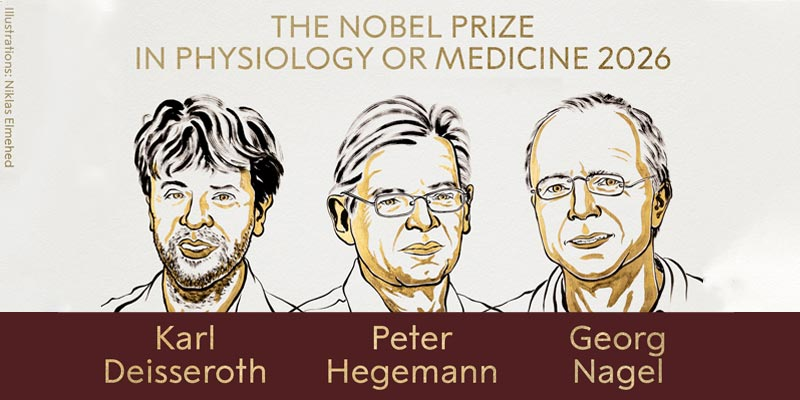
- The Nobel Prize in Physiology or Medicine (2026) was awarded for discoveries that enabled optogenetics, a technique that uses light to precisely control selected nerve cells.
Nobel Prize in Physiology or Medicine
- Awarded to: Karl Deisseroth, Peter Hegemann & Georg Nagel.
- Discovery: Scientific foundations of optogenetics.
- Optogenetics: Combines genetic engineering + light to control specific neurons.
- Mechanism: Opsins (light-sensitive proteins) regulate ion movement, switching neuronal activity on/off.
- Key breakthrough: Hegemann and Nagel identified channelrhodopsins; ChR2 enables rapid light-controlled electrical signals.
- Deisseroth: Developed the approach of combining light-sensitive proteins with genetic targeting of specific neurons.
- Applications: Research on pain, memory, sleep, epilepsy, Parkinson’s, Alzheimer’s, depression and restoration of vision/hearing.
Nobel Prize
- Established: Through the will of Alfred Nobel; Nobel died in 1896.
- First awarded: 1901.
- Original 5 prizes: Physics, Chemistry, Physiology/Medicine, Literature and Peace.
- Economic Sciences: Established by Swedish National Bank (1968); first awarded 1969 — not an original Nobel Prize.
Awarding Institutions
-
Physics & Chemistry: Royal Swedish Academy of Sciences
-
Medicine: Nobel Assembly, Karolinska Institutet
-
Literature: Swedish Academy
-
Peace: Norwegian Nobel Committee
-
Economic Sciences: Royal Swedish Academy of Sciences
Key Fact
-
Peace Prize: Awarded in Oslo, Norway.
-
All other prizes: Awarded in Stockholm, Sweden.
-
Prize:
Medal + Diploma + Monetary Award.
Five New Centres of Excellence for Studies in Classical Languages
History & Culture
Context
- The Ministry of Education has approved five Centres of Excellence (CoE) for the study of classical languages.
Classical Languages
-
India has 11 Classical Languages:
Tamil, Sanskrit, Telugu, Kannada, Malayalam, Odia, Marathi, Assamese, Bengali, Pali and Prakrit.
5 New Centres of Excellence
-
Objective – For advanced research, preservation and digitisation of classical linguistic heritage:
|
Classical Language |
Centre of Excellence |
State |
|
Assamese |
Tezpur University |
Assam |
|
Bengali |
Visva-Bharati University |
West Bengal |
|
Marathi |
Deccan College PG & Research Institute |
Maharashtra |
|
Pali |
Central University of Odisha |
Odisha |
|
Prakrit |
Central University of Gujarat |
Gujarat |
Recognition Timeline
-
Tamil — 2004
-
Sanskrit — 2005
-
Kannada & Telugu — 2008
-
Malayalam — 2013
-
Odia — 2014
Criteria for Classical Language
-
Antiquity: Early texts/recorded history of 1,500–2,000 years.
-
Ancient literature: Rich body of ancient texts regarded as heritage.
-
Knowledge tradition: Includes prose, poetry, epigraphic and inscriptional evidence.
-
Discontinuity:
Classical form/literature may be distinct from its modern form or show discontinuity with later forms.
Russia Plague Outbreak
Health
Context
- A suspected outbreak of pneumonic plague in Siberia, Russia, has triggered quarantine and precautionary measures after a laboratory worker at an anti-plague research institute died.
Cause: Bacterial disease caused by Yersinia pestis.
-
- Reservoir: Mainly small mammals and their fleas.
- Transmission:
- Bite of infected fleas
- Contact with infected body fluids/materials
- Inhalation of respiratory droplets in pneumonic plague
- Three clinical forms:
- Bubonic: Swollen, painful lymph nodes (buboes); usually flea-borne.
- Septicemic: Infection spreads into the bloodstream.
- Pneumonic: Infection of the lungs; can spread person-to-person via respiratory droplets.
- Symptoms: High fever, chills, headache, weakness; pneumonic form may cause cough, chest pain and breathing difficulty.
- Fatality: 30–100% if untreated.
- Treatment: Antibiotics such as gentamicin, ciprofloxacin and doxycycline; early treatment is crucial.
- Distribution: Occurs on all continents except Oceania.
Desert National Park
Environment
Context
- The Union Environment Minister and Wildlife Institute of India (WII) released two great Indian bustards (GIB) in Rajasthan’s Desert National Park.
About Desert National Park
- Location: Jaisalmer & Barmer, Rajasthan — Thar Desert.
- Established: 1980 under Wildlife Protection Act, 1972.
- Purpose: Conservation of the Thar’s fragile desert ecosystem.
- Climate: Extremely hot & arid; rainfall <100 mm/year in parts.
- Landscape: Barchan & longitudinal dunes, gravel plains, rocky areas, interdunal depressions.
- Vegetation: Sparse grasslands, thorny bushes & desert-adapted plants.
- Khejri: Prosopis cineraria; important Thar tree, traditionally protected by the Bishnoi community.
- Key Species: Great Indian Bustard (Godawan) — Critically Endangered.
- Other Fauna: Chinkara, desert cat, desert hare, long-eared hedgehog, saw-scaled viper, Persian gecko & toad-headed agama.
Small and Medium Enterprises (SME) Growth Fund
Economy
Context
- The Union Cabinet approved the proposal by the Ministry of Finance to commit ₹10,000 crore of central government funding for the setting up of a Small and Medium Enterprises (SME) Growth Fund.
About SME Growth Fund (SGF)
- Announced: Union Budget 2026.
- Nature: Direct equity fund structured as an AIF.
- Aim: Provide patient capital to high-potential SMEs for scaling and expansion.
- Focus: Manufacturing, technology, innovation, strategic sectors and Tier-II/III industrial clusters.
- Purpose: Boost technology adoption, exports, global value-chain integration and employment.
- Need: Fill the growth-equity gap faced by Small & Medium enterprises.










Leave a Reply