
Dahi Handi Festival
History & Culture
Context
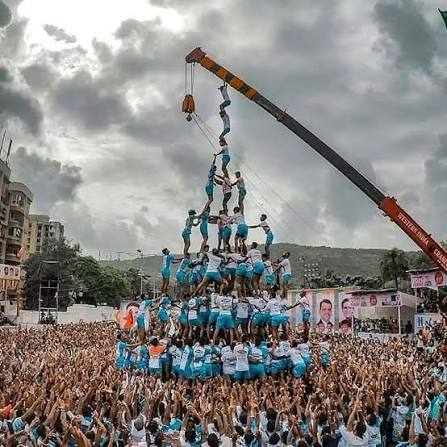
- The Maharashtra government is seeking UNESCO Intangible Cultural Heritage recognition for the Dahi Handi festival.
- It also plans to send ‘Govindas’, who form human pyramids during the festival, to Spain to showcase this traditional practice.
Dahi Handi Festival
- Dahi Handi, held a day after Janmashtami to mark the birth of Lord Krishna.
- It combines religious devotion with community participation and sport.
- Participants, or Govindas, form tall human pyramids to reach and break an earthen pot filled with curd, butter, and milk.
India-Spain Connection
-
- The traditional practice of building human pyramids and towers is the common link between the Dahi Handi festival and Spain, where communities practice building human towers called castells.
- Spain’s Catalan Castells (human towers)— is already recognized by UNESCO.
- Spanish teams regularly visit Mumbai and Thane to participate in the Dahi Handi festival.
Connect with the basics – Intangible Cultural Heritage
UNESCO defines “intangible” as “expressions that have:
- Passed from one generation to another.
- Evolved in response to their environments.
- Contributed to giving us a sense of identity and continuity.
-
- According to an official document by UNESCO, ‘intangible cultural heritage’ includes “oral traditions, performing arts, social practices, rituals, festive events, knowledge and practices concerning nature and the universe or the knowledge and skills to produce traditional crafts.”
- To date, 16 Indian elements have been inscribed on the UNESCO Representative List (including Deepavali)
-
- Garba of Gujarat (2023)
- Durga Puja in Kolkata (2021)
- Kumbh Mela (2017)
- Navroz (2016)
- Yoga (2016)
- Traditional brass and copper craft of utensil making among the Thatheras of Jandiala Guru, Punjab (2014)
- Sankirtana, ritual singing, drumming and dancing of Manipur (2013)
- Buddhist chanting of Ladakh: recitation of sacred Buddhist texts in the trans-Himalayan Ladakh region, Jammu and Kashmir (2012)
- Chhau dance (2010)
- Kalbelia folk songs and dances of Rajasthan (2010)
- Mudiyettu, ritual theatre and dance drama of Kerala (2010)
- Ramman, religious festival and ritual theatre of the Garhwal Himalayas (2009)
- Kutiyattam, Sanskrit theatre (2008)
- Tradition of Vedic chanting (2008)
- Ramlila, the traditional performance of the Ramayana (2008)
- Deepavali (2025) – Recently added
Communal Award
History & Culture
In News
- Recently, the anniversary of the Communal Award announcements was observed.
Communal Award
- Announced by – Ramsay MacDonald in August 1932.
- Objective – It Granted separate electorates to the Depressed Classes and 71 reserved seats.
- Also provided separate electorates for Muslims, Sikhs, Christians, Anglo-Indians and Europeans.
- Aim: political representation and protection of minorities.
Gandhi’s Response
- Gandhi opposed separate electorates for the Depressed Classes, arguing they would divide Hindu society.
- He began a fast unto death at Poona on 20 September 1932.
- M.C. Rajah and B.G. Horniman also opposed separate electorates.
Ambedkar’s Views
- Ambedkar strongly supported separate electorates for the Depressed Classes.
- He believed they needed independent political representation.
- Initially, he refused to compromise, prioritising their interests.
Poona Pact
- Signed on 24 September 1932 after negotiations between Gandhi and Ambedkar.
- Separate electorates were replaced by joint electorates.
- Reserved seats increased from 71 to 148 in provincial legislatures.
- The Pact became a modification of the Communal Award.
- Political reservation for SCs continued after independence.
Electronics Component Manufacturing Scheme (ECMS)
Economy
Context
- The Ministry of Electronics and Information Technology (MeitY) approved projects collectively worth ₹7,877 crore for incentives under the Electronics Component Manufacturing Scheme (ECMS).
Electronics Component Manufacturing Scheme (ECMS)
- Launched: 2025 by the Government of India.
- Objective: To develop a strong domestic ecosystem for electronic components and reduce import dependence.
- Nodal Ministry: Ministry of Electronics & Information Technology (MeitY).
- Outlay: ₹22,919 crore over 6 years.
- Focus: Manufacturing of components such as PCBs, camera modules, display modules, connectors, and other electronic sub-assemblies.
- Benefits: Attracts investment, creates jobs, strengthens supply chains and promotes Make in India.
- Significance: Supports India’s goal of becoming a global electronics manufacturing hub.
MQ-9B Sea Guardian Unmanned Aircraft
Science & technology

Context
- The Ministry of Defence signed a contract with the U.S. General Atomics Aeronautical to lease two MQ-9B Sea Guardian High-Altitude Long-Endurance (HALE) Remotely Piloted Aircraft Systems (RPAS) for the Indian Navy.
MQ-9B SeaGuardian Unmanned Aircraft
- Type: High-altitude, long-endurance (HALE) remotely piloted aircraft.
- Manufacturer: General Atomics Aeronautical Systems, USA.
- Role: Maritime surveillance, reconnaissance and intelligence gathering.
- Key feature: Can operate for 40+ hours and cover vast maritime areas.
- India: The Indian Navy is acquiring MQ-9B SeaGuardians to strengthen maritime domain awareness and surveillance in the Indian Ocean Region.
- Significance: Enhances India’s ability to monitor ships, submarines and suspicious maritime activity over long distances.
- Note: It is an unmanned aircraft, but is remotely controlled by operators rather than being fully autonomous.
Draft SHANTI Rules 2026
Polity
Context
- Recently, the government has released the draft SHANTI Rules, 2026,
Draft SHANTI Rules, 2026
- Full form – Sustainable Harnessing and Advancement of Nuclear Energy for Transforming India
- Purpose: Operationalise the SHANTI Act, 2025 and expand India’s nuclear energy sector.
- Private participation: Framework for greater private-sector involvement in nuclear activities.
- Licensing: Provides for a composite licence covering the nuclear installation lifecycle.
- Safety: Strengthens requirements for nuclear safety, radiation protection and emergency preparedness.
- Liability: Operators must maintain insurance/financial security against nuclear damage.
- Nuclear Liability Fund: Proposed fund supported through operator levies for compensation.
- Technology: Facilitates use of foreign nuclear technologies, subject to Indian regulatory requirements.
- Goal: Supports India’s target of 100 GW nuclear capacity by 2047 and net-zero by 2070.












Leave a Reply