Author: instakas

  • Karnataka Information Commission (KIC)

    Karnataka Information Commission (KIC)

    News –

    • The Karnataka Information Commission (KIC) has claimed to be the fastest in India for disposing of second appeal petitions under the RTI Act.

    Karnataka Information Commission (KIC)

    • It is an autonomous statutory body established on March 2, 2006, under the Right to Information (RTI) Act, 2005.
    • It serves as the final appellate authority for citizens seeking information from public authorities within the state of Karnataka.

    Key Leadership & Structure

    • State Chief Information Commissioner (In-Charge): Dr. H.C. Sathyan.
    • Information Commissioners: The commission includes several State Information Commissioners (SICs), such as Shri. Raman K., Dr. Harish Kumar, Sri. Rudranna Harthikote, and Sri. Rajashekara S..
    • Benches: In addition to its main headquarters in Bengaluru, the KIC operates regional benches in Belagavi and Kalaburagi to improve accessibility.

    Core Functions & Powers

    • Adjudication: The KIC hears Second Appeals and Complaints regarding the refusal of information or delays by Public Information Officers (PIOs).
    • Penalties: The commission has the authority to impose financial penalties—up to ₹25,000—on officials who delay information.
    • Judicial Authority: It possesses the powers of a Civil Court, including the ability to summon witnesses, require oral or written evidence under oath, and inspect public records.
  • PM Surya Ghar scheme | IAF’s Tejas Fleet Undergoes Maintenance Check | Pangolins | Free HPV Vaccination Drive for Adolescent Girls | Overseas Citizen of India (OCI)

    PM Surya Ghar scheme

    Government Schemes

    In News

    • Recently, the Prime Minister praised 30 lakh households adopting rooftop solar under the PM Surya Ghar scheme, marking a key clean energy milestone.
    • Gujarat leads in adoption, followed by Maharashtra and Uttar Pradesh, with widespread participation across other states and UTs.

    PM Surya Ghar Muft Bijli Yojana

      • Launched in – 2024
      • Ministry: Ministry of New and Renewable Energy
    • Objective: Installing rooftop solar (RTS) & providing free electricity for up to 300 monthly units for 1 Crore households. 
    • Uniqueness – It is the world’s largest domestic rooftop solar initiative, transforming India’s energy landscape
    • Subsidy: The scheme offers a subsidy of up to 40% to households.

    IAF’s Tejas Fleet Undergoes Maintenance Check

    Defence

    Context

    • The Indian Air Force’s (IAF) Tejas fighter aircraft fleet is undergoing a “maintenance check” to determine the reason for the recent incident that occurred while one of the fighters was taking off from a base.

    Tejas fighter aircraft

    • It is an indigenous, fourth-generation, multi-role supersonic fighter jet developed for the Indian Air Force (IAF) and Indian Navy
    • Designed by the Aeronautical Development Agency (ADA) under DRDO and manufactured by Hindustan Aeronautics Limited (HAL).

    Major Variants

    Variant 

    Features

    Status

    Tejas Mk-1

    Initial version; 4th-gen capabilities.

    Operational in IAF.

    Tejas Mk-1A

    4.5-gen; features AESA Radar (Uttam), Advanced Electronic Warfare Suite, and mid-air refueling.

    First aircraft completed; mass production starting in 2026.

    Tejas Mk-2

    Medium Weight Fighter; larger airframe, canards, more powerful GE F414 engine.

    Prototype flight expected by mid-2026.

    Naval Variant

    Carrier-capable with strengthened landing gear and arrestor hook.

    Prototype successfully tested on INS Vikramaditya.

    Pangolins

    Environment

    Context

    • CITES report revealed that over 500,000 pangolins were seized globally between 2016 and 2024.

    Pangolin

    • Pangolins are mammals covered in keratin scales, the only such mammals on Earth.
    • They feed on ants, termites, and larvae using their long sticky tongues.
    • When threatened, they use volvation (rolling into a ball) to protect themselves with their armor-like scales.
    • They are considered “ecosystem engineers” due to their role in soil aeration and pest control.
    • There are eight recognised species of pangolins globally — four species are found in Africa (Black-bellied, White-bellied, Giant Ground, and Temminck’s Ground pangolins) and four species are found in Asia (Indian, Philippine, Sunda, and Chinese pangolins).

    Free HPV Vaccination Drive for Adolescent Girls

    Health

    Context

    • The Union government is set to launch a nationwide immunisation drive against Human Papillomavirus (HPV) targeting girls aged 14 years, marking a major preventive step against cervical cancer.

    Human papillomavirus (HPV)

      • HPV is a common sexually transmitted infection. 
    • Most infections are asymptomatic and self-limiting.
    • Nature: HPV is a DNA virus from the Papillomaviridae family.

    Additional Information – Cervical Cancer

    • Cervical cancer develops in a woman’s cervix (the entrance to the uterus from the vagina).  
    • Spread: Almost all cervical cancer cases (99%) are linked to infection with high-risk human papillomaviruses (HPV), an extremely common virus transmitted through sexual contact.
    • Prevalence: Cervical cancer is the fourth most common cancer in women.
    • It is the second most common type of cancer in India for women.
    • Treatment: When diagnosed, cervical cancer is one of the most successfully treatable forms of cancer, as long as it is detected early and managed effectively.
    • Vaccination: There are, at present, two vaccines available in the country against the human papillomavirus (HPV) which causes cervical cancer, namely Merck’s Gardasil and Serum Institute of India’s Cervavac.

    Overseas Citizen of India (OCI)

    Governance

    In News

    • The Supreme Court dismissed a plea filed by an overseas citizen of India (OCI) seeking to be treated at par with NRIs for the purpose of practising law and obtaining state bar council membership. 

    Overseas Citizen of India

    • Introduced in – OCI scheme was introduced by the Indian government in 2005. 
    • A registered OCI is granted multiple entry, multi-purpose life-long visa for visiting India.
    • They are exempted from registration with Foreign Regional Registration Officer (FRRO) or Foreign Registration Officer (FRO) for any length of stay in India.
    • OCI cardholders can open special bank accounts in India. They can buy non-farm property and exercise ownership rights. They can also apply for a driver’s licence and PAN card.
    • However they are required to seek permission or a permit to visit protected areas in India.
  • Tulu language

    Tulu language

    News –

    • The Karnataka government has expressed support for declaring Tulu as the State’s second additional official language.

    Tulu language

    • Historical Roots and Geography: Boasting a recorded history of over 3,000 years, Tulu is predominantly spoken in the coastal Karnataka districts of Udupi and Dakshina Kannada.
    • Linguistic Heritage: Featuring its own distinct script, Tulu holds the distinction of being one of only five literary Dravidian languages, alongside Telugu, Tamil, Kannada, and Malayalam.
    • Constitutional Recommendation: A state-constituted committee in 2023, headed by educationist Mohan Alva, officially recommended declaring Tulu as the State’s second official language under Article 345 of the Indian Constitution.
  • ‘PRAHAAR’, India’s First National Counter-terror Policy | National Monetisation Pipeline 2.0 (NMP 2.0) | Green Ammonia | Chakravarti Rajagopalachari | ‘Rah-Veer’ scheme

    ‘PRAHAAR’, India’s First National Counter-terror Policy

    Governance

    Context

    • The Ministry of Home Affairs (MHA) unveiled India’s inaugural National Counter-Terrorism Policy and Strategy, titled ‘PRAHAAR’.

    ‘PRAHAAR’, India’s First National Counter-terror Policy

    • It is this principled approach which informs the Indian policy of ‘zero tolerance’ against terrorism. 

    The counter-terrorism strategy of India, ‘PRAHAAR’, flows from these ideals: 

    • Prevention of terror attacks to protect Indian citizens and interests; 
    • Responses, which are swift and proportionate to the threat posed; 
    • Aggregating internal capacities for achieving synergy in a whole-of-government approach; 
    • Human rights and ‘Rule of Law’ based processes for mitigation of threats; 
    • Attenuating the conditions enabling terrorism, including radicalization; 
    • Aligning and shaping the international efforts to counter terrorism;
    • Recovery and resilience through a whole-of-society approach.

    National Monetisation Pipeline 2.0 (NMP 2.0)

    Economy

    Context

    • Recently, the Union Finance Minister has launched the National Monetisation Pipeline 2.0 (NMP 2.0).

    National Monetisation Pipeline 2.0 (NMP 2.0) 

    • It is the second phase of India’s asset monetisation programme, covering the five-year period from FY 2025–26 to FY 2029–30. 
    • Objective – it aims to unlock value from existing (brownfield) public infrastructure by leasing it to private players for a fixed period while the government retains ownership

    National Monetisation Pipeline (NMP) 

    • It is the Indian government’s plan to lease out existing public infrastructure—like highways, railways, and power lines—to private companies for a specific period
    • The government retains ownership, while private firms operate the assets and pay the government for the right to earn revenue from them. 

    Key Aspects of NMP:

      • Goal: To unlock funds from underutilized, built assets (“brownfield” projects) to invest in new infrastructure development.
      • Mechanism: Rather than selling, the government uses public-private partnerships (PPPs) to transfer operating and maintenance rights.
    • Sectors: Major sectors included are roads, railways, power pipelines, telecom, and airports

    Green Ammonia

    Environment

    In News

    • India’s energy transition is increasingly focusing on green hydrogen and its derivatives, with green ammonia emerging as a crucial pathway.

    Green ammonia

    • It is produced using green hydrogen, and is emerging as a leading clean fuel for fertilizers, energy, and marine applications. 

    Benefits of Green Ammonia

    • Decarbonization of Fertilizers: India’s fertilizer sector, heavily dependent on imported ammonia, can significantly cut emissions by adopting green ammonia.

    Additional Information – Green Hydrogen

    • Green Hydrogen: It is produced using electrolysis of water with electricity generated by renewable energy.
    • Benefit: It is a clean burning element that can decarbonise a range of sectors including iron and steel, chemicals, and transportation. 
    • Hydrogen can be stored for long periods of time which can be used to produce electricity using fuel cells.

    National Green Hydrogen Mission

    • Aim: To make India a global hub for the production of green hydrogen.
    • Implementing Ministry: Ministry of New and Renewable Energy(MNRE) 

    Hydrogen

    • Symbol and Atomic number – Hydrogen is the chemical element with the symbol H and atomic number 1. 
    • Hydrogen is the lightest element and the most abundant chemical substance in the universe, constituting roughly 75% of all normal matter.
    • It is colorless, odorless, tasteless, non-toxic, and highly combustible gas.

    Chakravarti Rajagopalachari

    History

    Context

    • The President of India, unveiled a bust of Shri Chakravarti Rajagopalachari, the first and only Indian Governor General of independent India at Rashtrapati Bhavan.
    1. Rajagopalachari 
      • Early Life: Chakravarti Rajagopalachari, popularly referred to as Rajaji, was born in 1878 in Thorapalli, Tamil Nadu.
      • He participated in agitations against the Rowlatt Act, the Non-Cooperation movement, the Vaikom Satyagraha, and the Civil Disobedience Movement and was jailed five times between 1912 and 1941.
    • Post-independence, Rajaji served as the last Governor-General of India till 1950.
      • He briefly served as Tamil Nadu’s Chief Minister between 1952 and 1954.
      • He founded the Swatantra Party in 1959, representing classical liberal economic ideas.
      • Literary Contribution: His most popular works include a retelling of the Mahabharata and Ramayana in English, and Ramayana – Chakravarti Thirumagan in Tamil.
    • In 1954 he was conferred with the Bharat Ratna for his contribution to Indian politics and literature.

    ‘Rah-Veer’ scheme

    Governance

    In News

    • The Delhi government is going to implement the Centre’s ‘Rah-Veer’ scheme to motivate citizens to assist seriously injured road accidents.

    ‘Rah-Veer’ scheme

      • The scheme, aligned with the Good Samaritan Rules under the Motor Vehicles (Amendment) Act, 2019.
    • It provides legal protection and financial incentives to encourage prompt humanitarian action.
    • Features: citizens who help seriously injured road accident victims within the “golden hour” will receive a ₹25,000 cash reward.
    • A district-level committee will evaluate cases, and the reward will be directly transferred to beneficiaries’ bank accounts. 
    • Additionally, 10 outstanding Rah-Veers annually will receive ₹1 lakh and a certificate.
    • Significance – It aims to overcome citizens’ hesitation to assist accident victims due to legal or procedural fears.

  • PRASHAD Scheme | Prime Minister Launches Full Delhi-Meerut RRTS Corridor | Biopharma Shakti

    PRASHAD Scheme

    Governance

    In News

    • Union Civil Aviation Minister announced plans to enhance pilgrimage tourism in Andhra Pradesh under the PRASHAD scheme.

    Pilgrimage Rejuvenation and Spiritual Augmentation Drive (PRASAD) Scheme

    • Launched in – 2014–2015
    • Financing – Central Sector Scheme
    • Implementation – Ministry of Tourism
    • Objective- It focuses on developing and identifying pilgrimage sites across India to enrich the religious tourism experience.
    • Significance – It improved infrastructure in tourism areas—roads, transport, sanitation, and utilities—and enhanced both residents’ quality of life and the overall experience for tourists.

    Prime Minister Launches Full Delhi-Meerut RRTS Corridor

    Economy

    News

    • The Prime Minister inaugurated India’s first Namo Bharat Regional Rapid Transit System (RRTS) and dedicated the 82-km Delhi-Meerut Namo Bharat Corridor to the nation.

    Namo Bharat

    • It is India’s first Regional Rail connecting key urban nodes across the National Capital Region via high-speed rail corridors (82-km long corridor).
    • It is a rail-based, high-speed, high-frequency and sustainable transit system with a design speed of 180 Kmph and an average speed of 100 Kmph which aims at bringing people and places closer to NCR.
    • Implementing agency – National Capital Region Transport Corporation (NCRTC).
    • Significance- Bharat will provide fast, safe, and comfortable regional commute and encourage more people to switch to public transport by way of seamless integration among public transit systems in the region.

    Biopharma Shakti

    Economy

    Context

    • India announced a massive investment of ₹10,000 crore in the Union Budget 2026-27 for the biotechnology sector.

    Biopharma Shakti

    • The aim is to focus on boosting the production of biologics and biosimilars through a new initiative called the Biopharma Shakti.
    • The initiative aligns with the aim of transforming India into a leading global biopharma industry and capturing 5% of the global biopharmaceutical market share.
    • The initiative is designed to support domestic development and manufacturing of high-value biopharmaceutical products and medicines, reduce import dependence, and enhance India’s competitiveness in global biologics supply chains.
    • Biopharma involves production, manufacturing, or extraction of therapies through biological organisms, such as human cells, fungi, or microbes.
    • Some examples of biopharmaceuticals include vaccines, antibody treatments, gene therapies, cell implants, modern insulin, and recombinant protein drugs.
  • New ‘Sahyadri Sindhura’ Red Rice Variety

    New ‘Sahyadri Sindhura’ Red Rice Variety

    News – 

    • The Keladi Shivappa Nayaka University of Agricultural and Horticultural Sciences in Shivamogga recently launched a highly popular, nutrient-rich red rice variety named “Sahyadri Sindhura.”

    ‘Sahyadri Sindhura’ Red Rice Variety

    • The Cross-Breed: This new rice is a hybrid created by crossing two popular traditional rice varieties: Jyothi and Biliya.
    • Nutritional Benefits: This fine-grain red rice is packed with high protein, iron, and zinc.It also has a low glycaemic index, making it a much healthier dietary option.
    • High Crop Yield: It gives an impressive yield of 53 to 54 quintals per hectare in irrigated lands, easily outperforming traditional varieties that only yield 40 to 45 quintals.
    • Fast Maturation: The crop grows relatively fast and is ready to harvest in just 120 days.
    • Disease and Pest Resistance: Farmers benefit greatly because the crop is naturally resistant to blast disease and can tolerate common agricultural pests like leaf folders and stem borers.
    • Extra Benefits for Farmers: Along with fetching a strong market price (₹70 to ₹80 per kg), the crop produces high-quality straw that serves as excellent fodder for cattle.
    • Official Recognition: Developed after five years of rigorous research by a team led by Dr. B.M. Dushyantha Kumar, the variety is officially registered with the National Bureau of Plant Genetic Resources in New Delhi.
  • Karez Water System

    Karez Water System

    News – 

    • Recent unauthorized digging has damaged the centuries-old Naubad–Aliyabad karez in Bidar, causing the district administration to halt activities to protect this ancient water system.

    Karez (Qanat):

    • It is an ancient underground water-harvesting system.
    • It uses a gently sloping horizontal tunnel to bring groundwater from higher areas to the surface using gravity.
    • Key Design Features: The system includes vertical shafts at regular intervals for air and maintenance. Because the water flows underground, it highly minimizes water evaporation and contamination.
    • Historical Background: It was built in the 15th century during the Bahmani Sultanate. It is one of India’s earliest adaptations of Persian-Central Asian water technology.
    • Unique Geology: The Bidar karez is extremely rare because it is carved entirely through laterite rock, unlike most others globally that are built in limestone or soft soil.
    • Ecological Importance: It is not just a monument, but a living groundwater recharge system that can help solve Bidar’s chronic water shortage. If properly conserved, it has the potential to become a UNESCO World Heritage site.
  • Bela Gram Emerge as First Net-zero Village | Red Sanders | India AI Impact Summit 2026 | India’s Indigenous Tetanus and Adult Diphtheria (Td) Vaccine

    Bela Gram Emerge as First Net-zero Village

    Environment

    News

    • Recently, Bela Gram has become India’s first net-zero panchayat.

    Basic term – Net zero

    • It refers to achieving a balance between the amount of greenhouse gas emissions produced and the amount removed from the atmosphere, effectively reducing human-caused emissions to a net value of zero

    Bela Gram

    • It is situated in the Bhandara district of Vidarbha region of Maharashtra.
    • It was recognized as India’s first net-zero panchayat during Mumbai Climate Week 2026 for its sustainable and carbon-neutral initiatives.
    • The panchayat leadership plays a vital role in shaping localised climate action and combating climate change.
    • It planted over 90,000 trees, transitioned from smoky chulhas to LPG.
    • It installed solar panels, promoted waste segregation, and eliminated single-use plastics.
    • It received the 2024 Rashtriya Panchayat Puraskar.

    Other panchayat-led climate initiatives across India

    • Perinjanam, Kerala – “Solar Gramam” project: 850 households became rooftop solar prosumers, reducing bills by 80% and lowering emissions.
    • Siyari, Jharkhand – Water conservation, revived lakes, solar irrigation, streetlights, and plantation of thousands of fruit and shade trees using District Mineral Fund support.
    • Badakichab, Odisha – Indigenous women mapped commons and planted over 16,000 trees on 10 hectares of unused land, restoring forests.
    • Garhi, Bihar – Built 45 mud check dams, 90 boulder dams, and ponds to tackle water scarcity, flash floods, and soil erosion.
    • Kolar, Karnataka – Revived lakes and groundwater, reduced chemical fertilizer use, and implemented climate-resilient agriculture practices.

    Red Sanders

    Environment

    Context

    • The busy Tirupati pilgrimage route has made Red Sanders smuggling easier in southern Andhra Pradesh.

    Red Sanders (Pterocarpus santalinus)

    • Endemic Species: Found only in three districts of southern Andhra Pradesh — Chittoor, Nellore, and YSR Kadapa.
    • Largest Reserve: Located in the Seshachalam Biosphere Reserve, part of the Eastern Ghats, covering about 4,755 sq km.
    • Growth: A slow-growing species that takes 25–40 years to reach maturity.

    Conservation Status:

    • Listed as Endangered on the IUCN Red List.
    • Included under CITES, which strictly regulates international trade.
    • Protected under the Wildlife Protection Act, 1972.

    India AI Impact Summit 2026

    Science and Technology

    Context

    • The India AI Impact Summit 2026 concluded in New Delhi recently.

    Background of AI Summits

    • 2023 Bletchley Park Summit (UK): The first global AI summit was held at Bletchley Park and focused on safety. It brought together countries and experts to discuss AI risks and resulted in the Bletchley Declaration.
    • 2024 Seoul Summit (South Korea): The second summit was held in Seoul in May 2024, building on the discussions from the Bletchley Park meeting and broadening to include innovation and inclusivity alongside safety.
    • 2025 AI Action Summit (Paris, France): In February 2025, the AI Action Summit took place at the Grand Palais in Paris. It was co-chaired by France and India and followed the earlier Bletchley Park and Seoul events.
    • 2026 India AI Impact Summit (New Delhi): This is the next major summit in the series, held in India in February 2026.

    India–AI Impact Summit 2026

    • Hosted by – the Ministry of Electronics and Information Technology (MeitY).
    • It will be the first-ever global AI summit hosted in the Global South.
    • The Three Sutras: Three foundational pillars, known as ‘Sutras’ e. People, Planet and Progress, define how AI can be harnessed through multilateral cooperation for collective benefit.

    Outcomes of the summit

    • New Delhi Declaration on AI Impact: Endorsed by 89 countries and international organisations (including the US, China, and France).
    • It is a non-binding agreement focused on the democratisation of AI.
    • It is guided by the philosophy of “Sarvajan Hitaya, Sarvajan Sukhaya” (Welfare for all, Happiness for all).
    • MANAV Vision: India unveiled the MANAV governance framework, which stands for Moral and ethical systems, Accountable governance, National sovereignty, Accessible and inclusive, and Valid and legitimate.
    • Pax Silica Initiative: India formally joined this US-led coalition aimed at securing resilient supply chains for semiconductors, advanced hardware, and critical minerals.
    • New Delhi Frontier AI Commitments: A voluntary framework signed by global tech giants (Google, OpenAI, Microsoft, Anthropic) to ensure AI systems are effective across diverse languages and cultures, particularly for the Global South.

    Technological & Social Deliverables

    • Indigenous Sovereign AI: Launch of several “Made in India” Large Language Models (LLMs):
    • Sarvam AI: Unveiled multi-billion parameter open-source models trained on Indian data.
    • BharatGen: A 17-billion-parameter multilingual foundational model.
    • ai: Launched a multilingual voice model supporting 12 Indian languages.
    • Sectoral Impact: Showcased AI applications like Kisan E-Mitra (agriculture), ai (healthcare diagnostics), and the Bhashini platform for real-time translation.

    Strategic Framework: Sutras & Chakras

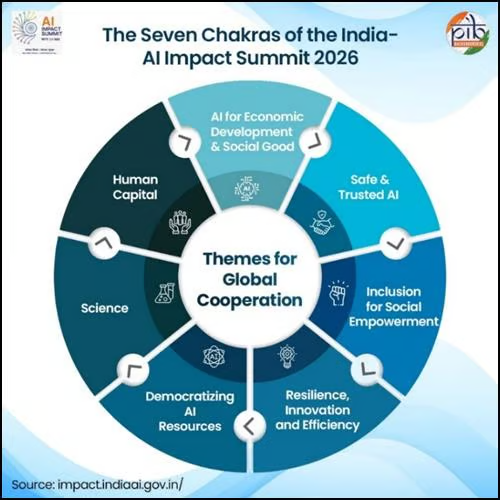
    • The summit’s architecture was built on:
    • 3 Sutras (Pillars): People, Planet, and Progress.
    • 7 Chakras (Working Groups): Human Capital, Inclusion, Safe & Trusted AI, Resilience/Sustainability, Science, Democratising Resources, and Economic Development

    India’s Indigenous Tetanus and Adult Diphtheria (Td) Vaccine

    Health

    Context

    • The Union Minister for Health and Family Welfare launched the indigenously manufactured Tetanus and Adult Diphtheria (Td) Vaccine at the Central Research Institute (CRI), Kasauli in Himachal Pradesh.

    Td Vaccine

    • The Td vaccine protects against tetanus and diphtheria, two potentially fatal bacterial diseases.
    • It replaces the earlier Tetanus Toxoid (TT) vaccine, expanding protection to include diphtheria.
    • In 2006, the World Health Organization (WHO) recommended that countries transition from Tetanus Toxoid (TT) vaccine to Td vaccine.

    Tetanus

    • Tetanus is a non-contagious infection that affects the nervous system, leading to painful muscle stiffness and spasms.
    • Cause: It is caused by the bacterium Clostridium tetani, which is commonly found in soil, dust, and animal manure.
    • Transmission: The bacteria typically enter the body through a break in the skin, such as a deep cut, puncture wound (like stepping on a rusty nail), or burn.

    Diphtheria

    • Diphtheria is a highly contagious infection that primarily affects the mucous membranes of the nose and throat.
    • The toxin released by the bacteria can travel through the bloodstream and damage the heart (myocarditis), kidneys, and nerves.
    • Cause: It is caused by Corynebacterium diphtheriae bacteria.
    • Transmission: It spreads from person to person through respiratory droplets (coughing or sneezing) or by touching contaminated objects.
  • Export of Karnataka’s GI-Tagged Produce to the Maldives

    Export of Karnataka’s GI-Tagged Produce to the Maldives

    News –

    • Prime Minister Narendra Modi recently highlighted the first-ever air-shipment of three Geographical Indication (GI)-tagged agricultural products from Karnataka to the Maldives during his ‘Mann Ki Baat’ radio broadcast.
    • Export Statistics: The successful trial shipment included 500 kg of Nanjangud Rasabale (bananas), 250 kg of Mysuru betel leaves, and 500 kg of Indi lemons.

    Nanjangud Rasabale (Banana):

    • GI Status: Awarded in 2006.
    • Region: Grown in Mysuru and Chamarajanagar districts of Karnataka.
    • Unique Features: Known for its unique aroma, thick pulp, and medicinal properties (believed to cure neurological ailments).
    • Soil Requirement: Thrives specifically in black clay alluvial saline soil found on the banks of the Kapila River.
    • Threat: Susceptible to Panama Wilt disease.

    Mysuru Betel Leaves (Veelyadele):

    • Region: Primarily grown in and around Mysuru.
    • Characteristics: Locally known as Chigurele, they are prized for their smooth texture, taste, and quality.

    Indi Limons (Lime):

    • Region: Cultivated in the Indi region of Vijayapura (Bijapur) district, Karnataka.
    • Export Value: Hailed as “superfoods” in international markets like the Maldives due to their high quality
  • India Joins Pax Silica | Skill Acquisition and Knowledge Awareness for Livelihood Promotion (SANKALP) Scheme | International Emergency Economic Powers Act (IEEPA) | Indian Ocean Naval Symposium (IONS)

    India Joins Pax Silica

    Science & Technology

    Context

    • Recently, India has formally entered the US-led Pax Silica coalition, marking a significant moment in the geopolitics of semiconductors, artificial intelligence (AI), and critical mineral supply chains.

    ‘Pax Silica’

    • launched in – December, 2025
    • It is a coalition comprising the United States, Australia, Greece, Israel, Japan, Qatar, the Republic of Korea, Singapore, the UAE, the UK, and now India.
    • Objective – It is a US-led strategic initiative to build a secure, prosperous, and innovation-driven silicon supply chain from critical minerals.
    • The term ‘Pax Silica’ derived from Latin ‘Pax’ (peace) and ‘Silica’ (a core compound in semiconductors).
    • Significance – It symbolizes the pursuit of technological peace and prosperity through resilient, transparent, and cooperative supply chains.

    Skill Acquisition and Knowledge Awareness for Livelihood Promotion (SANKALP) Scheme

    (Government schemes)

    Context

    • The Public Accounts Committee (PAC) of Parliament criticised the government for implementation of the Skill Acquisition and Knowledge Awareness for Livelihood Promotion (SANKALP) scheme.

    SANKALP Scheme

    • Implementation – Ministry of Skill Development and Entrepreneurship.
    • It was launched in 2018,
    • It was designed to strengthen short‑term skill training through better institutional frameworks, enhanced industry linkages, and targeted inclusion of marginalised communities.
    • Funding: The scheme was slated to be financed through a World Bank loan of ₹3,300 crore, State leverage of ₹660 crore, and industry leverage of ₹495 crore.

    International Emergency Economic Powers Act (IEEPA)

    Economy

    In News

    • The US Supreme Court ruled that President Trump lacked authority under the International Emergency Economic Powers Act (IEEPA) of 1977 to impose broad import tariffs, citing limits on presidential power over taxation and the “major questions” doctrine.

    International Emergency Economic Powers Act (IEEPA)

    • Enacted in 1977,
    • It empowers the President to address “unusual and extraordinary” foreign threats to national security, foreign policy, or the economy after declaring a national emergency.
    • In response, the President invoked Section 122 of the Trade Act of 1974 to proclaim a new 10% temporary tariff on goods from all countries, effective immediately, as a balance -of-payments measure.

    Indian Ocean Naval Symposium (IONS)

    Syllabus: GS3/ Defence

    In News

    • India assumed the chairmanship of the Indian Ocean Naval Symposium (IONS) from Thailand.

    Indian Ocean Naval Symposium (IONS)

    • It is a voluntary naval forum launched by the Indian Navy in 2008
    • Mandate – to boost maritime cooperation among littoral states of the Indian Ocean Region (IOR).
    • IONS promotes mutual understanding among navies through biennial conclaves of chiefs, working groups, and activities like workshops and exercises.
    • Key focus areas include maritime security (anti-piracy), Humanitarian Assistance and Disaster Relief (HADR), and capacity building to address regional threats collaboratively.
    • It features a rotating chairmanship (India held it multiple times) and divides 25 member states into four sub-regions: South Asian (e.g., India, Bangladesh, Maldives), West Asian, Southeast Asian/Australian, and East African.
    • Nine observers participate; no fixed headquarters exists.